DINOv3
zm_config.json + model.weights.h5).
Load with from_weights("zeromodels/<variant>").
DINOv3 pushes DINOv2's self-supervised features further, on 1.7 B images, and adds two architectural pieces aimed squarely at dense features: register tokens, extra learned tokens that soak up the global-information artifacts that otherwise show up as high-norm outlier patches, and rotary position embeddings, which encode position by rotating queries and keys rather than adding a learned table. It also ships a ConvNeXt line for a convolutional alternative.
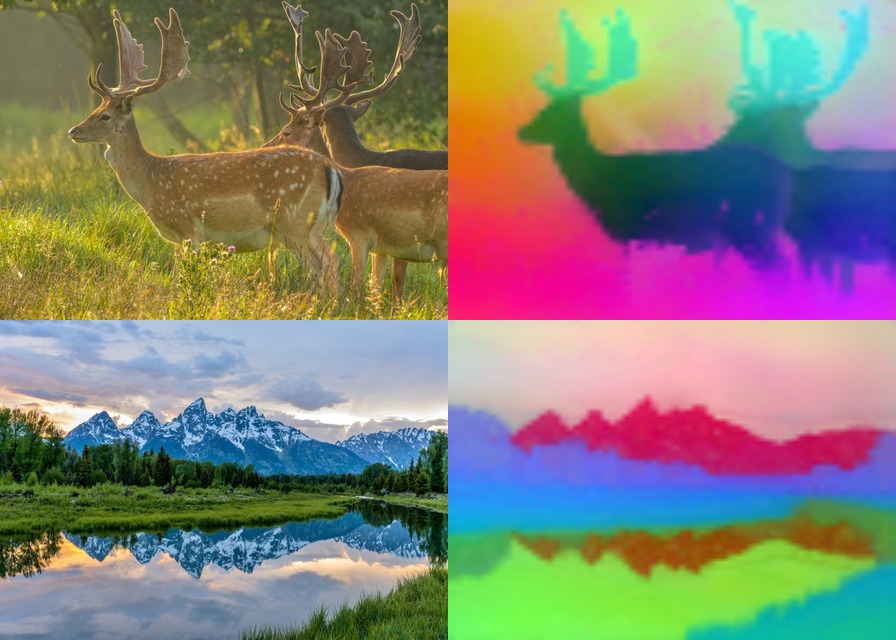
Like the earlier DINOs these are backbones, not task models. The figures below PCA the patch features to three RGB components; the register tokens make the resulting maps noticeably cleaner than DINOv2's.
Paper: DINOv3: Self-Supervised Visual Representation Learning at Scale
API
DinoV3ViTModel
DinoV3ViTModel(
    as_backbone=False,
    patch_size=16,
    embed_dim=768,
    depth=12,
    num_heads=12,
    mlp_ratio=4.0,
    use_swiglu=False,
    num_register_tokens=4,
    layer_scale_init=1.0,
    rope_theta=100.0,
    query_bias=True,
    key_bias=False,
    value_bias=True,
    hidden_act="gelu",
    mlp_bias=True,
    layer_norm_eps=1e-5,
    image_size=224,
    input_tensor=None,
    name="DinoV3ViTModel",
)
The DINOv3 Vision Transformer with RoPE and register tokens. This is the main backbone class.
Parameters
- as_backbone (
bool, optional, defaults toFalse): return a list of intermediate feature maps instead of the final token sequence. - patch_size (
int, optional, defaults to16): pixels per patch. - embed_dim / depth / num_heads (
int, optional): transformer width, blocks, and heads. Filled in byfrom_weightsfrom the variant config. - use_swiglu (
bool, optional, defaults toFalse): SwiGLU MLP instead of GELU, used by the larger variants. - num_register_tokens (
int, optional, defaults to4): learned register tokens inserted after[CLS]. The token layout is[CLS, registers..., patches...]. - rope_theta (
float, optional, defaults to100.0): rotary position embedding base. Position is applied on the fly, so there is no learned position table to interpolate. - layer_scale_init, query_bias / key_bias / value_bias, hidden_act, mlp_bias, layer_norm_eps: block-level knobs, all set from the variant config.
- image_size (
intortuple, optional, defaults to224): input resolution the model is built for. - input_tensor (
dict, optional): pre-existing input tensors to build on. - name (
str, optional, defaults to"DinoV3ViTModel"): model name.
Call model(pixel_values, training=False) with normalized pixels from
DinoV3ImageProcessor. Returns the token sequence
(B, 1 + num_register_tokens + num_patches, embed_dim). With as_backbone=True, a list of
intermediate tensors.
DinoV3ConvNeXtModel
DinoV3ConvNeXtModel(
    as_backbone=False,
    depths=None,
    projection_dim=None,
    image_size=224,
    input_tensor=None,
    name="DinoV3ConvNeXtModel",
)
The DINOv3 ConvNeXt backbone, a convolutional alternative. Returns the final spatial
feature map ((B, 7, 7, 768) for the tiny variant under channels_last), or with
as_backbone=True the per-stage maps.
Preprocessing
DinoV3ImageProcessor.from_weights("zeromodels/<variant>") reads its settings from the
repo's zm_preprocessor.json; DinoV3ImageProcessor() with no arguments gives the same
defaults. Two matching options:
DinoV3ImageProcessor(matches transformers'DINOv3ViTImageProcessorforfacebook/dinov3-*): a square resize to 224 (bilinear, through PIL on the raw uint8 image), rescale to[0, 1], and ImageNet-standard normalization. Run the image through the processor before the model:
from zeromodels.models.dino_v3 import DinoV3ViTModel, DinoV3ImageProcessor

model = DinoV3ViTModel.from_weights("zeromodels/dinov3-vitb16-pretrain-lvd1689m")
processor = DinoV3ImageProcessor.from_weights(
    "zeromodels/dinov3-vitb16-pretrain-lvd1689m"
)

pixel_values = processor("bear.jpg")["pixel_values"]  # (1, 224, 224, 3), normalized
tokens = model(pixel_values, training=False)
- Normalization lives in the processor. The models take already-normalized input, so
always preprocess with
DinoV3ImageProcessor: feeding raw[0, 255]pixels straight to the model produces wrong features.
Model Variants
| Variant id | Backbone | Patch | Params |
|---|---|---|---|
dinov3-vits16-pretrain-lvd1689m |
ViT-S | 16 | ~21 M |
dinov3-vitb16-pretrain-lvd1689m |
ViT-B | 16 | ~86 M |
dinov3-vitl16-pretrain-lvd1689m |
ViT-L | 16 | ~300 M |
dinov3-convnext-tiny-pretrain-lvd1689m |
ConvNeXt-T | n/a | ~29 M |
dinov3-convnext-small-pretrain-lvd1689m |
ConvNeXt-S | n/a | ~50 M |
dinov3-convnext-base-pretrain-lvd1689m |
ConvNeXt-B | n/a | ~89 M |
dinov3-convnext-large-pretrain-lvd1689m |
ConvNeXt-L | n/a | ~198 M |
Basic Usage: Feature Extraction
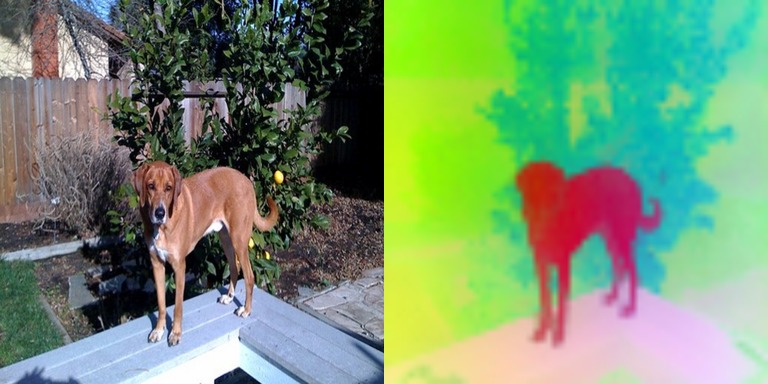
Run the backbone, drop the [CLS] and the register tokens, then PCA the patch
features to three components. The dog, the foliage, and the deck each take a distinct
colour. DINOv3's rotary position embeddings make any resolution native, and its dense
features get noticeably crisper at higher resolution, so the figures here run at 1024 (a
64x64 patch grid) rather than the 224 the model was trained at.
import keras
import numpy as np
import torch
from PIL import Image
from zeromodels.models.dino_v3 import DinoV3ImageProcessor, DinoV3ViTModel

size, patch, registers = 1024, 16, 4
model = DinoV3ViTModel.from_weights(
    "zeromodels/dinov3-vitl16-pretrain-lvd1689m",
    image_size=size,
)
processor = DinoV3ImageProcessor.from_weights(
    "zeromodels/dinov3-vitl16-pretrain-lvd1689m", image_resolution=size
)

x = processor("assets/data/coco_dog_yard.jpg")["pixel_values"]  # (1, 1024, 1024, 3)

with torch.no_grad():
    tokens = model(x, training=False)
tokens = np.asarray(keras.ops.convert_to_numpy(tokens))[0]
print(tokens.shape)  # (1 + registers + num_patches, embed_dim)

# PCA the patch tokens (drop the CLS token and the register tokens) to RGB.
grid = size // patch
prefix = 1 + registers
patches = (
    tokens[prefix : prefix + grid * grid].reshape(grid * grid, -1).astype("float64")
)
patches -= patches.mean(0, keepdims=True)
proj = patches @ np.linalg.svd(patches, full_matrices=False)[2][:3].T
proj = proj.reshape(grid, grid, 3)
lo, hi = proj.min((0, 1)), proj.max((0, 1))
proj = (proj - lo) / (hi - lo + 1e-8)

vis = Image.fromarray((proj * 255).astype("uint8")).resize((size, size), Image.BILINEAR)
vis.save("assets/dinov3_pca.jpg")
4101 = 1 + 4 + 64 * 64: the [CLS] token, four register tokens, and a 64x64 patch grid
at 1024/16. Forgetting to drop the register tokens shifts every patch by four and
scrambles the map, so always slice from 1 + num_register_tokens.
Use
torch.no_grad()on the torch backend. These are pure forward passes; autograd would retain every intermediate for nothing.
Batch Processing Multiple Images
Stack images that share a size into one batch:
import keras
import numpy as np
import torch
from zeromodels.models.dino_v3 import DinoV3ImageProcessor, DinoV3ViTModel

size = 1024
model = DinoV3ViTModel.from_weights(
    "zeromodels/dinov3-vitl16-pretrain-lvd1689m",
    image_size=size,
)
processor = DinoV3ImageProcessor.from_weights(
    "zeromodels/dinov3-vitl16-pretrain-lvd1689m", image_resolution=size
)

paths = ["assets/data/deer.jpg", "assets/data/mountain.jpg"]
batch = processor(paths)["pixel_values"]  # (2, 1024, 1024, 3)

with torch.no_grad():
    tokens = model(batch, training=False)
print(np.asarray(keras.ops.convert_to_numpy(tokens)).shape)  # (2, 4101, 1024)
The fallow bucks lift off the sunlit meadow as coherent shapes, and the Teton scene resolves into sky, snow-capped range, forest, and lake, the mountains' reflection echoing the peaks above it.
Intermediate Features
as_backbone=True returns intermediate feature maps for feeding a DPT-style neck or a
segmentation head:
model = DinoV3ViTModel.from_weights(
    "zeromodels/dinov3-vitl16-pretrain-lvd1689m", as_backbone=True, image_size=size
)
features = model(x, training=False)  # x from above, at 1024
print(len(features), features[-1].shape)  # (1, 4101, 1024) per map
DinoV3ConvNeXtModel(as_backbone=True) gives the convolutional stage maps instead.
Data Format
The ViT works in token space, so it is layout-agnostic. DinoV3ConvNeXtModel reads
keras.config.image_data_format() when it is constructed and returns
channels_last or channels_first spatial maps accordingly.
Input Resolution
Any size that is a multiple of the patch size, 16, works. DINOv3 uses rotary position
embeddings computed on the fly, so unlike DINO and DINOv2 there is no learned position
table to interpolate: a new resolution just works, on the Hub Keras or hf: path alike.
The figures here use image_size=1024; the dense feature map sharpens as you raise it (the
model was trained at 224), at the usual quadratic cost in tokens.
Loading Fine-tuned and Community Weights
Any Hugging Face repo whose model_type is "dinov3_vit" or "dinov3_convnext" loads
with the hf: prefix. The zeromodels Hub weights above are free to pull, but the
upstream facebook/dinov3-* checkpoints are gated, so accept Meta's license there before
using an hf:facebook/dinov3-* id.
from zeromodels.models.dino_v3 import DinoV3ViTModel

model = DinoV3ViTModel.from_weights("hf:facebook/dinov3-vits16-pretrain-lvd1689m")
model = DinoV3ViTModel.from_weights("hf:<user>/dinov3-finetuned")

# Architecture only, randomly initialized
model = DinoV3ViTModel.from_weights(
    "zeromodels/dinov3-vitl16-pretrain-lvd1689m", load_weights=False
)
See also DINO and DINOv2, the earlier self-supervised backbones this builds on.