EfficientDet
zm_config.json + model.weights.h5 +
zm_preprocessor.json), converted from Google AutoML's official COCO release.
Load with from_weights("zeromodels/efficientdet_d0").
EfficientDet is a family of single-shot, anchor-based detectors (D0 through D7) built for a clean accuracy/compute trade-off. An EfficientNet backbone produces multi-level features, a weighted bi-directional feature pyramid (BiFPN) fuses them top-down then bottom-up with a learnable weight per input, and one shared class head and one shared box head run over every pyramid level. Each spatial location emits nine anchor predictions, decoded against a fixed anchor grid.
Unlike the DETR line, EfficientDet keeps the conventional detector machinery: anchors and non-maximum suppression are part of the pipeline, run after the network in the post-processor. Compound scaling grows the backbone, BiFPN width and depth, head depth, and input resolution together from D0 (3.9 M params, 512²) to D7 (52 M, 1536²).
Paper: EfficientDet: Scalable and Efficient Object Detection
API
EfficientDetDetect
EfficientDetDetect(
    backbone_name="efficientnet_b0",
    image_size=512,
    num_classes=90,
    min_level=3,
    max_level=7,
    num_scales=3,
    aspect_ratios=(1.0, 2.0, 0.5),
    anchor_scale=4.0,
    fpn_num_filters=64,
    fpn_cell_repeats=3,
    box_class_repeats=3,
    act_type="swish",
    separable_conv=True,
    apply_bn_for_resampling=True,
    conv_after_downsample=False,
    conv_bn_act_pattern=False,
    fpn_weight_method="fastattn",
    survival_prob=None,
    name="EfficientDetDetect",
)
The detector: EfficientNet backbone, weighted BiFPN, shared class/box heads, and in-graph
anchor decoding. This is the class for object detection. Defaults describe
EfficientDet-D0; from_weights fills these in from the hosted zm_config.json for each
variant, so you rarely pass them by hand.
Parameters
- backbone_name (
str, optional, defaults to"efficientnet_b0"): EfficientNet backbone,"efficientnet_b0"through"efficientnet_b6". - image_size (
int, optional, defaults to512): input resolution the model is built for. Must be divisible by 128, see Input Resolution. - num_classes (
int, optional, defaults to90): COCO's 90 category ids (classcmaps toCOCO_91_CLASSES[c + 1]; index 0 is the "N/A" id). - min_level / max_level (
int, optional, defaults to3/7): pyramid levels the heads run on, strides 8 to 128. - num_scales (
int, optional, defaults to3) / aspect_ratios (tuple, optional, defaults to(1.0, 2.0, 0.5)): the anchor grid;num_scales * len(aspect_ratios)= 9 anchors per location. - anchor_scale (
float, optional, defaults to4.0): base anchor size relative to the level stride (D7 uses5.0). - fpn_num_filters (
int, optional, defaults to64): BiFPN channel width. - fpn_cell_repeats (
int, optional, defaults to3): number of stacked BiFPN cells. - box_class_repeats (
int, optional, defaults to3): depth of each shared head. - fpn_weight_method (
str, optional, defaults to"fastattn"): BiFPN fusion,"fastattn"(normalized ReLU weights),"attn"(softmax), or"sum"(unweighted; D6/D7 use this). - act_type (
str, optional, defaults to"swish"): activation. - name (
str, optional, defaults to"EfficientDetDetect"): model name.
Call model(pixel_values, training=False). Returns a dict:
- boxes (
(B, N, 4)): anchor-decoded boxes[ymin, xmin, ymax, xmax]inimage_sizepixel coordinates.Nis the total anchor count (49104 for D0 at 512²). - scores (
(B, N, num_classes)): per-class sigmoid scores.
Raw output is one decoded box per anchor at every class. Run it through post_process_object_detection to apply NMS and get scored, original-image boxes.
EfficientDetModel
The backbone, BiFPN, and shared heads without anchor decoding. Parameters are identical
to EfficientDetDetect, with name defaulting to
"EfficientDetModel".
Returns a dict of raw per-level head outputs, {"class_outputs", "box_outputs"}:
lists of (B, H_l, W_l, num_anchors * num_classes) and (B, H_l, W_l, num_anchors * 4) for
levels min_level..max_level. Use it when you want the raw pyramid outputs to attach a
custom decoder or loss. It shares its weights with EfficientDetDetect, so both load the
same hosted file.
Preprocessing
EfficientDetImageProcessor
EfficientDetImageProcessor(
    image_size=512,
    resample="bilinear",
    image_mean=None,
    image_std=None,
    rescale_factor=1 / 255,
    return_tensor=True,
    data_format=None,
)
Applies EfficientDet's aspect-preserving letterbox: scale by image_size / max(height,
width), ImageNet-normalize, then zero-pad the bottom and right to a square image_size.
The pad is applied after normalization, so padded pixels are true zeros.
Parameters
- image_size (
int, optional, defaults to512): square target size. Match the model'simage_size. - resample (
str, optional, defaults to"bilinear"): resize interpolation. - image_mean (
tuple, optional, defaults to(0.485, 0.456, 0.406)): per-channel mean. - image_std (
tuple, optional, defaults to(0.229, 0.224, 0.225)): per-channel std. - rescale_factor (
float, optional, defaults to1/255): applied before normalization. - return_tensor (
bool, optional, defaults toTrue): return backend tensors rather than numpy. - data_format (
str, optional):"channels_last"or"channels_first".None(default) resolves tokeras.config.image_data_format(), matching a model built under the same global setting. See Data Format.
Call processor(image) with a path, a PIL image, an array, or a list of any mix.
Returns a dict:
- pixel_values (
(B, H, W, 3)): the preprocessed images. - scales (
list[float]): the letterbox scale per image. - original_sizes (
list[(h, w)]): original sizes, ready to pass astarget_sizesbelow.
post_process_object_detection
processor.post_process_object_detection(
    outputs,
    threshold=0.3,
    iou_threshold=0.5,
    max_detections=100,
    class_agnostic=True,
    target_sizes=None,
    label_names=None,
)
Runs NMS over the decoded boxes and sigmoid scores, then, when target_sizes is given,
undoes the letterbox and clips boxes to each original image.
- outputs: the
dictreturned by the model. - threshold (
float, optional, defaults to0.3): minimum score to keep a detection. - iou_threshold (
float, optional, defaults to0.5): NMS IoU threshold. - max_detections (
int, optional, defaults to100): cap on detections per image. - class_agnostic (
bool, optional, defaults toTrue): one NMS across all classes, so an object yields a single box. See NMS Modes. - target_sizes (
listof(height, width), optional): original image sizes, one per batch element. Omit to leave boxes inimage_sizecoordinates. - label_names (
listofstr, optional): class names. Defaults to COCO's 90 categories.
Returns a list with one dict per image:
- scores: class probability per kept detection.
- labels: integer class indices.
- label_names: the resolved class names.
- boxes:
(x0, y0, x1, y1)in pixels.
Model Variants
Every variant is trained on COCO's 90 categories and converted from Google AutoML's
coco2 release. Load any of them with from_weights("zeromodels/<variant id>").
| Variant id | Backbone | Input | Params |
|---|---|---|---|
efficientdet_d0 |
EfficientNet-B0 | 512 | 3.9 M |
efficientdet_d1 |
EfficientNet-B1 | 640 | 6.6 M |
efficientdet_d2 |
EfficientNet-B2 | 768 | 8.1 M |
efficientdet_d3 |
EfficientNet-B3 | 896 | 12.0 M |
efficientdet_d4 |
EfficientNet-B4 | 1024 | 20.7 M |
efficientdet_d5 |
EfficientNet-B5 | 1280 | 33.7 M |
efficientdet_d6 |
EfficientNet-B6 | 1280 | 51.9 M |
efficientdet_d7 |
EfficientNet-B6 | 1536 | 51.9 M |
Bigger variants are more accurate and slower. D6 and D7 fuse the BiFPN with an unweighted
sum (fpn_weight_method="sum") instead of the fast-attention weighting D0–D5 use.
Basic Usage: Object Detection
from PIL import Image
from zeromodels.models.efficientdet import (
    EfficientDetDetect,
    EfficientDetImageProcessor,
)

model = EfficientDetDetect.from_weights("zeromodels/efficientdet_d0")
processor = EfficientDetImageProcessor.from_weights("zeromodels/efficientdet_d0")

image = Image.open("assets/data/coco_bicycles.jpg").convert("RGB")
inputs = processor(image)

output = model(inputs["pixel_values"], training=False)
# output["boxes"]:  (1, 49104, 4)
# output["scores"]: (1, 49104, 90)

results = processor.post_process_object_detection(
    output, threshold=0.3, target_sizes=inputs["original_sizes"]
)[0]

# Detections come back unordered, so sort by score for readability.
detections = sorted(
    zip(results["scores"], results["label_names"], results["boxes"]),
    key=lambda d: -float(d[0]),
)
for score, name, box in detections:
    print(f"{name:14s} {float(score):.3f}  {[round(float(v)) for v in box]}")
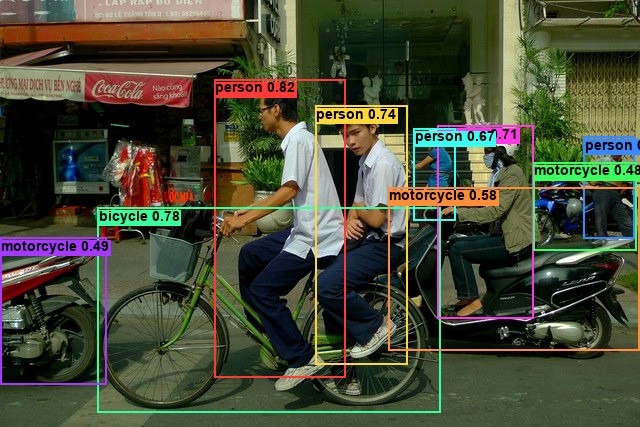
person         0.819  [214, 79, 345, 378]
bicycle        0.782  [98, 208, 441, 412]
person         0.746  [584, 137, 634, 239]
person         0.743  [315, 106, 407, 364]
person         0.710  [437, 126, 533, 318]
person         0.674  [414, 128, 456, 220]
motorcycle     0.582  [388, 187, 639, 350]
motorcycle     0.493  [0, 238, 107, 384]
motorcycle     0.485  [533, 162, 637, 251]
potted plant   0.342  [209, 32, 295, 189]
motorcycle     0.317  [532, 165, 596, 238]
Two riders on the bicycle, the bicycle itself, and the parked motorcycles down the street,
all from a 3.9 M-parameter model. threshold=0.3 is a reasonable default for D0; raise it to
0.4–0.5 to keep only the confident detections.
Batch Processing Multiple Images
Pass a list of images and one target_sizes entry per image:
from PIL import Image
from zeromodels.models.efficientdet import (
    EfficientDetDetect,
    EfficientDetImageProcessor,
)

model = EfficientDetDetect.from_weights("zeromodels/efficientdet_d0")
processor = EfficientDetImageProcessor.from_weights("zeromodels/efficientdet_d0")

paths = ["assets/data/coco_cat_tv.jpg", "assets/data/coco_cats.jpg"]
images = [Image.open(p).convert("RGB") for p in paths]

inputs = processor(paths)  # (2, 512, 512, 3)
output = model(inputs["pixel_values"], training=False)

results = processor.post_process_object_detection(
    output, threshold=0.3, target_sizes=[(im.height, im.width) for im in images]
)

for path, result in zip(paths, results):
    print(f"\n{path}")
    detections = sorted(
        zip(result["scores"], result["label_names"], result["boxes"]),
        key=lambda d: -float(d[0]),
    )
    for score, name, box in detections:
        print(f"  {name:10s} {float(score):.3f}  {[round(float(v)) for v in box]}")
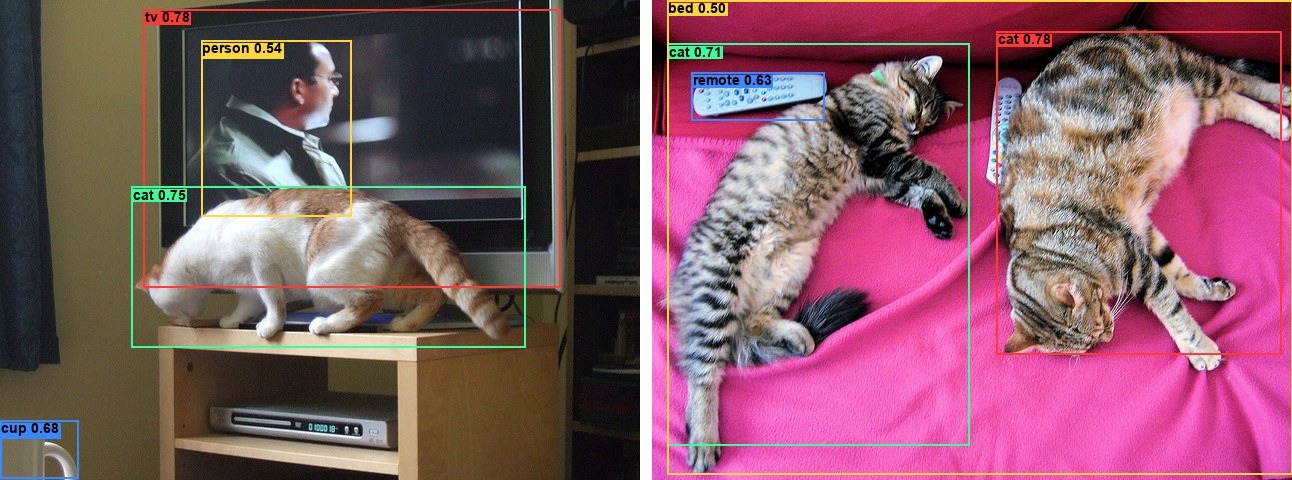
assets/data/coco_cat_tv.jpg
  tv         0.779  [144, 9, 560, 288]
  cat        0.749  [132, 187, 525, 348]
  cup        0.676  [0, 420, 78, 478]
  person     0.536  [201, 40, 352, 216]

assets/data/coco_cats.jpg
  cat        0.779  [345, 31, 630, 355]
  cat        0.714  [16, 44, 318, 446]
  remote     0.635  [40, 72, 173, 120]
  bed        0.504  [15, 0, 640, 474]
Every image is letterboxed to the same square, so stacking is always safe; results come back as per-image lists, not a fixed-width tensor.
NMS Modes
EfficientDet emits a score for every class at every anchor, so a single object can clear the threshold under more than one label (a dog also read as a cat, a truck also as a car). How the duplicates are resolved is the post-processor's job:
class_agnostic=True(the default, Google'spostprocess_global): each anchor keeps only its single highest-scoring class, then one NMS runs across everything. One object yields one box. This is what the examples above use.class_agnostic=False(postprocess_per_class): NMS runs independently per class, so the same object can surface under several labels. Useful when you want the full per-class ranking.
results = processor.post_process_object_detection(
    output, threshold=0.3, class_agnostic=False, target_sizes=inputs["original_sizes"]
)[0]
Per-class NMS cannot suppress a dog box and a cat box over the same animal, because they are different classes; the class-agnostic default collapses them to the higher-scoring one.
Input Resolution
EfficientDet is Functional, so the input shape is fixed when the model is constructed, and the anchor grid is generated for that size. Each variant has a native resolution (the table above), but the weights are resolution-independent — the conv, BatchNorm, and separable weights do not depend on the input size, and the only size-dependent tensor, the anchor grid, is a computed constant rather than a stored weight. So you can build any variant at any valid size and load the same checkpoint:
model = EfficientDetDetect.from_weights("zeromodels/efficientdet_d0", image_size=768)
processor = EfficientDetImageProcessor(image_size=768)  # match the model
The image_size=768 kwarg overrides the checkpoint's native 512; the 512-trained weights
load unchanged, and the anchor count scales with the input:
512:  49104 anchors   cat 0.78, cat 0.71, remote 0.63, bed 0.50
640:  76725 anchors   cat 0.83, cat 0.73, couch 0.64, remote 0.62
896: 150381 anchors   couch 0.78, cat 0.73, remote 0.73, remote 0.71
The side must be divisible by 128. The heads run on levels 3 through 7 (strides 8 to 128), so the input has to survive seven halvings cleanly. Every native size (512, 640, 768, 896, 1024, 1280, 1536) qualifies.
Accuracy is best near the trained resolution. The model runs at any valid size, but scores and box quality drift as you move away from native (visible above at 640 and 896). For the best result, run each variant near its native size, or pick the variant whose native size matches your target.
Custom Class Names
A model fine-tuned on your own dataset predicts your class indices, not COCO's. Pass the names
through label_names so the result reads correctly:
MY_CLASSES = ["cat", "dog", "bird"]

results = processor.post_process_object_detection(
    output,
    threshold=0.3,
    target_sizes=[(image.height, image.width)],
    label_names=MY_CLASSES,
)
Custom names are indexed directly by the 0-based class id (label_names[c]). The default
COCO list is offset by one instead (COCO_91_CLASSES[c + 1], since index 0 is the "N/A" id),
so the post-processor handles the two cases automatically. Without label_names a custom
model is silently mislabeled with COCO names; the integer labels are unaffected either way.
Data Format
Both the model and the processor support channels_last and channels_first. Nothing is
hard-coded to a layout, so the whole pipeline runs either way, and the same weights load into
both — the conv, BatchNorm, and separable-conv weights are layout-independent. Detections are
identical (boxes bit-exact, scores within backend rounding).
They pick the format differently, which is the one thing to keep straight:
| How it picks the format | |
|---|---|
| Processor | A data_format kwarg, per instance. None (the default) resolves to keras.config.image_data_format(). |
| Model | Reads keras.config.image_data_format() when it is constructed. There is no data_format argument. |
Overriding the processor only
EfficientDetImageProcessor(data_format="channels_last")("photo.jpg")["pixel_values"]
# (1, 512, 512, 3)

EfficientDetImageProcessor(data_format="channels_first")("photo.jpg")["pixel_values"]
# (1, 3, 512, 512)
Switching the whole pipeline
Set the global format before constructing the model, and both sides agree:
import keras

keras.config.set_image_data_format("channels_first")

model = EfficientDetDetect.from_weights("zeromodels/efficientdet_d0")
processor = EfficientDetImageProcessor.from_weights("zeromodels/efficientdet_d0")

inputs = processor(image)
# inputs["pixel_values"] is (1, 3, 512, 512)
output = model(inputs["pixel_values"], training=False)
Set it once at the top of a script, since already-built models keep the layout they were
constructed with. The post-processor emits xyxy pixel boxes and class indices, which have no
channel axis, so it is not format-sensitive.