Stable Diffusion XL
zm_config.json + the float16 weights +
tokenizer.json). Load with from_weights("zeromodels/<variant>").
Stable Diffusion XL, ported to pure Keras 3: the Stable Diffusion
latent-diffusion recipe scaled up to 1024px with a 2.6B-parameter UNet and two text
encoders, plus the refiner, an image-to-image expert that finishes the base model's
latents, and SDXL-Turbo, the base distilled to a few steps. It subclasses the SD 1.x
family (StableDiffusionXLModel is a StableDiffusionModel with a fourth component,
StableDiffusionXLTextToImage is StableDiffusionTextToImage with the SDXL conditioning
hooks; the refiner classes subclass those), so everything on that page applies: one
container per repo, generate from BaseDiffusion, the schedulers, both data formats.
What changes:
- Two text encoders: CLIP ViT-L/14's text tower (768-d, the SD 1.x one) and OpenCLIP
ViT-bigG/14's (1280-d, 32 layers,
gelu, with a 1280-dtext_projection). The prompt goes through both; their penultimate hidden states (no final LayerNorm) are concatenated into the UNet's 2048-d cross-attention context, and the second tower's projected pooled (EOT) state is thetext_embedsmicro-conditioning. - One tokenizer call: both towers use the same CLIP BPE and differ only in the pad
token (
<|endoftext|>vs!), soStableDiffusionXLTokenizeris the first one and the model derives the second tower's ids from the returnedattention_mask. - Micro-conditioning: the UNet's timestep embedding also receives the pooled text
embedding and six size / crop values (
original_size,crops_coords_top_left,target_size, each(height, width)), sinusoidally embedded and projected by theadd_embeddingMLP (addition_embed_type="text_time"). - UNet: three levels (320, 640, 1280) with no attention at the first, (1, 2, 10) transformer blocks per Transformer2D, (5, 10, 20) heads (64 wide), linear token projection, built at a 128x128 latent (1024px).
- VAE: the SDXL autoencoder (
scaling_factor0.13025), built in float32 whatever the load dtype (force_upcast: it overflows in float16, as in diffusers). - Classifier-free guidance with no negative prompt uses zero embeddings
(
force_zeros_for_empty_prompt), not the encoded empty prompt. Default guidance is 5.0. - Scheduler: Euler with
leadingtimestep spacing (steps_offset1) for the base models and the refiners, ancestral Euler withtrailingspacing for SDXL-Turbo; all come from the repo'sscheduler_config. - Refiner: a second model (
StableDiffusionXLRefinerModel/StableDiffusionXLRefinerImageToImage) with the OpenCLIP tower alone (1280-d context), a four-level UNet ((384, 768, 1536, 1536), attention at the middle levels, 4 blocks per Transformer2D, 2.3B parameters) and an aesthetic score as the fifth micro-conditioning id. It refines a latent the base left partially denoised (denoising_start) or any image (strength); its empty negative prompt is encoded, not zeroed. - float16 weights: SDXL was released in float16, so the repos store that (the VAE in
float32) and
from_weightsbuilds the model in float16 by default (6.6 GB of weights). Passload_dtype="float32"for a float32 model (13.9 GB).
The weights are converted once, offline, and hosted: on-the-fly hf: conversion is
deliberately not supported for diffusion models.
Links:
- Paper: SDXL: Improving Latent Diffusion Models for High-Resolution Image Synthesis (arXiv:2307.01952)
- Reference implementation: diffusers
StableDiffusionXLPipeline - Licenses: CreativeML Open RAIL++-M (1.0 base and refiner), Stability AI Non-Commercial Research Community License (Turbo); the 0.9 research previews are not hosted
See also stable_diffusion.md, stable_diffusion_2.md, clip.md.
Variants
Preconverted weights are hosted under zeromodels/. Load with
from_weights("zeromodels/<variant>"). A base repo is one container: UNet (2.57B) + VAE
(84M) + CLIP ViT-L/14 text encoder (123M) + OpenCLIP ViT-bigG/14 text encoder (695M),
3.47B parameters, 6.6 GB in float16 (two model.weights.json shards); a refiner repo is
UNet (2.26B) + VAE + OpenCLIP text encoder, 3.04B parameters, 5.8 GB.
| Variant | Hub | Class | Resolution | Sampler | License |
|---|---|---|---|---|---|
stable-diffusion-xl-base-1.0 |
zeromodels/stable-diffusion-xl-base-1.0 |
StableDiffusionXLTextToImage |
1024 | Euler, 50 steps, guidance 5.0 | CreativeML Open RAIL++-M |
stable-diffusion-xl-refiner-1.0 |
zeromodels/stable-diffusion-xl-refiner-1.0 |
StableDiffusionXLRefinerImageToImage |
1024 | Euler, 50 steps, guidance 5.0, strength 0.3 | CreativeML Open RAIL++-M |
sdxl-turbo |
zeromodels/sdxl-turbo |
StableDiffusionXLTextToImage |
512 | Euler ancestral, 1 step, no guidance | Stability AI Non-Commercial Research Community |
The SDXL 0.9 research previews (stabilityai/stable-diffusion-xl-base-0.9 and
-refiner-0.9, the same architecture with different weights, gated behind the research
license) are not hosted; with an authorized token the converter turns them into the same
containers (transfer_stable_diffusion_xl(repo, token=...), see
Loading Fine-tuned Weights). SDXL-Turbo is a
research-only, non-commercial release; its repo defaults (generate_args) are 1 step and
guidance_scale=0.0, which is how it was trained (do not add guidance).
API
Configs are typed: StableDiffusionXLConfig (composite, model_type
"stable_diffusion_xl") over StableDiffusionXLUNetConfig, StableDiffusionXLVAEConfig,
StableDiffusionTextConfig (the CLIP ViT-L/14 tower, as SD 1.x) and
StableDiffusionXLTextConfig2 (the OpenCLIP ViT-bigG/14 tower, with projection_dim and
its own hidden_act), plus the scheduler config, the token ids (pad_token_id_2 for the
second tokenizer's !), force_zeros_for_empty_prompt and requires_aesthetics_score.
Flat constructor with unet_ / vae_ / text_ / text_2_ prefixes.
StableDiffusionXLRefinerConfig (model_type "stable_diffusion_xl_refiner") is the
same with text_config=None, the StableDiffusionXLRefinerUNetConfig denoiser,
requires_aesthetics_score=True and force_zeros_for_empty_prompt=False.
StableDiffusionXLTextToImage
StableDiffusionTextToImage over the SDXL graph; generate gains the micro-conditioning
arguments:
generate(
    input_ids,
    attention_mask=None,
    negative_input_ids=None,
    num_inference_steps=None,
    guidance_scale=None,
    seed=None,
    latents=None,
    image=None,
    strength=None,
    denoising_start=None,
    denoising_end=None,
    output_type="image",
    original_size=None,
    crops_coords_top_left=(0, 0),
    target_size=None,
    aesthetic_score=6.0,
    negative_original_size=None,
    negative_crops_coords_top_left=None,
    negative_target_size=None,
    negative_aesthetic_score=2.5,
)
| Argument | Description |
|---|---|
input_ids, attention_mask |
**tokenizer(prompts); the mask tells the model which positions are padding, so the second tower's !-padded ids can be derived (without it, everything after the first <|endoftext|> counts as padding). |
negative_input_ids |
Tokenized negative prompt, one row per prompt or a single row shared by the batch. Without it the unconditional branch is zero embeddings (force_zeros_for_empty_prompt), as in diffusers. |
num_inference_steps, guidance_scale, seed, latents |
As for Stable Diffusion; defaults from the repo's generate_args (50 steps, guidance 5.0 for the base model). |
image, strength, denoising_start, denoising_end, output_type |
The image-to-image and ensemble controls of BaseDiffusion.generate: refine an image (noised to strength), stop early (denoising_end) and hand the latent over (output_type="latent"), or resume one (denoising_start). |
original_size, crops_coords_top_left, target_size |
SDXL's size / crop conditioning, (height, width) in pixels; the sizes default to the generated image's size, the crop to (0, 0). |
aesthetic_score |
The refiner's fifth conditioning value (6.0), in place of target_size; ignored by the base models. |
negative_* |
The same for the negative branch; each defaults to its positive value, except negative_aesthetic_score (2.5). |
Returns (batch, H, W, 3) uint8 images (or the latent); latents is
(batch, 128, 128, 4) at 1024px (channels_first: channels second).
The hooks, for anyone composing their own loop: encode_prompt(input_ids, attention_mask,
original_size, crops_coords_top_left, target_size) returns the dict the UNet takes
(encoder_hidden_states (batch, 77, 2048), text_embeds (batch, 1280), time_ids
(batch, 6)); encode_negative_prompt zeroes the first two when no negative ids are given;
predict_noise(latents, timesteps, embeddings) runs the UNet.
StableDiffusionXLRefinerImageToImage
The refiner task: the same class over the refiner container (text_encoder_2 alone,
aesthetic_score in the conditioning, generate_args with strength 0.3). Its
generate is the one above; with no image / latents it runs text-to-image, which the
refiner was not trained for. The two intended uses:
base = StableDiffusionXLTextToImage.from_weights(
    "zeromodels/stable-diffusion-xl-base-1.0"
)
refiner = StableDiffusionXLRefinerImageToImage.from_weights(
    "zeromodels/stable-diffusion-xl-refiner-1.0"
)
tokenizer = StableDiffusionXLTokenizer.from_weights(
    "zeromodels/stable-diffusion-xl-base-1.0"
)
inputs = tokenizer("a lighthouse on a rocky coast at dawn, dramatic clouds, cinematic")

# ensemble of experts: the base denoises 80% of the schedule, the refiner the rest
latent = base.generate(
    **inputs, num_inference_steps=50, denoising_end=0.8, output_type="latent"
)
images = refiner.generate(
    **inputs, latents=latent, num_inference_steps=50, denoising_start=0.8
)

# image-to-image: refine any image (uint8 or [0, 1] float, (batch, H, W, 3))
images = refiner.generate(**inputs, image=images, strength=0.3, seed=0)
StableDiffusionXLModel
The container: four disconnected paths in one functional model, .unet / .vae /
.text_encoder / .text_encoder_2.
| Inputs | Outputs |
|---|---|
sample (B, 128, 128, 4), timestep (B,), encoder_hidden_states (B, 77, 2048), text_embeds (B, 1280), time_ids (B, 6) |
noise_pred (B, 128, 128, 4) |
image (B, 1024, 1024, 3), latent (B, 128, 128, 4) |
moments (B, 128, 128, 8), image (B, 1024, 1024, 3) |
token_ids (B, 77), token_ids_2 (B, 77), padding_mask (B, 77) |
prompt_embeds (B, 77, 2048), pooled_prompt_embeds (B, 1280) |
Each text tower is a functional CLIP text model (the clip family's layers) whose outputs
are penultimate_hidden_state, last_hidden_state, pooler_output and, for the second,
text_embeds. The UNet is the SD 1.x UNet2DConditionModel with the SDXL config
(transformer_layers_per_block=(1, 2, 10), addition_embed_type="text_time"); the VAE
is AutoencoderKL with force_upcast=True. StableDiffusionXLRefinerModel is the same
container without the first tower (token_ids_2 + padding_mask in, prompt_embeds
(B, 77, 1280) out) and with time_ids (B, 5).
Preprocessing
StableDiffusionXLTokenizer
StableDiffusionTokenizer (CLIP BPE, <|startoftext|> / <|endoftext|> framing,
<|endoftext|>-padded to 77 tokens). Returns {"input_ids", "attention_mask"}; pass both
to generate.
StableDiffusionXLTokenizer(
    hf_id=None, tokenizer_file=None, max_seq_len=77, pad_token="<|endoftext|>"
)
A literal ! in a prompt is encoded as OpenCLIP encodes it (the BPE token !</w>, id
256) in the second tower's derived ids; diffusers' tokenizer_2, whose pad token is !,
turns it into the pad id 0 instead.
End-to-end example
import os

os.environ["KERAS_BACKEND"] = "torch"  # or "jax" / "tensorflow"

from PIL import Image
from zeromodels.models.stable_diffusion_xl import (
    StableDiffusionXLTextToImage,
    StableDiffusionXLTokenizer,
)

model = StableDiffusionXLTextToImage.from_weights(
    "zeromodels/stable-diffusion-xl-base-1.0"
)
tokenizer = StableDiffusionXLTokenizer.from_weights(
    "zeromodels/stable-diffusion-xl-base-1.0"
)

inputs = tokenizer(
    "a lighthouse on a rocky coast at dawn, dramatic clouds, cinematic, highly detailed"
)
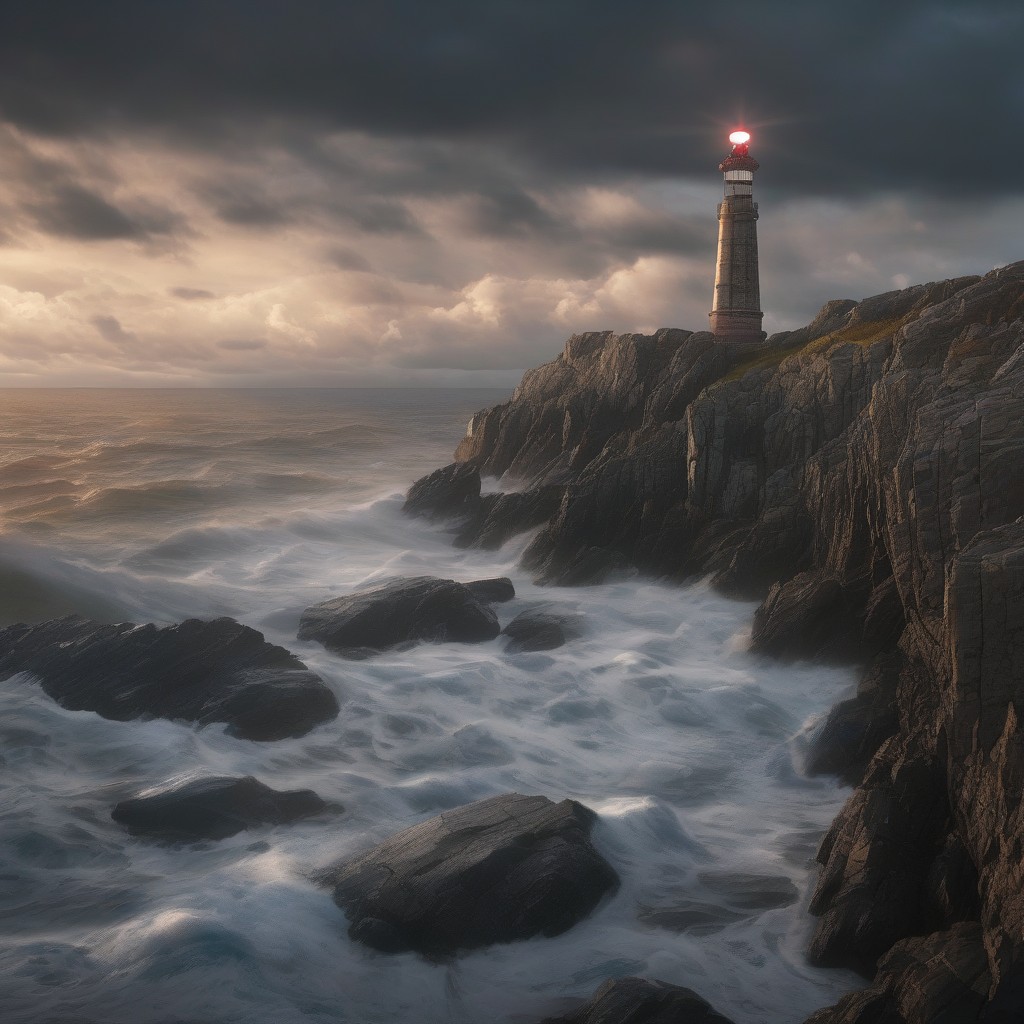
images = model.generate(**inputs, num_inference_steps=30, guidance_scale=5.0, seed=3)

Image.fromarray(images[0]).save("lighthouse.png")  # (1024, 1024, 3) uint8
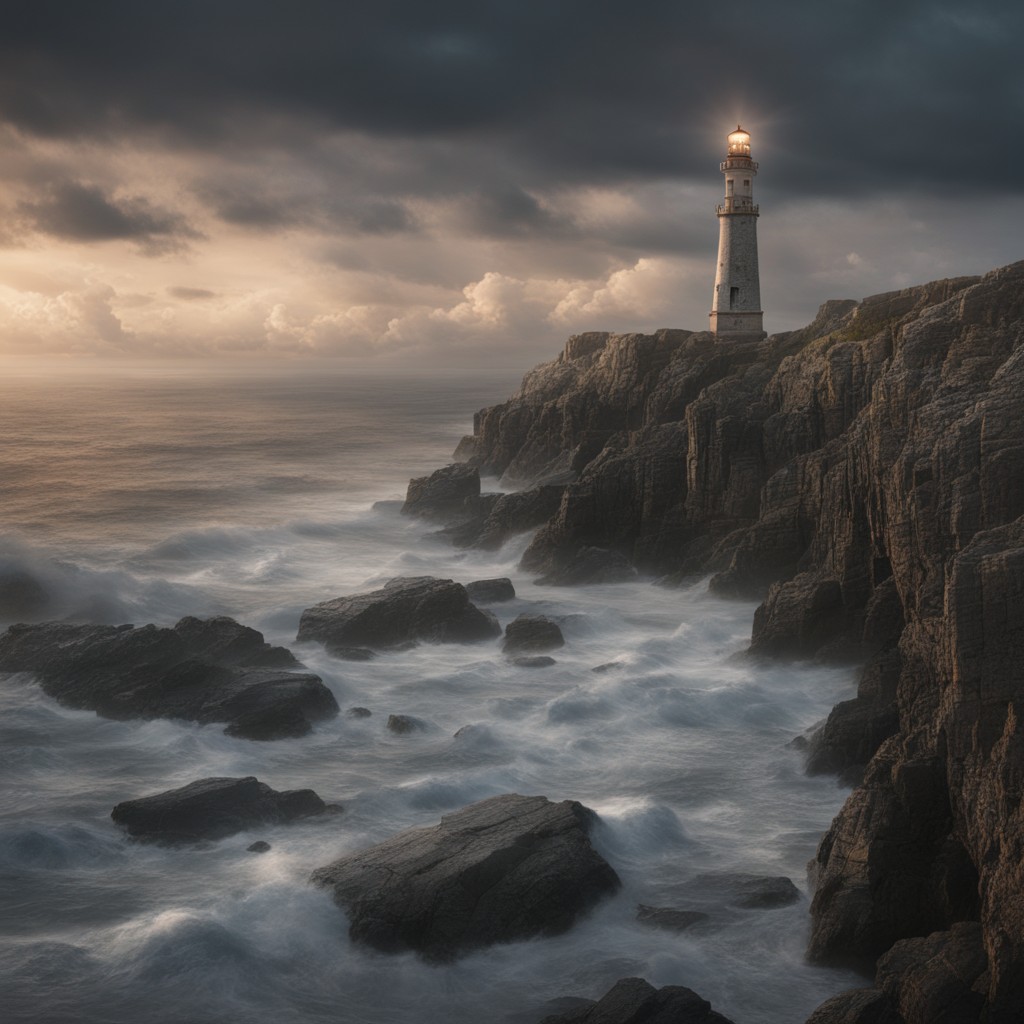
Base + refiner
The SDXL "ensemble of experts": the base runs the first 80% of the schedule and hands its latent to the refiner, which finishes it. Same prompt and initial latent as above:
refiner = StableDiffusionXLRefinerImageToImage.from_weights(
    "zeromodels/stable-diffusion-xl-refiner-1.0"
)
latent = model.generate(
    **inputs, num_inference_steps=30, denoising_end=0.8, output_type="latent", seed=3
)
images = refiner.generate(
    **inputs, latents=latent, num_inference_steps=30, denoising_start=0.8
)
SDXL-Turbo
One step, no guidance, 512px (the repo's defaults):
model = StableDiffusionXLTextToImage.from_weights("zeromodels/sdxl-turbo")
tokenizer = StableDiffusionXLTokenizer.from_weights("zeromodels/sdxl-turbo")
images = model.generate(
    **tokenizer(
        "a cinematic shot of a baby raccoon wearing an intricate italian priest robe"
    )
)

Negative prompts, micro-conditioning
inputs = tokenizer(["a red bicycle", "a blue bicycle"])
negative = tokenizer("blurry, low quality")  # one row, shared by the batch
images = model.generate(
    **inputs,
    negative_input_ids=negative["input_ids"],
    original_size=(2048, 2048),  # "a crop of a larger image": sharper detail
    crops_coords_top_left=(0, 0),
    target_size=(1024, 1024),
    seed=0,
)
Other resolutions
The graphs are built for the repo's resolution; pass overrides to build for another (the weights are resolution-independent; multiples of 64px):
model = StableDiffusionXLTextToImage.from_weights(
    "zeromodels/stable-diffusion-xl-base-1.0",
    unet_sample_size=(96, 128),
    vae_sample_size=(768, 1024),
)
images = model.generate(**tokenizer("a wide mountain valley"))  # (1, 768, 1024, 3)
float32
model = StableDiffusionXLTextToImage.from_weights(
    "zeromodels/stable-diffusion-xl-base-1.0", load_dtype="float32"
)
Verified against diffusers
The components of stable-diffusion-xl-base-1.0 and stable-diffusion-xl-refiner-1.0
were checked one by one against diffusers 0.39 / transformers in float32 on the same
inputs (the converted float16 weights computed in float32):
base     text_encoder penultimate      max|d|=6.1e-05   (values up to 854)
base     text_encoder_2 penultimate    max|d|=3.1e-05
base     text_encoder_2 pooled         max|d|=3.6e-06
base     unet noise_pred (t=981)       max|d|=9.3e-06
base     vae decode (512px)            max|d|=3.5e-05
refiner  text_encoder_2 penultimate    max|d|=3.1e-05
refiner  unet noise_pred (t=181)       max|d|=1.2e-05
The pipelines (Euler leading spacing, classifier-free guidance with the zeroed or
encoded negative branch, the micro-conditioning values, negative prompts, batches,
strength, denoising_end / denoising_start) were checked against
StableDiffusionXLPipeline and StableDiffusionXLImg2ImgPipeline on small
random-weight models, where the generated images are pixel-identical on torch and jax.
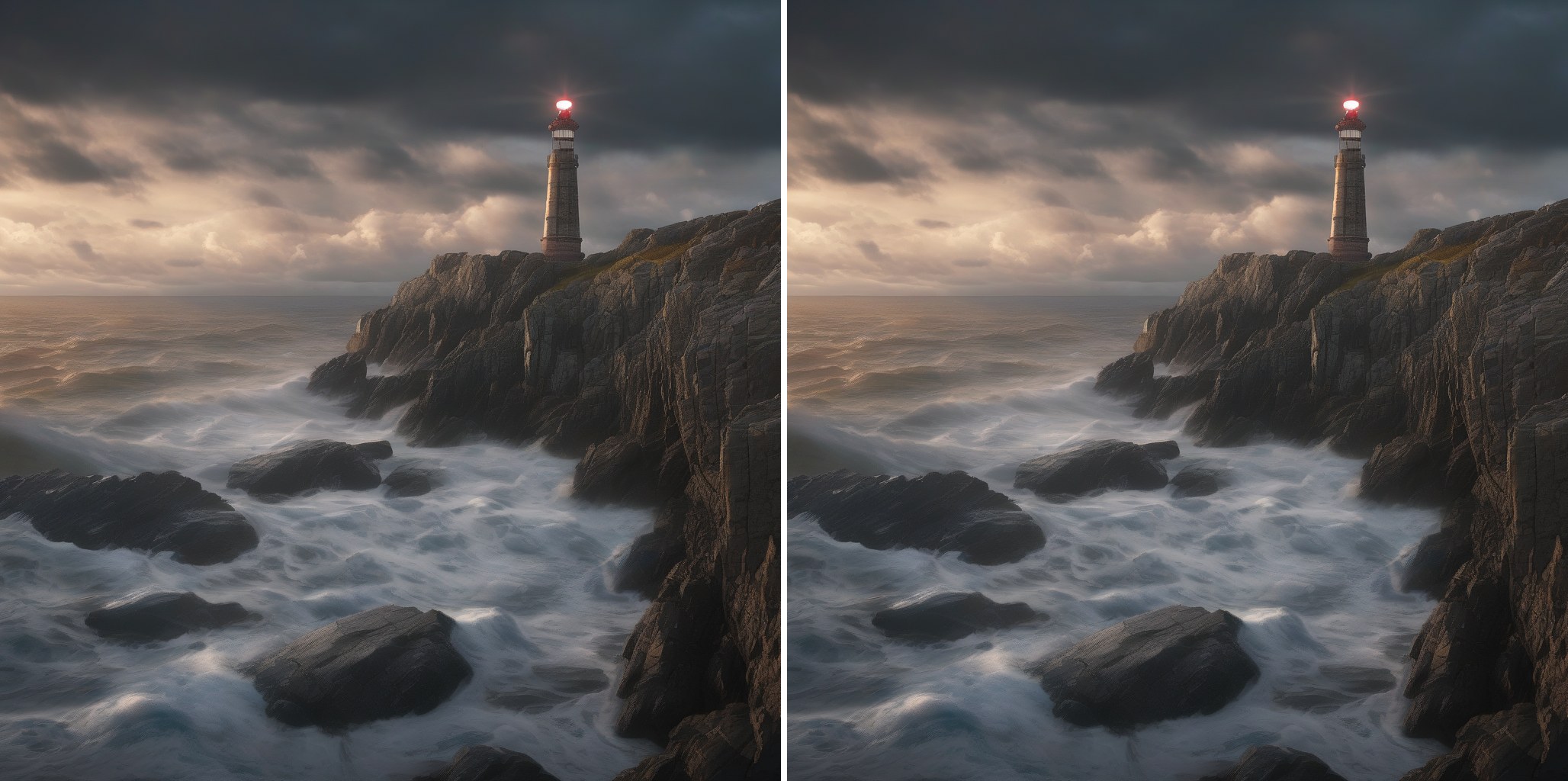
At full size in float16 (the default load; diffusers in float16 with its float32 VAE),
the lighthouse above matches diffusers to PSNR 49.7 dB (98.5% of pixels within 2 uint8
levels), the base + refiner ensemble to PSNR 51.9 dB (98.8% within 2) and SDXL-Turbo
(1 step, 512px) to PSNR 44.9 dB (92% within 2; a single step amplifies float16 rounding).
The lighthouse, zeromodels (left) and diffusers (right):
Data Format
Both channels_last and channels_first are supported, as for
Stable Diffusion; generate always returns
(batch, H, W, 3) uint8.
Memory and speed
Measured on the torch backend with the default float16 load (weights resident: 6.8 GB for a base model, 6.3 GB for the refiner, the VAE in float32):
| Resolution | Denoising step (guided, batch 1) | VAE decode (float32) |
|---|---|---|
| 512px | peak 7.1 GB, 1.2 s/step on an RTX 4060 Laptop | peak 8.5 GB |
| 768px | peak 8.0 GB | peak 10.5 GB |
| 1024px | peak 10.4 GB | about 14 GB |
Keras' functional executor keeps every layer output of a graph alive until the graph
returns, so the decoder's feature maps at 1024px add several GB on top of the weights: a
16 GB GPU runs 1024px comfortably, a 12 GB GPU 768px; on 8 GB, generate at 512px, or
denoise on the GPU (output_type="latent") and decode the latent on the CPU (about 100 s
at 1024px) with a second, CPU-only process. In float32 the weights alone take 13.9 GB.
The UNet's attention runs the portable "sdpa" math by default, which materializes the
4096 x 4096 float32 logits of the 64 x 64 level at 1024px; loading with
attn_implementation="fused" (the backend's fused kernel, see
fused_attention) cuts the 1024px step from a 10.3 GB
peak to 7.6 GB on the same GPU. On JAX and TensorFlow the denoiser step is compiled once
per run (see BaseDiffusion).
Loading Fine-tuned Weights
Any repo laid out like the hosted ones (zm_config.json declaring
StableDiffusionXLModel, the weights, tokenizer.json) loads with
from_weights("<org>/<repo>"). The hf: prefix raises for diffusion models: convert a
diffusers-format SDXL checkpoint once with
zeromodels/models/stable_diffusion_xl/convert_stable_diffusion_xl_diffusers_to_keras.py
(transfer_stable_diffusion_xl(repo), pip install zeromodels[conversion]) and host the result.