SAM3
zm_config.json + model.weights.h5 +
tokenizer.json + zm_preprocessor.json). Load with
from_weights("zeromodels/sam3") — no license gate. The gated upstream
facebook/sam3 also converts on the fly
via the hf: prefix once you accept its license.
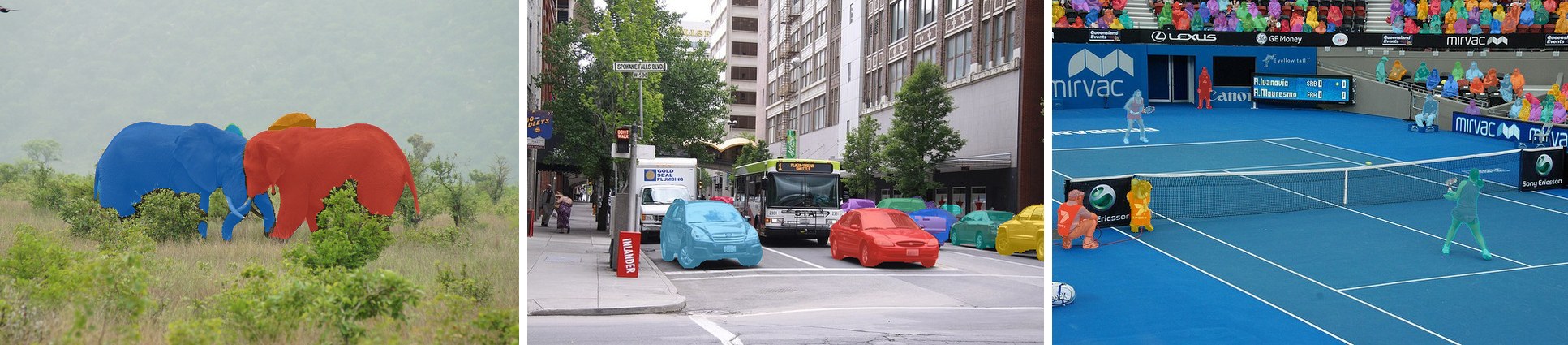
SAM3 breaks with SAM and SAM2: instead of a click or a box saying this thing here, you give it a noun phrase and it finds every instance. "car" returns eleven cars; "person" returns ninety-five people including the crowd in the stands. The prompt is a concept, not a location, so a single call segments an open vocabulary the model was never given a fixed label set for.
Architecturally it is a different model too: a ViT-L backbone and FPN feed a DETR-style encoder/decoder with 200 object queries, a CLIP text encoder supplies the open-vocabulary side, and a mask decoder turns each surviving query into a mask. Boxes are still available, through a geometry encoder, and can be mixed with text.
Paper: SAM 3: Segment Anything with Concepts
API
Three task wrappers share one SAM3Model. They differ only in what they return. There is a
single SAM3 checkpoint, hosted ungated at zeromodels/sam3, so load with from_weights
(no variant to pick):
Task.from_weights(repo_id="zeromodels/sam3", load_weights=True, **kwargs)  # load + wrap
Task(model)  # wrap an existing SAM3Model
Load once, share the backbone across tasks rather than paying for a second copy:
from zeromodels.models.sam3 import (
    SAM3Detect,
    SAM3InstanceSegment,
    SAM3SemanticSegment,
)

segmenter = SAM3InstanceSegment.from_weights("zeromodels/sam3")
detector = SAM3Detect(model=segmenter.model)  # same weights, no reload
semantic = SAM3SemanticSegment(model=segmenter.model)
predict
task.predict(
    images=None,
    text=None,
    input_boxes=None,
    input_boxes_labels=None,
    threshold=0.3,
    vision_embeds=None,
    text_embeds=None,
)
SAM3InstanceSegment.predict also takes mask_threshold=0.5. All three return a list
with one entry per image:
| Class | Each entry |
|---|---|
SAM3Detect |
{"scores": (N,), "boxes": (N, 4)}, boxes (x1, y1, x2, y2) in original pixels |
SAM3InstanceSegment |
the same plus "masks" (N, H, W) int32, at original resolution |
SAM3SemanticSegment |
a single (H, W) int32 mask, not a dict |
images accepts a path, a PIL image, a numpy array, or a list of any of those.
SAM3Model
The functional model underneath. Its detect / segment_instances / segment_semantic
methods are what the wrappers delegate to, and encode_image / encode_text are the
caching entry points. Raw outputs:
- pred_logits
(B, 200)and presence_logits: multiply the sigmoids to get scores. - pred_boxes
(B, 200, 4)normalizedcxcywh. - pred_masks
(B, 200, 288, 288)per-query mask logits. - semantic_seg
(B, 288, 288, 1)logits.
Free functions post_process_object_detection, post_process_instance_segmentation and
post_process_semantic_segmentation turn those into the dicts above if you drive the
model directly.
SAM3Processor
SAM3Processor composes the CLIP tokenizer + image processor and turns raw images, a text
noun phrase, and optional boxes into model inputs, mirroring transformers' Sam3Processor.
The task wrappers reuse the same image processor internally, so you rarely need it
directly, but it is the transformers-style entry point and the home of the
post_process_* helpers.
from zeromodels.models.sam3 import SAM3Processor

# tokenizer.json + zm_preprocessor.json, both hosted ungated
processor = SAM3Processor.from_weights("zeromodels/sam3")

inputs = processor(images="cats.jpg", text="cat")
# -> pixel_values (1, 1008, 1008, 3), input_ids (1, 32), attention_mask, original_sizes
Boxes are normalized and padded here too ((x1, y1, x2, y2) pixels to normalized cxcywh);
text defaults to "visual" for box-only prompts:
inputs = processor(
    images="cats.jpg",
    input_boxes=[[[133, 183, 512, 340]]],  # [image][box][xyxy]
    input_boxes_labels=[[1]],  # 1 = positive, 0 = negative
)
# -> input_boxes (norm cxcywh), input_boxes_labels, box_mask, pixel_values, ...
SAM3ImageProcessor (the image half) loads its config from zm_preprocessor.json;
post_process_object_detection / post_process_instance_segmentation /
post_process_semantic_segmentation on either the processor or the image processor turn
raw SAM3Model outputs into the result dicts.
Model Variants
| Variant id | Backbone | Params | Source |
|---|---|---|---|
zeromodels/sam3 |
ViT-L/14 | ~839 M | hosted, ungated (SAM license) |
sam3_saco |
ViT-L/14 | ~839 M | converts from facebook/sam3 (gated) |
One checkpoint, two ways to load it: zeromodels/sam3 is the preconverted ungated repo;
hf:facebook/sam3 converts the gated upstream on the fly. Native resolution is
1008x1008 — the ViT uses windowed attention with 2-D RoPE plus a learned position
table sized to a 72x72 patch grid — and predict preprocesses to that size. The
graph is resolution-parametric, so you can build it at another size for
Custom Resolution inference.
Text Prompts
import torch
from zeromodels.models.sam3 import SAM3InstanceSegment

segmenter = SAM3InstanceSegment.from_weights("zeromodels/sam3")

with torch.no_grad():
    result = segmenter.predict(
        images="assets/data/coco_elephants.jpg", text="elephant"
    )[0]

print(len(result["scores"]), [round(float(s), 3) for s in result["scores"]])
print(result["masks"].shape)
The same call with text="car" on a street scene returns 11 instances, and
text="person" on a tennis match returns 95, including the spectators. Nothing about
the prompt is drawn from a fixed label set.
Wrap inference in
torch.no_grad()on the torch backend. A ViT-L at 1008x1008 is 5184 tokens per image, and autograd will hold every intermediate.
Threshold
threshold filters on sigmoid(pred_logits) * sigmoid(presence_logits). On the street
scene with text="car":
threshold |
instances |
|---|---|
0.1 |
26 |
0.3 (default) |
11 |
0.5 |
6 |
0.7 |
5 |
Open-vocabulary scores are not calibrated across prompts. Sweep it per prompt rather than trusting the default.
Box Prompts
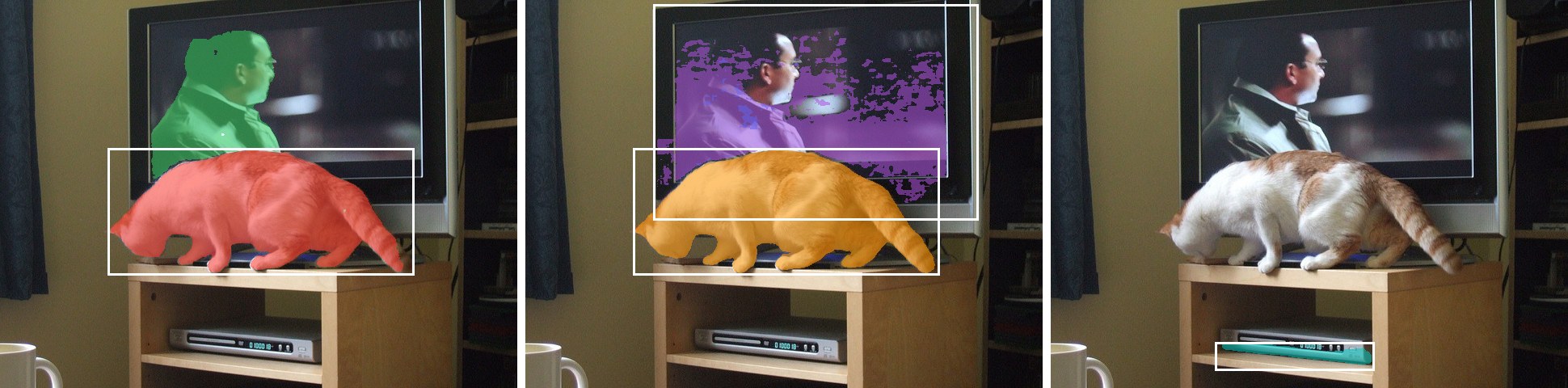
A box says this region, and needs no text at all. Coordinates are (x1, y1, x2, y2)
in original pixels.
CAT = [133, 183, 512, 340]
TV = [158, 5, 560, 272]

with torch.no_grad():
    result = segmenter.predict(
        images="assets/data/coco_cat_tv.jpg", input_boxes=[[CAT]]
    )[0]
print(len(result["scores"]), [round(float(s), 3) for s in result["scores"]])
input_boxesis nested per image. The outer list is the batch. Two boxes on one image is[[CAT, TV]]; writing[CAT, TV]is read as one box for each of two images, and since only one image was passed, the second box is silently dropped. The call succeeds and returns the single-box answer, so nothing warns you.
With both boxes, [[CAT, TV]] returns 3 instances scoring [0.695, 0.965, 0.859].
Boxes reach objects that are awkward to name. A box on the DVD player,
[[203, 423, 400, 458]], returns one mask at 0.934, against 0.884 for the text
prompt "dvd player".
Positive and negative boxes
Several boxes go on one image as [[box1, box2, ...]] with a matching label list. A
positive box (label 1) adds a region; a negative box (label 0) suppresses one.
Labels default to all-positive when omitted.
CAT = [133, 183, 512, 340]
TV = [158, 5, 560, 272]

with torch.no_grad():
    result = segmenter.predict(
        images=["assets/data/coco_cat_tv.jpg"],
        input_boxes=[[CAT, TV]],  # two boxes, one image  -> [[...]]
        input_boxes_labels=[[1, 0]],  # keep the cat region, suppress the tv region
    )[0]
See Prompt Label Conventions for the exact meaning of the label values and the nesting rules.
Mixing Text and Boxes
Pass both, and label each box. Labels index a learned Embedding(2, dim), so 0 and
1 are conditioning signals, not a hard include/exclude:
with torch.no_grad():
    result = segmenter.predict(
        images="assets/data/coco_cat_tv.jpg",
        text="cat",
        input_boxes=[[CAT]],
        input_boxes_labels=[[0]],  # 0 = negative, 1 = positive
    )[0]
| Call | instances | top score |
|---|---|---|
text="cat" |
1 | 0.978 |
text="cat" + negative box on the cat |
1 | 0.481 |
The cat survives, but its score halves. A negative box suppresses, it does not delete. If you need it gone, threshold on the suppressed score.
Leaving text=None while passing boxes substitutes the prompt "visual" for you, which
is the box-only mode above. Every image in a batch needs either text or boxes, or
predict raises.
Prompt Label Conventions
Box prompts carry a per-box label that indexes a learned Embedding(2, dim):
| Label | Meaning |
|---|---|
1 |
positive — segment this region (the default when labels are omitted) |
0 |
negative — suppress this region (a soft signal, not a hard delete) |
input_boxesis nested[image][box][x1, y1, x2, y2]in original pixels;input_boxes_labelsis[image][box]. For one image with several boxes wrap as[[box1, box2]]/[[1, 0]]— a single-nested[box1, box2]is read as one box per image, so with one image the extra boxes are silently dropped.- Omitting
input_boxes_labelsmakes every box positive. - Batches pad to the widest box count with the sentinel
-10(POINT_PAD_VALUE); padded slots get label0and are masked out by the geometry encoder, so padding never acts as a real negative prompt. - A negative box lowers a concept's score rather than deleting it, so threshold on the suppressed score if you need the region gone.
Semantic Segmentation
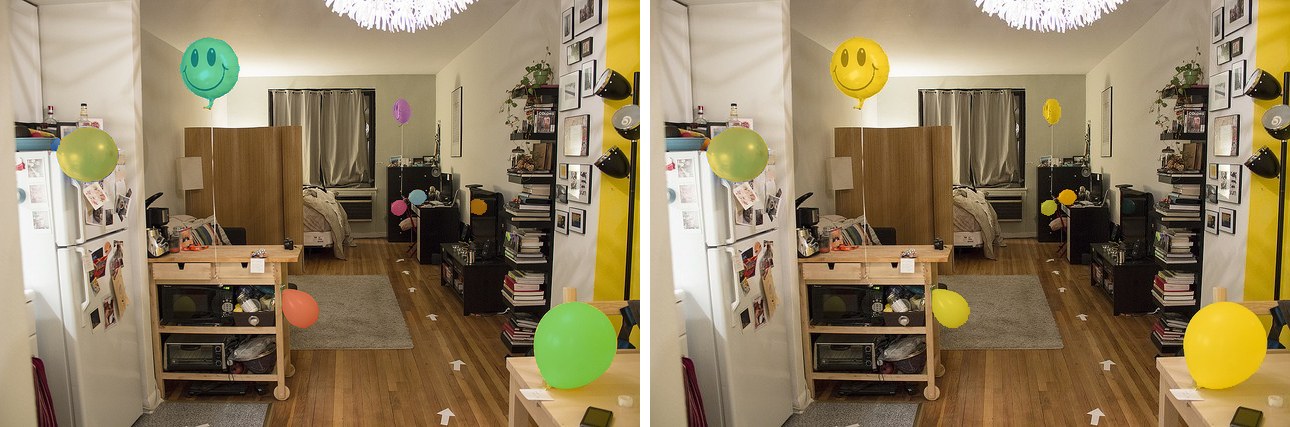
Same prompt, same image, different question. Instance mode asks which balloons; semantic mode asks where is balloon, and returns one merged binary mask.
from zeromodels.models.sam3 import SAM3SemanticSegment

semantic = SAM3SemanticSegment.from_weights("zeromodels/sam3")

with torch.no_grad():
    mask = semantic.predict(images="assets/data/coco_apartment.jpg", text="balloon")[0]

print(mask.shape, mask.dtype, int(mask.sum()), sorted(set(mask.ravel().tolist())))
The instance call on the same image returns 9 separate masks. Note the return is a bare
array per image, not a dict, and threshold here defaults to 0.5 and binarizes the
semantic map rather than filtering queries.
Detection Only
Skip the mask decoder when boxes are all you need:
from zeromodels.models.sam3 import SAM3Detect

detector = SAM3Detect.from_weights("zeromodels/sam3")

with torch.no_grad():
    result = detector.predict(images="assets/data/coco_city_bus.jpg", text="car")[0]

print(sorted(result), len(result["scores"]))
print([[round(float(v), 1) for v in b] for b in result["boxes"][:2]])
Encode Once, Prompt Many Times
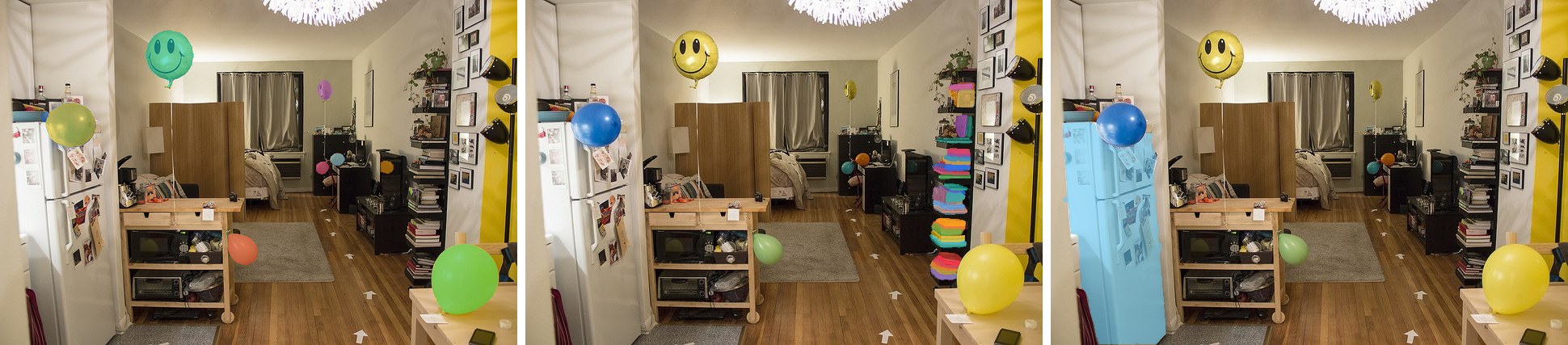
The ViT-L dominates the cost and does not depend on the prompt, so cache it with
encode_image and pay only the decoder per prompt:
import torch
from zeromodels.models.sam3 import SAM3InstanceSegment

segmenter = SAM3InstanceSegment.from_weights("zeromodels/sam3")

with torch.no_grad():
    features = segmenter.model.encode_image("assets/data/coco_apartment.jpg")
print(sorted(features))

for prompt in ("balloon", "book", "refrigerator"):
    with torch.no_grad():
        r = segmenter.predict(text=prompt, vision_embeds=features)[0]
    print(f"{prompt:14s} {len(r['scores']):3d}  {r['scores'].max():.3f}")
['fpn_0', 'fpn_1', 'fpn_2', 'fpn_3', 'original_size', 'text_projected']
balloon          9  0.969
book            52  0.692
refrigerator     1  0.977
The balloon row reproduces the uncached call exactly, which is the point: caching moves
where the time goes, not the answer.
encode_text is the mirror image, for one prompt against many images:
text = segmenter.model.encode_text("balloon")
r = segmenter.predict(images="other.jpg", text_embeds=text)[0]
vision_embedsis single-image and text-only. It carries oneoriginal_size, so the batch axis is fixed at 1, and the cached path holds nopixel_valuesfor the geometry encoder to read, so it cannot be combined withinput_boxes.
Batching
Pass a list of images. One shared prompt applies to all; a list of prompts pairs positionally.
images = ["a.jpg", "b.jpg"]

with torch.no_grad():
    rs = segmenter.predict(images=images, text="animal")  # shared
    rs = segmenter.predict(images=images, text=["elephant", "bus"])  # per image
    rs = segmenter.predict(
        images=images, text=["elephant", None], input_boxes=[[], [[200, 150, 400, 330]]]
    )  # mixed
In the mixed form, None text with boxes falls back to "visual", and [] means that
image has no boxes. Batched rows are identical to running the images one at a time,
verified against the same image duplicated.
Batching is memory-bound, not compute-bound. Two images at 1008x1008 through a ViT-L needs roughly 3 GB more than an 8 GB card has free, so batch size 2 already OOMs there. Looping one image at a time costs the same compute and is the practical choice on consumer hardware. Box prompts are looped internally regardless: the geometry encoder runs once per image.
Data Format
channels_last and channels_first are both supported. The model reads
keras.config.image_data_format() when it is constructed, so set it first:
import keras

keras.config.set_image_data_format("channels_first")

from zeromodels.models.sam3 import SAM3InstanceSegment

segmenter = SAM3InstanceSegment.from_weights("zeromodels/sam3")
Returned masks and boxes are in original-image pixel space either way.
Custom Resolution
Any input image resolution already works: predict resizes to the model's native
1008x1008 and returns masks / boxes in original-image pixels. To run the ViT itself
at a different resolution, build the model at that size and load the same weights. The 2-D
RoPE recomputes for the new patch grid and the learned position table (stored at the 24x24
pretrain grid) tiles / crops to it, so the checkpoint loads unchanged.
import torch
from zeromodels.models.sam3 import SAM3InstanceSegment, SAM3Model

# build the graph at 1512x1512 (grid 108x108) and load the hosted weights
model = SAM3Model.from_weights("zeromodels/sam3", vit_image_size=1512, image_size=1512)
# the task's image processor follows model.vit_image_size
segmenter = SAM3InstanceSegment(model=model)

with torch.no_grad():
    result = segmenter.predict(images="large.jpg", text="person")[0]
Experimental. The weights are trained and validated at 1008; other sizes run but are not guaranteed to match upstream. Re-check accuracy at your resolution before relying on it.
Visualization
sam3_utils ships the overlay helpers used for the figures above:
from zeromodels.models.sam3.sam3_utils import (
    draw_detections,
    draw_instance_masks,
    draw_semantic_mask,
)

draw_instance_masks(image, result, title="balloons").save("out.jpg")
Tokenizer
SAM3CLIPTokenizer is the OpenAI CLIP BPE tokenizer with max_seq_len=32. It resolves
tokenizer.json from the ungated zeromodels/sam3 on the fly (no license gate);
encode returns an (input_ids, attention_mask) tuple, not a dict.
from zeromodels.models.sam3 import SAM3CLIPTokenizer

tokenizer = SAM3CLIPTokenizer()
input_ids, attention_mask = tokenizer.encode("a photo of a cat")
See also SAM and SAM2, which prompt by location rather than concept.