BEiT
from_weights("zeromodels/beit-base-patch16-224")
(classification) or from_weights("zeromodels/beit-base-finetuned-ade-640-640")
(segmentation). Any upstream beit repo also loads on the fly via the hf:
prefix, e.g. from_weights("hf:microsoft/beit-base-patch16-224"). The architecture is
read from the repo config, so no shape arguments are needed.
BEiT (BERT pre-training of Image Transformers) is a ViT-family vision transformer: a convolutional patch stem, a learned CLS token, and a stack of pre-norm transformer blocks. It differs from a vanilla ViT in three ways that every hosted checkpoint uses:
- a per-layer 2D relative position bias in attention (and no absolute position embeddings),
- a learnable layer scale (
lambda_1/lambda_2) on each residual branch, and - mean pooling of the patch tokens (followed by a LayerNorm) for classification, rather than reading the CLS token.
It ships as an ImageNet classifier and, with a UPerNet head, as an ADE20K semantic segmenter.
Paper: BEiT: BERT Pre-Training of Image Transformers
API
BeitImageClassify
BeitImageClassify(
    hidden_size=768,
    num_hidden_layers=12,
    num_attention_heads=12,
    intermediate_size=3072,
    patch_size=16,
    layer_scale_init_value=0.1,
    layer_norm_eps=1e-12,
    image_size=224,
    num_classes=1000,
    classifier_activation="linear",
    name="BeitImageClassify",
)
The classifier: the BeitModel backbone plus the mean-pool head (mean of the patch
tokens, a LayerNorm, then a Dense). The model takes already-normalized input;
BeitImageProcessor applies BEiT's 0.5/0.5 normalization.
Parameters
- hidden_size (
int, defaults to768): transformer width. - num_hidden_layers (
int, defaults to12): number of transformer blocks. - num_attention_heads (
int, defaults to12): attention heads per block. - intermediate_size (
int, defaults to3072): MLP inner dimension. - patch_size (
int, defaults to16): conv-stem patch size. - layer_scale_init_value (
float, defaults to0.1): initial layer-scale value. - layer_norm_eps (
float, defaults to1e-12): epsilon of every LayerNorm. - image_size (
int, defaults to224): resolution the model is built for. - num_classes (
int, defaults to1000): classifier outputs.
from_weights fills the architectural fields from the repo config, so you normally pass only
the repo id.
Call model(pixel_values, training=False). Returns class logits (B, num_classes).
BeitModel
The backbone alone: the patch stem, CLS token, and transformer blocks, ending at the token
sequence (B, num_patches + 1, hidden_size) (the first token is the CLS token). There is no
final backbone LayerNorm (BEiT normalizes only inside the mean-pool head). With
as_backbone=True it returns the per-block token sequences (the initial embedding plus one per
block), which the segmentation head reshapes into 2D feature maps.
BeitSemanticSegment
BeitSemanticSegment(
    hidden_size=768,
    num_hidden_layers=12,
    num_attention_heads=12,
    intermediate_size=3072,
    patch_size=16,
    image_size=640,
    num_classes=150,
    out_indices=(3, 5, 7, 11),
    pool_scales=(1, 2, 3, 6),
    name="BeitSemanticSegment",
)
Semantic segmentation: four intermediate token sequences (at out_indices) are reshaped into
2D feature maps, rescaled by an FPN neck (4x up, 2x up, identity, 2x down), and decoded by a
UPerNet head (pyramid pooling module + FPN fusion) into per-pixel class logits at a quarter
of the input resolution. The training-only auxiliary FCN head is omitted.
Call model(pixel_values, training=False). Returns segmentation logits
(B, H/4, W/4, num_classes) (channels_last; the head runs in channels_last). Upsample to
the input size and argmax over the class axis for a label map.
Model Variants
Load any of these with from_weights("zeromodels/<variant>").
| Task | Repo | Classes |
|---|---|---|
| Classification | zeromodels/beit-base-patch16-224 |
1000 |
| Classification | zeromodels/beit-large-patch16-224 |
1000 |
| Classification | zeromodels/beit-large-patch16-512 |
1000 |
| Classification (22k) | zeromodels/beit-base-patch16-224-pt22k-ft22k |
21841 |
| Classification (22k) | zeromodels/beit-large-patch16-224-pt22k-ft22k |
21841 |
| Segmentation | zeromodels/beit-base-finetuned-ade-640-640 |
150 |
| Segmentation | zeromodels/beit-large-finetuned-ade-640-640 |
150 |
Use BeitImageClassify for the classification repos and BeitSemanticSegment for the
finetuned-ade repos. The upstream microsoft/beit-* checkpoints load the same way with the
hf: prefix.
Basic Usage: Classification
import keras
import numpy as np
from PIL import Image
from zeromodels.models.beit import BeitImageClassify, BeitImageProcessor

model = BeitImageClassify.from_weights("zeromodels/beit-base-patch16-224")
processor = BeitImageProcessor.from_weights("zeromodels/beit-base-patch16-224")

image = Image.open("assets/data/coco_bear.jpg").convert("RGB")
pixels = processor(image)  # (1, 224, 224, 3), resized + normalized

logits = model(pixels, training=False)
top5 = np.argsort(keras.ops.convert_to_numpy(logits)[0])[-5:][::-1]
print("top-5 ImageNet-1k class ids:", top5.tolist())
Normalization lives in the processor, so run the image through BeitImageProcessor
before the model. Map the class ids to the
ImageNet-1k label list to read names.
Semantic Segmentation
Load the hosted segmenter and its processor with from_weights, run the image, and turn the
logits into a full-resolution label map with post_process_semantic_segmentation:
import os

os.environ["KERAS_BACKEND"] = "torch"  # or "jax" / "tensorflow"

from PIL import Image
from zeromodels.models.beit import BeitSemanticSegment, BeitImageProcessor
from zeromodels.utils.labels_util import ADE20K_150_CLASSES
from zeromodels.utils.visualization_util import plot_segmentation

model = BeitSemanticSegment.from_weights("zeromodels/beit-base-finetuned-ade-640-640")
processor = BeitImageProcessor.from_weights(
    "zeromodels/beit-base-finetuned-ade-640-640"
)

image = Image.open("assets/data/mountain.jpg").convert("RGB")
pixels = processor(image)  # (1, 640, 640, 3), raw [0, 255]; the model normalizes
logits = model(pixels, training=False)  # (1, 160, 160, 150), channels_last
seg = processor.post_process_semantic_segmentation(
    logits,
    target_sizes=[image.size[::-1]],  # (height, width)
)[0]  # (H, W) ADE20K class ids at full resolution

plot_segmentation(image, seg, ADE20K_150_CLASSES)  # overlay + legend
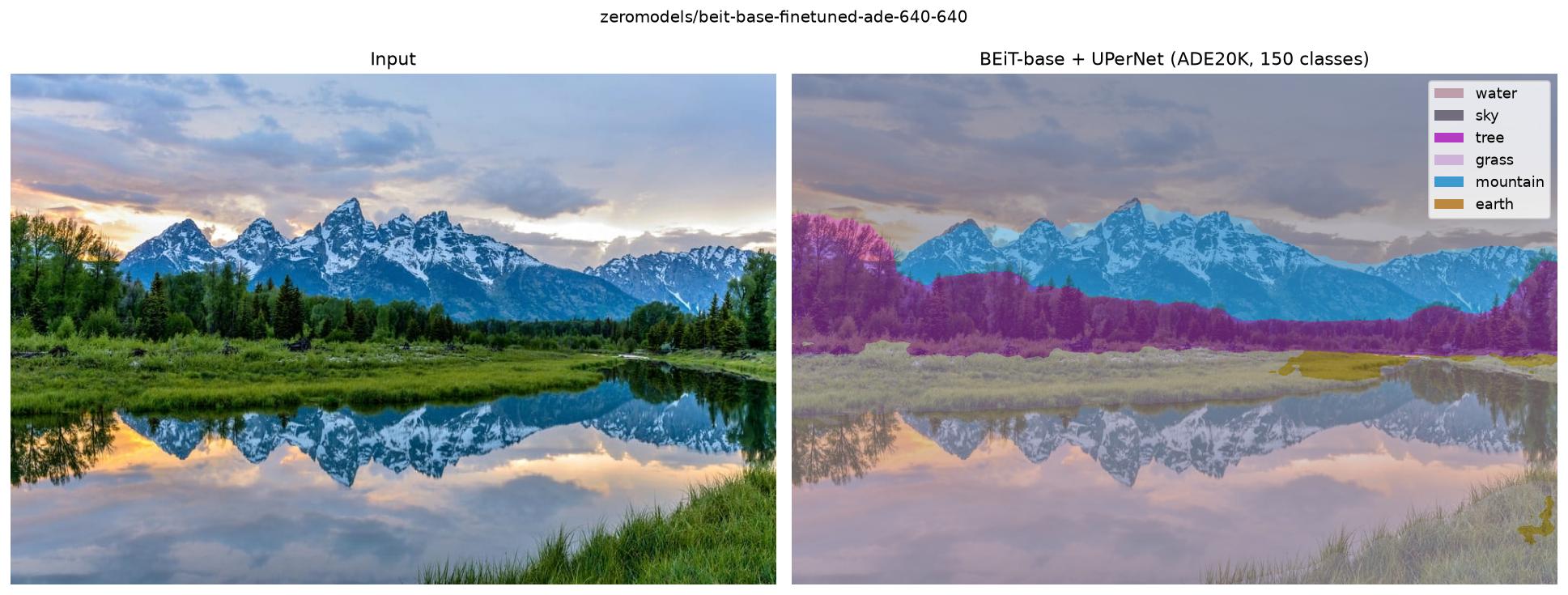
The logits come out at a quarter of the input resolution (160x160 for a 640 input);
post_process_semantic_segmentation upsamples them (bilinear, before the argmax) to each
target_sizes entry and returns one (H, W) label map per image. The 150 classes are the ADE20K
label set. The hosted processor only resizes (the model normalizes internally); see
Image Processor for the details and the alternative normalizing path.
Image Processor
BeitImageProcessor handles the input resize and the segmentation post-processing, and mirrors
transformers' BeitImageProcessor (resize to a square size bicubic, rescale 1/255, normalize
0.5/0.5). It accepts a file path, a PIL image, a uint8 array, or a keras/float pixel tensor,
and returns a (B, H, W, C) batch (pass a list for several images). Rescale and normalize are
bit-exact to transformers; the resize matches the fast (torchvision) processor to about 7e-3
(antialias=True).
The hosted segmentation repos ship a zm_preprocessor.json, so from_weights builds a processor
that matches the model. The models take already-normalized input, so the hosted processor
resizes, rescales, and normalizes (0.5/0.5) and provides post_process_semantic_segmentation:
processor = BeitImageProcessor.from_weights(
    "zeromodels/beit-base-finetuned-ade-640-640"
)
# do_resize=True (640, bicubic), do_rescale=True, do_normalize=True
Constructed directly, the processor defaults to the same HF-faithful settings
(do_rescale=True, do_normalize=True):
from zeromodels.models.beit import BeitImageProcessor, BeitImageClassify

processor = BeitImageProcessor(size=224, resample="bilinear")  # normalizes (0.5/0.5)
model = BeitImageClassify.from_weights("zeromodels/beit-base-patch16-224")

pixels = processor("assets/data/coco_bear.jpg")  # (1, 224, 224, 3), normalized
logits = model(pixels, training=False)
post_process_semantic_segmentation(logits, target_sizes=[(H, W)]) upsamples the
quarter-resolution logits (bilinear, then argmax) and returns a list of per-pixel label maps, one
per image, matching the reference. BeitImageProcessor.from_hf(preprocessor_config) builds a
processor straight from a repo's preprocessor_config.json.
Feature Extraction
BeitModel.from_weights(..., as_backbone=True) returns the per-block token sequences (the
embedding plus one per transformer block). Drop the CLS token and reshape each to a
(B, grid, grid, hidden_size) map to hook a detection or segmentation neck onto:
from zeromodels.models.beit import BeitModel

backbone = BeitModel.from_weights("zeromodels/beit-base-patch16-224", as_backbone=True)
features = backbone(pixels, training=False)  # list of (B, 197, 768) token sequences
Loading Fine-tuned and Community Weights
The official checkpoints live under zeromodels/, but any Hugging Face repo whose model_type
is "beit" also loads on the fly with the hf: prefix, including microsoft/beit-* and
arbitrary fine-tunes:
from zeromodels.models.beit import BeitImageClassify

model = BeitImageClassify.from_weights("hf:<user>/beit-finetuned-on-my-data")

# Architecture only, randomly initialized
model = BeitImageClassify.from_weights(
    "zeromodels/beit-base-patch16-224", load_weights=False
)
The architecture is read from the repo's config.json and mapped onto the constructor:
hidden_size, num_hidden_layers, num_attention_heads, intermediate_size, patch_size,
image_size, and the label count. BeitModel and BeitSemanticSegment accept hf: the same
way.