Stable Diffusion
zm_config.json + model.weights.h5 +
tokenizer.json). Load with from_weights("zeromodels/<variant>").
Stable Diffusion 1.x, ported to pure Keras 3: latent text-to-image diffusion with a
UNet denoiser, a KL-regularized autoencoder and the CLIP ViT-L/14 text encoder. The
whole model is one container, StableDiffusionModel, a single functional graph with
the three towers as disconnected sub-graphs (the way CLIPModel holds its two), so a
hosted repo is one model.weights.h5 and one zm_config.json.
StableDiffusionTextToImage is that same graph plus generate: the classifier-free
guidance denoising loop of BaseDiffusion, the diffusion counterpart of
BaseGeneration.
All five SD 1.x checkpoints (v1-1 to v1-5) share this architecture; only the weights
differ. The weights are converted once, offline, and hosted: on-the-fly hf: conversion
is deliberately not supported for diffusion models.
Key facts of the port:
- Both data formats: the UNet and VAE follow
keras.config.image_data_format()(every conv takes it, GroupNorm normalizes the layout's channel axis, and the two token <-> grid boundaries transpose around their flatten underchannels_first). Weights are layout-independent, so one hosted checkpoint serves both, and the converter is a(O, I, H, W) -> (H, W, I, O)kernel transpose and nothing else. - Block-level layers: the UNet and VAE are built from composite Keras layers
(
ResnetBlock2D,Transformer2DModel,CrossAttention, ...). A functional graph keeps every node's output alive until the forward ends, and at 512px the UNet's per-op intermediates (4096x4096 attention maps above all) would need several GB; a layer's internals are freed when its call returns. - Schedulers match diffusers to the bit: the training noise schedule is built in
float32 the way torch does it, so
alphas_cumprodand the Euler sigmas are identical and a 50-step run stays within float rounding of the reference. - Verified end to end: at 512px, fp32, PNDM 50 steps and the same initial latent, the generated image matches diffusers' to within 1 uint8 level (99.3% of pixels identical, PSNR 75 dB); the UNet, VAE and text encoder outputs agree to ~1e-6.
Links:
- Paper: High-Resolution Image Synthesis with Latent Diffusion Models (arXiv:2112.10752)
- Reference implementation: diffusers
StableDiffusionPipeline - License: CreativeML OpenRAIL-M
See also clip.md (the text encoder is CLIPTextModel).
Variants
Preconverted, float32 weights are hosted under zeromodels/. Load with
from_weights("zeromodels/<variant>"). Each repo is one container: UNet (860M) + VAE
(84M) + CLIP text encoder (123M), 1.07B parameters, 3.97 GB. All checkpoints are released
under the CreativeML OpenRAIL-M license, which carries use-based restrictions.
| Variant | Hub | Training |
|---|---|---|
stable-diffusion-v1-1 |
zeromodels/stable-diffusion-v1-1 |
237k steps at 256px on laion2B-en, then 194k steps at 512px on laion-high-resolution |
stable-diffusion-v1-2 |
zeromodels/stable-diffusion-v1-2 |
v1-1 + 515k steps at 512px on laion-aesthetics v2 5+ |
stable-diffusion-v1-3 |
zeromodels/stable-diffusion-v1-3 |
v1-2 + 195k steps at 512px, 10% text-conditioning dropout |
stable-diffusion-v1-4 |
zeromodels/stable-diffusion-v1-4 |
v1-2 + 225k steps at 512px, 10% text-conditioning dropout |
stable-diffusion-v1-5 |
zeromodels/stable-diffusion-v1-5 |
v1-2 + 595k steps at 512px, 10% text-conditioning dropout |
The 10% text-conditioning dropout of v1-3 onwards is what makes classifier-free guidance work well; v1-5 is the usual default.
API
Configs are typed: StableDiffusionConfig (composite) over UNet2DConditionConfig,
AutoencoderKLConfig and StableDiffusionTextConfig (a CLIPTextConfig with the
ViT-L/14 defaults), plus the checkpoint's scheduler_config and the CLIP special token
ids. Each repo's zm_config.json parses through it; the constructor stays flat, with the
sub-config fields prefixed unet_ / vae_ / text_.
StableDiffusionTextToImage
The text-to-image task: the StableDiffusionModel container plus BaseDiffusion's
generate. It supplies the hooks the mixin needs (encode_prompt on the CLIP tower,
the empty prompt's unconditional_ids, predict_noise on the UNet, decode_latents on
the VAE) and a scheduler, built from the config's scheduler_config (PNDM for every
SD 1.x checkpoint).
generate(
    input_ids,
    attention_mask=None,
    negative_input_ids=None,
    num_inference_steps=None,
    guidance_scale=None,
    seed=None,
    latents=None,
)
| Arg | Default | Meaning |
|---|---|---|
input_ids |
required | (batch, 77) token ids, **tokenizer(prompts) |
attention_mask |
None |
accepted alongside the tokenizer's output; SD attends its padding tokens, so it is unused |
negative_input_ids |
None |
(batch, 77) tokenized negative prompt for guidance; the empty prompt when unset |
num_inference_steps |
None |
scheduler steps; the repo's generate_args (50) when unset |
guidance_scale |
None |
classifier-free guidance strength; generate_args (7.5) when unset, <= 1 disables it |
seed |
None |
seed for the initial latent, reproducible per backend |
latents |
None |
explicit (batch, 64, 64, 4) initial latent; identical results across backends |
Returns (batch, 512, 512, 3) uint8 numpy images. The denoiser call (the UNet plus the
guidance combine) runs as a per-backend compiled function cached on the instance,
jax.jit on JAX and tf.function(jit_compile=True) on TensorFlow, eager on Torch; its
shapes are the same at every step, so one compile serves the whole loop.
| Constructor arg | Default | Meaning |
|---|---|---|
scheduler |
None |
a BaseScheduler; built from scheduler_config when unset |
unet_sample_size |
64 |
latent size the UNet graph is built for (image size / 8) |
vae_sample_size |
512 |
image size the VAE graphs are built for |
unet_* / vae_* / text_* |
SD 1.x | the flat sub-config fields (see Configuration) |
bos_token_id / eos_token_id / pad_token_id |
49406 / 49407 / 49407 |
CLIP's special tokens, used to build the empty prompt |
scheduler_config |
None |
the diffusers scheduler dict (_class_name, betas, steps_offset, ...) |
StableDiffusionModel
The container: one functional model whose graph is three disconnected paths, one per
component. Inputs {"sample", "timestep", "encoder_hidden_states"} (UNet),
{"image", "latent"} (VAE encode / decode) and {"token_ids", "padding_mask"} (text);
outputs {"noise_pred", "moments", "image", "text_embeds"}. The components are exposed as
.unet, .vae and .text_encoder and share the container's weights, so loading the
container loads all three. It loads the same repo as the task class.
UNet2DConditionModel
The denoiser (diffusers' UNet2DConditionModel): a symmetric down / mid / up UNet whose
ResNet blocks are conditioned on the sinusoidal timestep embedding and whose
CrossAttn blocks attend the latent to the text context. Inputs
{"sample": (B, h, w, 4), "timestep": (B,), "encoder_hidden_states": (B, 77, 768)},
output {"sample": (B, h, w, 4)}.
| Arg | Default | Meaning |
|---|---|---|
sample_size |
64 |
latent spatial size the graph is built for |
in_channels / out_channels |
4 |
latent channels |
down_block_types / up_block_types |
SD 1.x | CrossAttnDownBlock2D x3 + DownBlock2D, mirrored |
block_out_channels |
(320, 640, 1280, 1280) |
width per level |
layers_per_block |
2 |
ResNet blocks per level |
cross_attention_dim |
768 |
width of the text context |
num_attention_heads |
8 |
heads in the cross-attention blocks |
norm_num_groups |
32 |
GroupNorm groups |
text_seq_len |
77 |
static text length |
AutoencoderKL
The VAE (diffusers' AutoencoderKL): encode(image, sample=False) returns the posterior
mean (or a sample) of a (B, H/8, W/8, 4) latent and decode(latent) the (B, H, W, 3)
image in [-1, 1]; multiply / divide by scaling_factor (0.18215) around the UNet, as
generate does. One functional graph with the encoder and decoder as two disconnected
paths.
| Arg | Default | Meaning |
|---|---|---|
in_channels / out_channels |
3 |
image channels |
latent_channels |
4 |
latent channels |
block_out_channels |
(128, 256, 512, 512) |
width per level, x8 spatial compression |
layers_per_block |
2 |
ResNet blocks per encoder level |
norm_num_groups |
32 |
GroupNorm groups |
sample_size |
512 |
image size the graphs are built for |
scaling_factor |
0.18215 |
latent scaling |
Schedulers
zeromodels.base.base_scheduler has the SD samplers as weightless classes with the
diffusers interface (set_timesteps, scale_model_input, step,
init_noise_sigma), configured the diffusers way:
| Scheduler | Notes |
|---|---|
PNDMScheduler |
the SD 1.x default (PLMS, skip_prk_steps=True) |
DDIMScheduler |
deterministic, eta=0 |
EulerDiscreteScheduler |
Karras-style sigma sampler, linspace spacing |
EulerAncestralDiscreteScheduler |
stochastic Euler (seed for reproducibility) |
get_scheduler(config) builds the one named by a diffusers scheduler config dict, which
is what the model does with its scheduler_config; swap at any time:
from zeromodels.base.base_scheduler import EulerDiscreteScheduler

model.scheduler = EulerDiscreteScheduler.from_config(model.config.scheduler_config)
Preprocessing
StableDiffusionTokenizer
The CLIP ViT-L/14 BPE tokenizer: <|startoftext|> / <|endoftext|> framing, truncated
and <|endoftext|>-padded to 77 tokens, the fixed context length the UNet's
cross-attention is built for. Calling it returns {"input_ids", "attention_mask"}
for a string or a list of strings.
There is no image processor and no processor class: text-to-image takes token ids in and hands uint8 images out.
End-to-end example
Single prompt
import os

os.environ["KERAS_BACKEND"] = "torch"  # or "jax" / "tensorflow"

from PIL import Image
from zeromodels.models.stable_diffusion import (
    StableDiffusionTextToImage,
    StableDiffusionTokenizer,
)

model = StableDiffusionTextToImage.from_weights("zeromodels/stable-diffusion-v1-5")
tokenizer = StableDiffusionTokenizer.from_weights("zeromodels/stable-diffusion-v1-5")

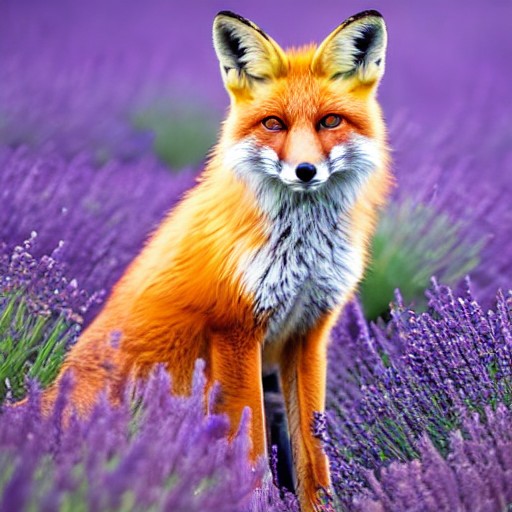
inputs = tokenizer(
    "a red fox sitting in a field of lavender, golden hour, wildlife photography, sharp focus"
)
images = model.generate(**inputs, num_inference_steps=50, guidance_scale=7.5, seed=1)

Image.fromarray(images[0]).save("fox.png")  # (512, 512, 3) uint8
Negative prompt and batching
Prompts batch through the tokenizer; a negative prompt is tokenized the same way and
passed as negative_input_ids (one per prompt, or one broadcast row).
prompts = [
    "a watercolor painting of a lighthouse at sunset",
    "a red vintage car on a coastal road",
]
inputs = tokenizer(prompts)  # {"input_ids": (2, 77), "attention_mask": (2, 77)}
negative = tokenizer(["blurry, low quality"] * len(prompts))["input_ids"]

images = model.generate(**inputs, negative_input_ids=negative, num_inference_steps=30)
for i, image in enumerate(images):
    Image.fromarray(image).save(f"out_{i}.png")
Reproducible across backends
seed reproduces a run on a given backend, but keras.random differs between torch,
jax and tensorflow. For an image that is identical everywhere, pass the initial latent
yourself ((batch, 64, 64, 4) at 512px):
import numpy as np

latents = np.random.default_rng(0).standard_normal((1, 64, 64, 4)).astype("float32")
images = model.generate(**tokenizer("a bowl of ramen"), latents=latents)
Verified against diffusers
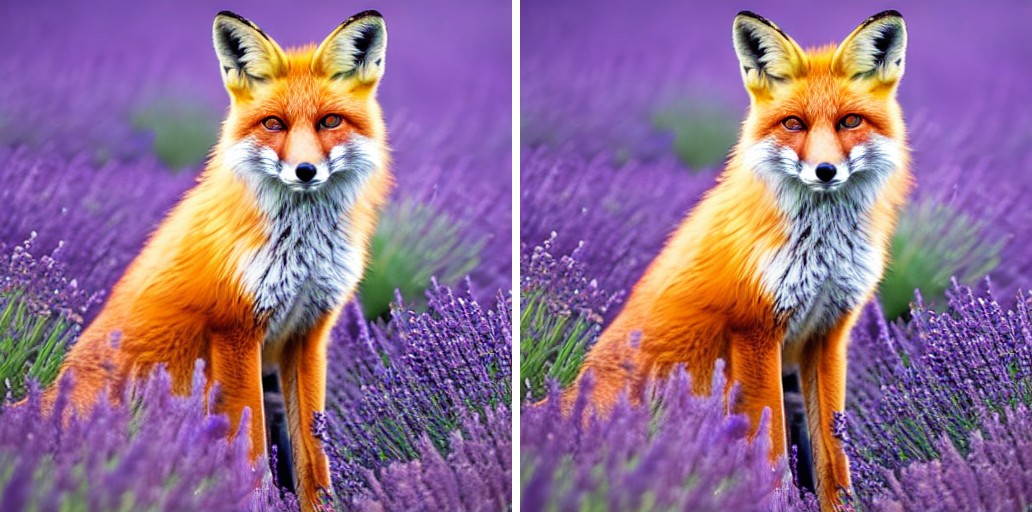
The fox prompt above with the same initial latent, PNDM 50 steps and guidance 7.5
through StableDiffusionTextToImage (left) and diffusers' StableDiffusionPipeline
(right), both fp32:
tokenizer input_ids           identical
text_encoder                  max|d|=9.5e-06
unet noise_pred (t=981)       max|d|=9.5e-07
vae decode                    max|d|=3.5e-06
final image (uint8)           max|d|=1  mean|d|=0.0022  PSNR=74.7 dB  identical_pixels=99.34%
Container only
from zeromodels.models.stable_diffusion import StableDiffusionModel

sd = StableDiffusionModel.from_weights("zeromodels/stable-diffusion-v1-5")
latent = sd.vae.encode(image)  # (1, 512, 512, 3) in [-1, 1] -> (1, 64, 64, 4)
text = sd.text_encoder({"token_ids": ids, "padding_mask": mask})["last_hidden_state"]
Other resolutions
The graphs are built for a fixed size, the weights are not. Rebuild at another size with the constructor overrides (multiples of 64px; SD 1.x was trained at 512px):
model = StableDiffusionTextToImage.from_weights(
    "zeromodels/stable-diffusion-v1-5", unet_sample_size=96, vae_sample_size=768
)
images = model.generate(**tokenizer("a mountain lake at dawn"))  # (1, 768, 768, 3)
Data Format
Both channels_last and channels_first are supported. The models read
keras.config.image_data_format() when they are constructed (there is no
data_format argument), so set it once, before from_weights, and every tensor that
crosses the model boundary follows it:
channels_last (default) |
channels_first |
|
|---|---|---|
latents passed to generate |
(batch, 64, 64, 4) |
(batch, 4, 64, 64) |
AutoencoderKL.encode input / decode output |
(batch, 512, 512, 3) |
(batch, 3, 512, 512) |
UNet sample |
(batch, 64, 64, 4) |
(batch, 4, 64, 64) |
generate itself always hands back (batch, height, width, 3) uint8 images, whatever
the layout, so the PIL step is the same in both. The same hosted model.weights.h5
loads under either layout (conv kernels are (kh, kw, in, out) in both), and the two
runs agree to within 1 uint8 level (99.7% of pixels identical, the rest being the
NCHW / NHWC convolution kernels' rounding).
import keras

keras.config.set_image_data_format("channels_first")

model = StableDiffusionTextToImage.from_weights("zeromodels/stable-diffusion-v1-5")
images = model.generate(
    **tokenizer("a bowl of ramen"), seed=0
)  # still (1, 512, 512, 3)
Note that keras.config.set_image_data_format is global state. Set it once at the top
of a script rather than toggling it between calls, since already-built models keep the
layout they were constructed with.
Memory and speed
The fp32 container is 3.97 GB; a 512px, batch-1, guided run peaks at 6.5 GB of GPU memory (the guided UNet call runs batch 2). On an RTX 4060 laptop the 50-step run takes ~25 s in eager Torch, about 1.5x diffusers' eager time. On JAX the compiled denoiser step measured 2-3x faster than an op-by-op run; TensorFlow uses the same mechanism.
Loading Fine-tuned Weights
The five hosted checkpoints are the supported weights; any repo laid out like them
(zm_config.json declaring StableDiffusionModel, model.weights.h5, tokenizer.json)
loads with from_weights("<org>/<repo>"). The hf: prefix raises for diffusion models:
convert a diffusers-format checkpoint once with
zeromodels/models/stable_diffusion/convert_stable_diffusion_diffusers_to_keras.py
(build_from_diffusers(repo), pip install zeromodels[conversion]) and host the result.