Depth Anything V1
from_weights(...).
Depth Anything estimates depth from a single image, with no camera parameters and no stereo pair. A DINOv2 ViT backbone feeds a DPT-style neck and head. What made V1 work is scale: 1.5 M labeled images train a teacher, which then pseudo-labels 62 M unlabeled ones, so the model generalizes to scenes no depth dataset covers.
The output is relative inverse depth: a bigger value means closer, and the units are arbitrary, so a map is only meaningful within its own image. For real metres or cross-image comparison, use the metric heads in Depth Anything V2, which keeps this architecture unchanged and only retrains it.
Paper: Depth Anything: Unleashing the Power of Large-Scale Unlabeled Data
API
DepthAnythingV1DepthEstimation
DepthAnythingV1DepthEstimation(backbone_dim=384, backbone_depth=12,
                               backbone_num_heads=6, out_indices=None,
                               neck_hidden_sizes=None, fusion_hidden_size=64,
                               reassemble_factors=None,
                               depth_estimation_type="relative", max_depth=1.0,
                               image_size=518, input_tensor=None,
                               name="DepthAnythingV1DepthEstimation")
The DINOv2 backbone, DPT neck, and depth head. This is the class for depth estimation.
Parameters
- backbone_dim (
int, optional, defaults to384): ViT width. Filled in byfrom_weightsfrom the variant config. - backbone_depth (
int, optional, defaults to12): transformer blocks, the main size lever from small to large. - backbone_num_heads (
int, optional, defaults to6): attention heads. - out_indices (
tuple, optional): block indices whose features feed the neck. - neck_hidden_sizes (
tuple, optional): per-scale reassemble widths. - fusion_hidden_size (
int, optional, defaults to64): DPT fusion width. - reassemble_factors (
tuple, optional): per-scale up/down sampling factors. - depth_estimation_type (
str, optional, defaults to"relative"):"relative"ends the head in aReLU;"metric"in asigmoidscaled bymax_depth. All V1 variants are relative. - max_depth (
float, optional, defaults to1.0): output ceiling for metric heads. Unused when relative. - image_size (
intortuple, optional, defaults to518): input resolution the model is built for. - input_tensor (
dict, optional): pre-existing input tensors to build on. - name (
str, optional, defaults to"DepthAnythingV1DepthEstimation"): model name.
Call model(pixel_values, training=False). Returns a tensor of shape
(B, 518, 518, 1) under channels_last: per-pixel depth at the model's resolution.
DepthAnythingV1Model
DepthAnythingV1Model(backbone_dim=384, backbone_depth=12, backbone_num_heads=6,
                     out_indices=None, neck_hidden_sizes=None,
                     fusion_hidden_size=64, reassemble_factors=None,
                     image_size=518, input_tensor=None, name="DepthAnythingV1Model")
The backbone and DPT neck alone, without the head, returning the fused pyramid at quarter
resolution ((B, 296, 296, 64) for a 518 input). Use it as a feature extractor.
The backbone class has no entry on the release tag, so
DepthAnythingV1Model.from_weights("depth_anything_small")raises"No release weights configured for variant": the release assets are exports of the full estimator. Load it overhf:, or read the layer you want offDepthAnythingV1DepthEstimation.
Preprocessing
DepthAnythingV1ImageProcessor
Stretches the image to a square target_size and normalizes with ImageNet statistics.
Parameters
- target_size (
int, optional, defaults to518): square side the image is resized to. Match the model'simage_size. - image_mean / image_std (
tuple, optional): defaults to the ImageNet statistics. - data_format (
str, optional):"channels_last"or"channels_first". Defaults tokeras.config.image_data_format().
processor(image) accepts a path, PIL image, or numpy array and returns a dict with
pixel_values (1, 518, 518, 3).
post_process_depth_estimation
Resamples the prediction back to original_size, given as (height, width), and
squeezes the channel axis. Returns a (H, W) depth tensor.
Model Variants
| Variant id | Backbone | Params | Resolution |
|---|---|---|---|
depth_anything_small |
ViT-S/14 | ~25 M | 518 |
depth_anything_base |
ViT-B/14 | ~97 M | 518 |
depth_anything_large |
ViT-L/14 | ~335 M | 518 |
Basic Usage: Depth Estimation
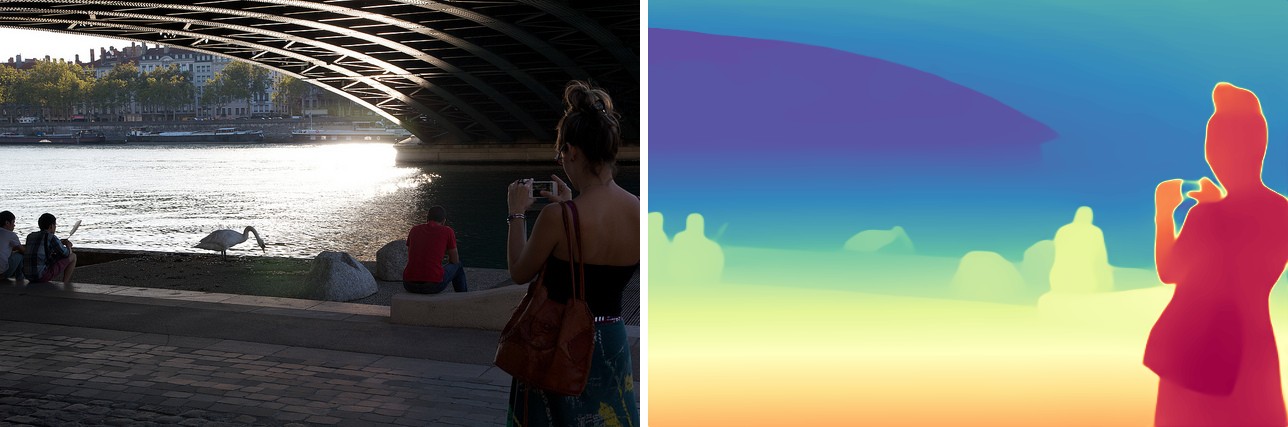
The original beside its predicted depth, coloured with Spectral_r over the map's own min
and max. The photographer reads closest (red), the far bank and sky farthest (blue), and
the swan and seated figures separate cleanly from the water behind them.
import keras
import matplotlib
import numpy as np
import torch
from PIL import Image
from kerasformers.models.depth_anything_v1 import (
    DepthAnythingV1DepthEstimation, DepthAnythingV1ImageProcessor,
)

model = DepthAnythingV1DepthEstimation.from_weights("depth_anything_large")
processor = DepthAnythingV1ImageProcessor()

image = Image.open("assets/data/coco_waterfront.jpg").convert("RGB")

with torch.no_grad():
    output = model(processor(image)["pixel_values"], training=False)
# output: (1, 518, 518, 1)

depth = processor.post_process_depth_estimation(
    output, original_size=(image.height, image.width)
)
depth = np.squeeze(np.asarray(keras.ops.convert_to_numpy(depth)))
print(depth.shape, round(float(depth.min()), 2), round(float(depth.max()), 2))

# Visualize: per-image min-max normalize, then Spectral_r.
lo, hi = float(depth.min()), float(depth.max())
rgb = matplotlib.colormaps["Spectral_r"]((depth - lo) / (hi - lo + 1e-8))[..., :3]
Image.fromarray((rgb * 255).astype("uint8")).save("assets/depth.jpg")
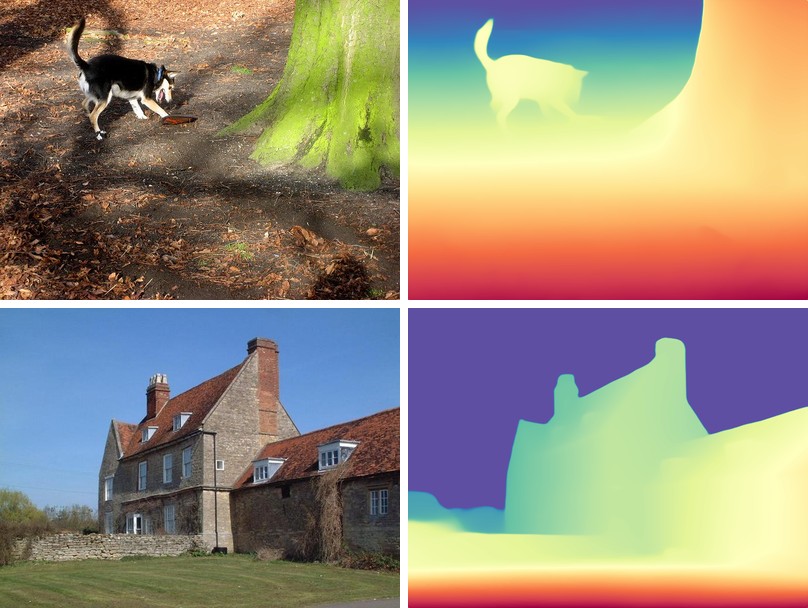
The value range carries no unit: on these five scenes V1 produced maxima of 319, 268, 322, 379 and 213, which track scene content, not distance. Do not compare them across images.
Use
torch.no_grad()on the torch backend. The large variant at 518x518 is a ViT-L, and autograd will hold every intermediate for a forward pass you never differentiate.
Batch Processing Multiple Images
Every image is stretched to the same 518 square, so a batch is just stacked
pixel_values. Post-process each map on its own, since the originals differ in size:
import keras
import numpy as np
import torch
from PIL import Image
from kerasformers.models.depth_anything_v1 import (
    DepthAnythingV1DepthEstimation, DepthAnythingV1ImageProcessor,
)

model = DepthAnythingV1DepthEstimation.from_weights("depth_anything_large")
processor = DepthAnythingV1ImageProcessor()

paths = ["assets/data/coco_dog_woods.jpg", "assets/data/ade_val_1.jpg"]
images = [Image.open(p).convert("RGB") for p in paths]

pixel_values = np.concatenate(
    [np.asarray(keras.ops.convert_to_numpy(processor(p)["pixel_values"])) for p in paths],
    axis=0,
)   # (2, 518, 518, 3)
with torch.no_grad():
    output = model(pixel_values, training=False)   # (2, 518, 518, 1)

for path, image, logits in zip(paths, images, output):
    depth = processor.post_process_depth_estimation(
        logits[None], original_size=(image.height, image.width)
    )
    depth = np.squeeze(np.asarray(keras.ops.convert_to_numpy(depth)))
    print(f"{path}: {depth.shape}  [{depth.min():.2f}, {depth.max():.2f}]")
assets/data/coco_dog_woods.jpg: (480, 640)  [1.43, 213.33]
assets/data/ade_val_1.jpg: (480, 640)  [0.00, 267.59]
Feature Extraction
DepthAnythingV1Model stops after the DPT neck, for attaching your own head:
from kerasformers.models.depth_anything_v1 import DepthAnythingV1Model

backbone = DepthAnythingV1Model.from_weights("hf:LiheYoung/depth-anything-small-hf")
features = backbone(processor(image)["pixel_values"], training=False)
# features: (1, 296, 296, 64)
Input Resolution
The default is 518x518, the DINOv2 pretraining size. Other sizes work as long as both sides are multiples of the patch size, 14: the checkpoint's position embeddings are bilinearly interpolated to the requested patch grid at load time, so the pretrained weights stay valid.
# 392 / 14 = 28 x 28 patches
model = DepthAnythingV1DepthEstimation.from_weights(
    "depth_anything_small", image_size=392
)

# Non-square, 28 x 56 patches
model = DepthAnythingV1DepthEstimation.from_weights(
    "depth_anything_small", image_size=(392, 784)
)
Pass the matching target_size to the processor. Larger inputs recover more fine
structure at quadratic attention cost.
Resizing works on the release path, not
hf:. The interpolation lives inViTAddPositionEmbs.load_own_variables, which the Keras.weights.h5reader calls; thehf:converter assigns the checkpoint tensor straight into the variable and so requires an exact match. Asking for a non-default size overhf:fails withUnsupported layer type or shape mismatch for backbone_pos_embed/pos_embed.
Data Format
Both the model and the processor support channels_last and channels_first.
| How it picks the format | |
|---|---|
| Processors | A data_format kwarg, per instance. None (the default) resolves to keras.config.image_data_format(). |
| Models | Read keras.config.image_data_format() when they are constructed. There is no data_format argument. |
import keras

keras.config.set_image_data_format("channels_first")

model = DepthAnythingV1DepthEstimation.from_weights("depth_anything_large")
processor = DepthAnythingV1ImageProcessor()
# model input: (B, 3, 518, 518), output: (B, 1, 518, 518)
post_process_depth_estimation also takes data_format, and always returns (H, W).
Loading Fine-tuned and Community Weights
Any Hugging Face repo whose model_type is "depth_anything" loads with the hf:
prefix.
from kerasformers.models.depth_anything_v1 import DepthAnythingV1DepthEstimation

model = DepthAnythingV1DepthEstimation.from_weights(
    "hf:LiheYoung/depth-anything-large-hf"
)
model = DepthAnythingV1DepthEstimation.from_weights("hf:<user>/depth-anything-finetuned")

# Architecture only, randomly initialized
model = DepthAnythingV1DepthEstimation.from_weights(
    "depth_anything_small", load_weights=False
)
See also Depth Anything V2, the same architecture retrained for sharper boundaries and metric output.