RT-DETRv2
from_weights(...).
RT-DETRv2 keeps RT-DETR's hybrid encoder and deformable decoder and improves the sampling. Where v1 uses a fixed grid of deformable sampling points, v2 merges the per-level offsets into one dimension and scales them by a learned n_points_scale buffer, so the model adapts its sampling radius per feature level. The rest is a refined training recipe, the paper's "bag of freebies".
The API surface is identical to v1, and so is the inference pipeline. The weights are not interchangeable.
Paper: RT-DETRv2: Improved Baseline with Bag-of-Freebies for Real-Time Detection Transformers
API
RTDETRV2Detect
RTDETRV2Detect(backbone_hidden_sizes=(256, 512, 1024, 2048),
               backbone_block_repeats=(3, 4, 6, 3), backbone_embedding_size=64,
               backbone_layer_type="bottleneck", encoder_in_channels=(512, 1024, 2048),
               encoder_hidden_dim=256, encoder_num_layers=1, encoder_ffn_dim=1024,
               encoder_num_heads=8, encode_proj_layers=(2,),
               encoder_activation_function="gelu", activation_function="silu",
               hidden_expansion=1.0, hidden_dim=256, decoder_num_layers=6,
               decoder_ffn_dim=1024, decoder_num_heads=8, decoder_n_points=4,
               decoder_activation_function="relu", num_feature_levels=3,
               feat_strides=(8, 16, 32), num_queries=300, num_classes=80,
               image_size=640, input_tensor=None, name="RTDETRV2Detect")
The detector: ResNet-vd backbone, hybrid encoder, and the selective multi-scale deformable decoder. This is the class for object detection.
Parameters match RT-DETR exactly, since v2 changes the deformable sampling internals rather than the configuration surface. The ones worth knowing:
- num_classes (
int, optional, defaults to80): COCO's 80 categories. No background class. - num_queries (
int, optional, defaults to300): decoder queries, the ceiling on detections per image. - image_size (
int, optional, defaults to640): input resolution the model is built for. Must be a multiple of 32, see Input Resolution. - backbone_block_repeats (
tuple, optional, defaults to(3, 4, 6, 3)): ResNet stage depths.(2, 2, 2, 2)for r18,(3, 4, 23, 3)for r101. - backbone_layer_type (
str, optional, defaults to"bottleneck"):"basic"for r18 and r34,"bottleneck"for r50 and r101. - decoder_n_points (
int, optional, defaults to4): deformable sampling points per level, scaled per level by the learnedn_points_scalein v2. - feat_strides (
tuple, optional, defaults to(8, 16, 32)): strides of the three feature levels. - input_tensor (
dict, optional): pre-existing input tensors to build on. - name (
str, optional, defaults to"RTDETRV2Detect"): model name.
Call model(pixel_values, training=False). Returns a dict:
- logits (
(B, num_queries, num_classes)): per-query class logits, sigmoid-activated downstream. - pred_boxes (
(B, num_queries, 4)): normalized(cx, cy, w, h)in[0, 1].
RTDetrV2Model
The backbone and hybrid encoder without detection heads. Parameters match
RTDETRV2Detect, minus num_classes, with name defaulting to
"RTDetrV2Model".
Preprocessing
RTDETRV2ImageProcessor
RTDETRV2ImageProcessor(size=None, resample="bilinear", do_rescale=True,
                       rescale_factor=1/255, do_normalize=False, image_mean=None,
                       image_std=None, return_tensor=True, data_format=None)
Resizes to a fixed square and rescales to [0, 1]. Identical to v1's processor.
Parameters
- size (
dict, optional, defaults to{"height": 640, "width": 640}): target size. - resample (
str, optional, defaults to"bilinear"): resize interpolation. - do_rescale (
bool, optional, defaults toTrue): scale pixels to[0, 1]. - rescale_factor (
float, optional, defaults to1/255): the rescaling factor. - do_normalize (
bool, optional, defaults toFalse): see the note below. - image_mean / image_std (
tuple, optional): normalization statistics, unused whiledo_normalizeisFalse. - return_tensor (
bool, optional, defaults toTrue): return backend tensors rather than numpy. - data_format (
str, optional):"channels_last"or"channels_first". Defaults tokeras.config.image_data_format().
do_normalizedefaults toFalsehere, and that is correct. Like v1, RT-DETRv2 was trained on rescaled[0, 1]input with no ImageNet normalization, matchingPekingU/rtdetr_v2_*upstream. DETR and RF-DETR default toTrue. Turning it on here degrades detection quality.
Call processor(image) with a path, a PIL image, an array, or a list of any
mix of those. Returns a dict:
- pixel_values (
(B, H, W, 3)): preprocessed images, in the configured data format.
post_process_object_detection
processor.post_process_object_detection(outputs, threshold=0.5,
                                        num_top_queries=300, target_sizes=None,
                                        label_names=None)
Applies sigmoid, takes the top scoring query/class pairs, converts boxes to pixel
(x0, y0, x1, y1), and filters by threshold. Omitting target_sizes leaves boxes
normalized.
Returns a list with one dict per image, holding scores, labels,
label_names, and boxes.
Model Variants
| Variant id | Backbone | Params | HF original |
|---|---|---|---|
rtdetr-v2-r18vd |
ResNet-18-vd | 20 M | PekingU/rtdetr_v2_r18vd |
rtdetr-v2-r34vd |
ResNet-34-vd | 31 M | PekingU/rtdetr_v2_r34vd |
rtdetr-v2-r50vd |
ResNet-50-vd | 43 M | PekingU/rtdetr_v2_r50vd |
rtdetr-v2-r101vd |
ResNet-101-vd | 76 M | PekingU/rtdetr_v2_r101vd |
All are 640×640 COCO models. v2 has no Objects365-pretrained variants, unlike v1.
Basic Usage: Object Detection
from PIL import Image
from kerasformers.models.rt_detr_v2 import RTDETRV2Detect, RTDETRV2ImageProcessor

model = RTDETRV2Detect.from_weights("rtdetr-v2-r18vd")
processor = RTDETRV2ImageProcessor()

image = Image.open("assets/data/coco_surfer.jpg").convert("RGB")
inputs = processor(image)

output = model(inputs["pixel_values"], training=False)
# output["logits"]:     (1, 300, 80)
# output["pred_boxes"]: (1, 300, 4)

results = processor.post_process_object_detection(
    output, threshold=0.5, target_sizes=[(image.height, image.width)]
)[0]

# Queries come back in the model's own order, so sort by score for readability.
detections = sorted(
    zip(results["scores"], results["label_names"], results["boxes"]),
    key=lambda d: -float(d[0]),
)
for score, name, box in detections:
    print(f"{name:14s} {float(score):.3f}  {[round(float(v)) for v in box]}")
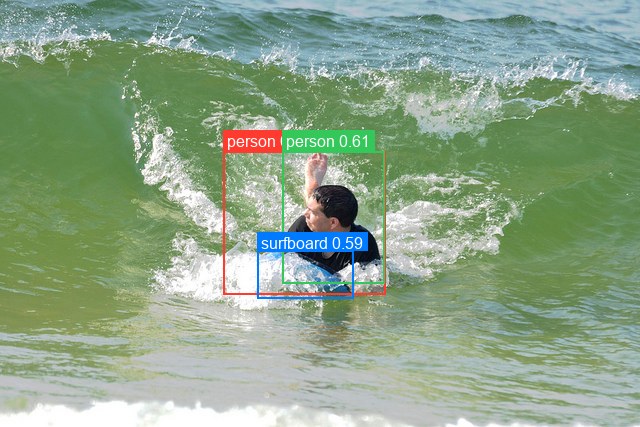
person         0.676  [223, 151, 385, 294]
person         0.606  [282, 151, 384, 283]
surfboard      0.588  [257, 250, 353, 298]
Scores here sit lower than on a clean studio shot because the subject is small against
a busy background. Lowering threshold surfaces more, at the cost of duplicates.
Batch Processing Multiple Images
Pass a list of images and one target_sizes entry per image:
from PIL import Image
from kerasformers.models.rt_detr_v2 import RTDETRV2Detect, RTDETRV2ImageProcessor

model = RTDETRV2Detect.from_weights("rtdetr-v2-r18vd")
processor = RTDETRV2ImageProcessor()

paths = ["assets/data/coco_woman_phone.jpg", "assets/data/coco_waterfront.jpg"]
images = [Image.open(p).convert("RGB") for p in paths]

inputs = processor(paths)                                  # (2, 640, 640, 3)
output = model(inputs["pixel_values"], training=False)

results = processor.post_process_object_detection(
    output, threshold=0.5,
    target_sizes=[(im.height, im.width) for im in images],
)

for path, result in zip(paths, results):
    print(f"\n{path}")
    detections = sorted(
        zip(result["scores"], result["label_names"], result["boxes"]),
        key=lambda d: -float(d[0]),
    )
    for score, name, box in detections:
        print(f"  {name:12s} {float(score):.3f}  {[round(float(v)) for v in box]}")
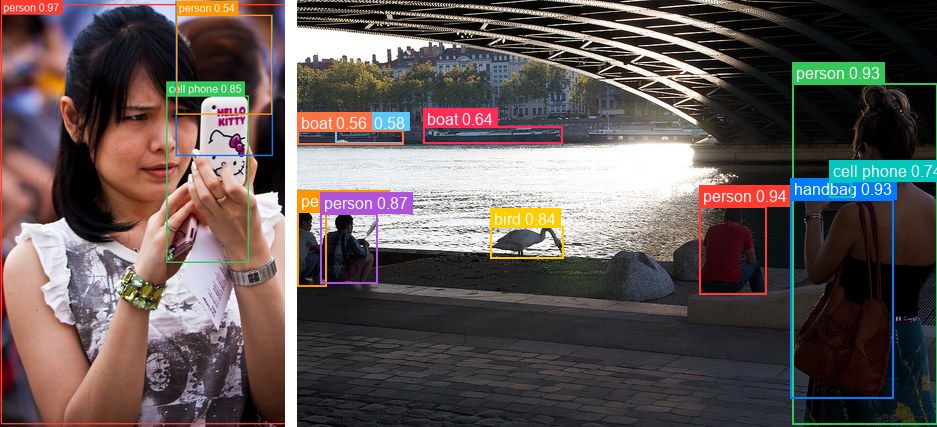
assets/data/coco_woman_phone.jpg
  person       0.969  [1, 6, 428, 635]
  cell phone   0.849  [249, 143, 372, 393]
  person       0.669  [263, 22, 408, 233]
  person       0.539  [264, 22, 407, 171]

assets/data/coco_waterfront.jpg
  person       0.938  [402, 206, 469, 294]
  person       0.931  [495, 83, 640, 424]
  handbag      0.929  [493, 199, 596, 398]
  person       0.884  [0, 211, 29, 286]
  person       0.871  [23, 213, 80, 283]
  bird         0.839  [193, 226, 266, 258]
  cell phone   0.738  [532, 181, 554, 197]
  boat         0.639  [126, 126, 265, 143]
  boat         0.579  [38, 130, 106, 143]
  boat         0.562  [0, 130, 106, 144]
Every image is resized to the same square, so stacking is always safe. Batch results are identical to running the images one at a time.
Input Resolution
RT-DETRv2 is Functional, so the input shape is fixed when the model is constructed. To run at another resolution, build at that size and match the processor:
model = RTDETRV2Detect.from_weights("rtdetr-v2-r18vd", image_size=512)
processor = RTDETRV2ImageProcessor(size={"height": 512, "width": 512})
The side must be a multiple of 32, for the same reason as v1: the encoder fuses an upsampled stride-32 map with the stride-16 map, and at 600 they come out 37 and 38 wide.
Pretrained weights load at any valid size, since the position encodings are computed sine functions rather than a learned grid:
320:  laptop 0.780, mouse 0.748, tv 0.748, keyboard 0.745
480:  laptop 0.936, keyboard 0.933, tv 0.920, mouse 0.906
512:  keyboard 0.951, laptop 0.943, tv 0.926, mouse 0.918
640:  laptop 0.965, keyboard 0.959, mouse 0.918, tv 0.914   <- native
800:  tv 0.913, keyboard 0.909, mouse 0.905, laptop 0.899
480 to 800 is the comfortable band. v2 holds up slightly better than v1 at 320, still finding all four objects where v1 loses the laptop, though confidence drops sharply.
Custom Class Names
A model fine-tuned on your own dataset predicts your class indices, not COCO's. Pass
the names so label_names reads correctly:
MY_CLASSES = ["cat", "dog", "bird"]

results = processor.post_process_object_detection(
    output, threshold=0.5, target_sizes=[(image.height, image.width)],
    label_names=MY_CLASSES,
)
Without it the post-processor falls back to COCO's 80 names, silently mislabeling a
custom model. The integer labels are unaffected.
Data Format
Both the models and the processors support channels_last and channels_first.
Neither is hard-coded to a layout, so the whole pipeline runs either way.
They pick the format differently, which is the one thing to keep straight:
| How it picks the format | |
|---|---|
| Processors | A data_format kwarg, per instance. None (the default) resolves to keras.config.image_data_format(). |
| Models | Read keras.config.image_data_format() when they are constructed. There is no data_format argument. |
Overriding the processor only
RTDETRV2ImageProcessor(data_format="channels_last")("photo.jpg")
# {"pixel_values": (1, 640, 640, 3)}

RTDETRV2ImageProcessor(data_format="channels_first")("photo.jpg")
# {"pixel_values": (1, 3, 640, 640)}
Switching the whole pipeline
Set the global format before constructing the model, and both sides agree:
import keras

keras.config.set_image_data_format("channels_first")

model = RTDETRV2Detect.from_weights("rtdetr-v2-r18vd")
processor = RTDETRV2ImageProcessor()
Detections are the same under either layout. Only the tensor shape changes. Set it once at the top of a script, since already-built models keep the layout they were constructed with.
The post-processor is not format-sensitive: it emits xyxy pixel boxes and class
indices, which have no channel axis, so it takes no data_format kwarg.
Loading Fine-tuned and Community Weights
Any Hugging Face repo whose model_type is "rt_detr_v2" loads directly with the
hf: prefix.
from kerasformers.models.rt_detr_v2 import RTDETRV2Detect

# Upstream release
model = RTDETRV2Detect.from_weights("hf:PekingU/rtdetr_v2_r18vd")

# Somebody's fine-tune
model = RTDETRV2Detect.from_weights("hf:<user>/rtdetrv2-finetuned-on-my-data")

# Architecture only, randomly initialized
model = RTDETRV2Detect.from_weights("rtdetr-v2-r18vd", load_weights=False)
No shape arguments are needed. The architecture is read from the repo's config.json
and mapped onto the constructor. Both model classes accept hf:, as does
RTDETRV2ImageProcessor:
Note that v1 and v2 weights are not interchangeable despite the shared configuration surface: the deformable sampling differs, so load v2 checkpoints into v2 classes only.