DINOv2
from_weights(...).
DINOv2 keeps DINO's self-supervised recipe and scales it: a curated 142 M-image
dataset, a larger teacher, and a training objective (iBOT plus DINO) that supervises
individual patches, not just the image-level [CLS] token. The result is dense
features good enough to use raw: run a linear probe on the patch tokens and you get
competitive depth, segmentation, and correspondence, with the backbone frozen.
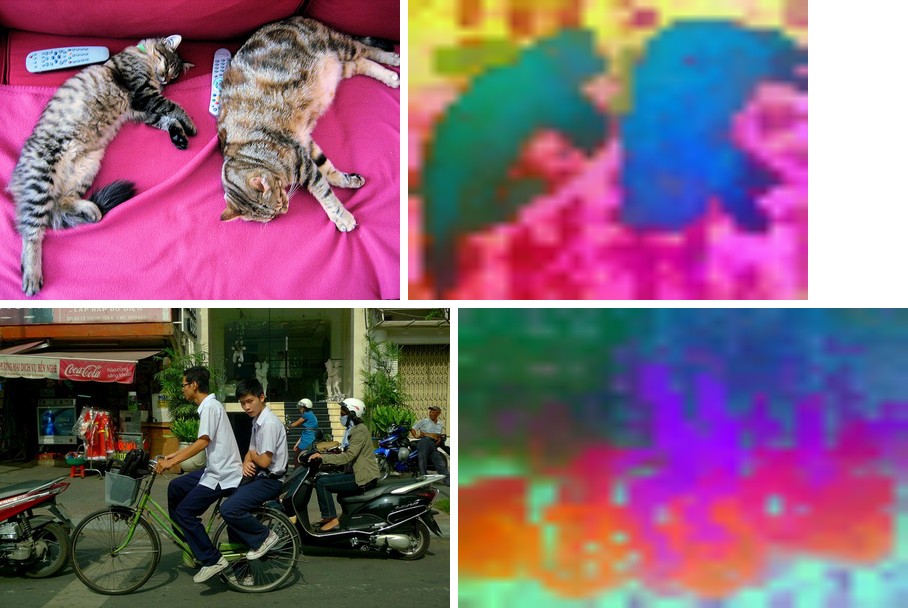
Like DINO these are backbones, not task models. The figures below PCA the patch features to three RGB components, the visualization the DINOv2 paper made famous: the object pops out of the background and its parts take on consistent colours.
Paper: DINOv2: Learning Robust Visual Features without Supervision
API
DinoV2Model
DinoV2Model(as_backbone=False, patch_size=14, embed_dim=384, depth=12,
            num_heads=6, mlp_ratio=4.0, qkv_bias=True, qk_norm=False,
            drop_rate=0.0, attn_drop_rate=0.0, layer_scale_init=1.0,
            include_normalization=True, normalization_mode="imagenet",
            image_size=224, input_tensor=None, name="DinoV2Model")
The DINOv2 Vision Transformer. This is the backbone class.
Parameters
- as_backbone (
bool, optional, defaults toFalse): return a list of intermediate feature maps (embedding + one per block) instead of the final token sequence. - patch_size (
int, optional, defaults to14): pixels per patch. DINOv2 uses 14, so a 224 input is a 16x16 grid. - embed_dim / depth / num_heads (
int, optional): transformer width, blocks, and heads. Filled in byfrom_weightsfrom the variant config. - layer_scale_init (
float, optional, defaults to1.0): initial LayerScale value, DINOv2's per-branch learned scaling. - include_normalization (
bool, optional, defaults toTrue): normalize inside the model, so you feed raw[0, 255]pixels. - normalization_mode (
str, optional, defaults to"imagenet"): which mean/std to use when normalizing. - image_size (
intortuple, optional, defaults to224): input resolution the model is built for. - input_tensor (
dict, optional): pre-existing input tensors to build on. - name (
str, optional, defaults to"DinoV2Model"): model name.
Call model(pixel_values, training=False) with raw [0, 255] pixels. Returns the
token sequence (B, 1 + num_patches, embed_dim), the leading token being [CLS]. With
as_backbone=True, a list of depth + 1 such tensors.
Preprocessing
There is no separate image processor. DinoV2Model carries include_normalization=True,
so feed raw [0, 255] pixels resized to the model's image_size; normalization
happens inside. Pass include_normalization=False if you have already normalized.
Model Variants
| Variant id | Backbone | Patch | Params |
|---|---|---|---|
dinov2_vits14 |
ViT-S | 14 | ~21 M |
dinov2_vitb14 |
ViT-B | 14 | ~86 M |
dinov2_vitl14 |
ViT-L | 14 | ~300 M |
Basic Usage: Feature Extraction
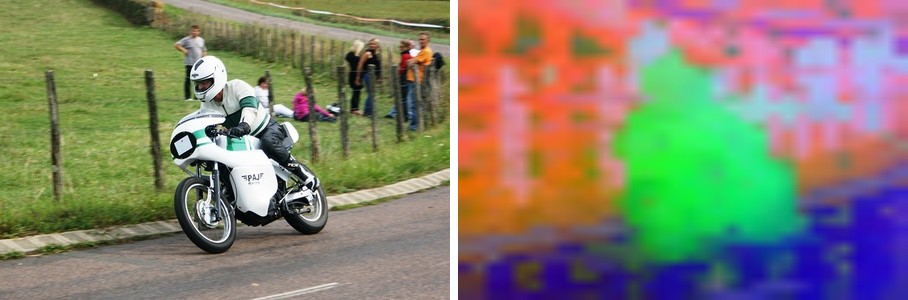
Run the backbone, drop the [CLS] token, and PCA the patch features to three components.
The rider and machine take one colour, the grass and road two others, all recovered with
no labels.
import keras
import numpy as np
import torch
from PIL import Image
from kerasformers.models.dino_v2 import DinoV2Model

size, patch = 448, 14
model = DinoV2Model.from_weights("dinov2_vits14", image_size=size)

image = Image.open("assets/data/coco_motorcycle.jpg").convert("RGB")
x = np.asarray(image.resize((size, size)))[None].astype("float32")   # raw [0, 255]

with torch.no_grad():
    tokens = model(x, training=False)
tokens = np.asarray(keras.ops.convert_to_numpy(tokens))[0]
print(tokens.shape)   # (1 + num_patches, embed_dim)

# PCA the patch tokens (drop the CLS token) to RGB.
grid = size // patch
patches = tokens[1:].reshape(grid * grid, -1).astype("float64")
patches -= patches.mean(0, keepdims=True)
proj = patches @ np.linalg.svd(patches, full_matrices=False)[2][:3].T
proj = proj.reshape(grid, grid, 3)
lo, hi = proj.min((0, 1)), proj.max((0, 1))
proj = (proj - lo) / (hi - lo + 1e-8)

vis = Image.fromarray((proj * 255).astype("uint8")).resize(image.size, Image.BILINEAR)
vis.save("assets/dinov2_pca.jpg")
1025 = 1 + 32 * 32: one [CLS] token plus a 32x32 patch grid at 448/14. DINOv2's whole
selling point is that those patch features are good enough to use directly, so a linear
layer on tokens[1:] is a real segmentation or depth head.
Use
torch.no_grad()on the torch backend. These are pure forward passes; autograd would retain every intermediate for nothing.
Batch Processing Multiple Images
Stack images that share a size into one batch:
import keras
import numpy as np
import torch
from PIL import Image
from kerasformers.models.dino_v2 import DinoV2Model

size = 448
model = DinoV2Model.from_weights("dinov2_vits14", image_size=size)

paths = ["assets/data/coco_cats.jpg", "assets/data/coco_bicycles.jpg"]
batch = np.stack(
    [np.asarray(Image.open(p).convert("RGB").resize((size, size)), "float32")
     for p in paths]
)   # (2, 448, 448, 3)

with torch.no_grad():
    tokens = model(batch, training=False)
print(np.asarray(keras.ops.convert_to_numpy(tokens)).shape)   # (2, 1025, 384)
The two cats separate from the blanket as one region each; even the cluttered street resolves the riders, bikes, and shopfront into distinct patches.
Intermediate Features
as_backbone=True returns the embedding plus one feature map per block, for feeding a
DPT-style neck or a segmentation head, which is exactly how DINOv2 is used for dense
prediction:
model = DinoV2Model.from_weights("dinov2_vits14", as_backbone=True, image_size=size)
features = model(x, training=False)   # x from above, at 448
print(len(features), features[-1].shape)   # 13  (1, 1025, 384)
Data Format
The ViT works in token space, so it is layout-agnostic: it returns (B, tokens, dim)
regardless of keras.config.image_data_format().
Input Resolution
Any size that is a multiple of the patch size, 14, works: the learned position
embeddings are bilinearly interpolated to the requested patch grid at load time, so the
pretrained weights stay valid. The figures here use image_size=448 for a finer map than
the default 224 gives.
Interpolation runs in the Keras
.weights.h5reader, which the release path uses. Thehf:path assigns the checkpoint tensor directly and so requires an exact match; ask for a non-default size overhf:and it raises a position-embedding shape mismatch.
Loading Fine-tuned and Community Weights
Any Hugging Face repo whose model_type is "dinov2" loads with the hf: prefix.
from kerasformers.models.dino_v2 import DinoV2Model

model = DinoV2Model.from_weights("hf:facebook/dinov2-small")
model = DinoV2Model.from_weights("hf:<user>/dinov2-finetuned")

# Architecture only, randomly initialized
model = DinoV2Model.from_weights("dinov2_vits14", load_weights=False)
See also DINO, the original, and DINOv3, which adds register tokens and rotary position embeddings.