RF-DETR
from_weights(...).
RF-DETR is Roboflow's real-time DETR, built on a windowed DINOv2 backbone with a lightweight deformable decoder. The configurations came out of a neural architecture search, which is why the variants differ along several axes at once (resolution, patch size, window count, decoder depth) rather than just scaling width.
Two things distinguish it from the RT-DETR family: it uses a pretrained ViT backbone rather than a CNN, and each variant trains at its own resolution rather than a shared 640. That second point matters in practice, see Input Resolution.
Paper: RF-DETR: Neural Architecture Search for Real-Time Detection Transformers
API
RFDETRDetect
RFDETRDetect(hidden_dim=256, backbone_hidden_size=384, backbone_num_heads=6,
             backbone_num_layers=12, backbone_mlp_ratio=4,
             backbone_use_swiglu=False, num_register_tokens=0,
             out_feature_indexes=None, patch_size=14, num_windows=4,
             positional_encoding_size=37, resolution=560, dec_layers=3,
             sa_nheads=8, ca_nheads=16, dec_n_points=2, num_queries=300,
             num_classes=91, two_stage=True, bbox_reparam=True,
             lite_refpoint_refine=True, group_detr=13, dim_feedforward=2048,
             image_size=None, input_tensor=None, name="RFDETRDetect")
The detector: DINOv2 backbone, deformable decoder, and class and box heads. This is the class for object detection.
Most parameters are architecture dimensions that from_weights fills in from the
variant config. The ones worth knowing:
- num_classes (
int, optional, defaults to91): COCO's 91-index label space. - num_queries (
int, optional, defaults to300): decoder queries. Also a lower bound on usable resolution, see Input Resolution. - resolution (
int, optional, defaults to560): the variant's native training resolution. - image_size (
intortuple, optional): input shape the model is built for. Defaults toresolution. - patch_size (
int, optional, defaults to14): DINOv2 patch size.16for every variant except base. - num_windows (
int, optional, defaults to4): windows per spatial dimension in the windowed-attention blocks.2for every variant except base. - positional_encoding_size (
int, optional, defaults to37): side of the learned position-encoding grid, interpolated to the actual patch grid at build time. - dec_layers (
int, optional, defaults to3): decoder depth, 2 to 4 depending on variant. - two_stage (
bool, optional, defaults toTrue): initialize queries from encoder proposals. - bbox_reparam (
bool, optional, defaults toTrue): reparameterized box regression. - group_detr (
int, optional, defaults to13): query groups used during training; inference uses one. - input_tensor (
dict, optional): pre-existing input tensors to build on. - name (
str, optional, defaults to"RFDETRDetect"): model name.
Call model(pixel_values, training=False). Returns a dict:
- logits (
(B, num_queries, num_classes)): per-query class logits, sigmoid-activated downstream. - pred_boxes (
(B, num_queries, 4)): normalized(cx, cy, w, h)in[0, 1].
RFDETRInstanceSegment
RFDETRInstanceSegment(..., patch_size=12, num_windows=2,
                      positional_encoding_size=32, resolution=384, dec_layers=4,
                      num_queries=100, mask_downsample_ratio=4,
                      intermediate_size=1024, seg_activation="gelu",
                      name="RFDETRInstanceSegment")
Adds a mask head to the same backbone and decoder, predicting one mask per query. Parameters match RFDETRDetect plus:
- mask_downsample_ratio (
int, optional, defaults to4): masks are emitted atresolution // ratio. - intermediate_size (
int, optional, defaults to1024): width of the mask head. - seg_activation (
str, optional, defaults to"gelu"): mask-head activation.
Returns a dict with logits, pred_boxes, and pred_masks
(B, num_queries, H // ratio, W // ratio) of mask logits.
RFDetrModel
The backbone and decoder without heads. Parameters match
RFDETRDetect, minus num_classes.
Preprocessing
RFDETRImageProcessor
RFDETRImageProcessor(size=None, resample="bilinear", do_rescale=True,
                     rescale_factor=1/255, do_normalize=True, image_mean=None,
                     image_std=None, return_tensor=True, data_format=None,
                     variant=None)
Resizes to a fixed square, rescales to [0, 1], and normalizes with ImageNet
statistics.
Prefer
RFDETRImageProcessor.from_weights(variant). Every variant trains at its own resolution, and the bare constructor gives rfdetr-base's 560, which is wrong for every other variant.from_weightsreads the right size from the model config.
Parameters
- variant (
str, optional): release variant whose resolution to adopt, for example"rfdetr-nano". Ignored whensizeis given. - size (
dict, optional): target size, overridingvariant. Defaults to the variant's resolution, or{"height": 560, "width": 560}when neither is given. - resample (
str, optional, defaults to"bilinear"): resize interpolation. - do_rescale (
bool, optional, defaults toTrue): scale pixels to[0, 1]. - rescale_factor (
float, optional, defaults to1/255): the rescaling factor. - do_normalize (
bool, optional, defaults toTrue): apply ImageNet normalization. RF-DETR does normalize, unlike RT-DETR and D-FINE. - image_mean (
tuple, optional, defaults to(0.485, 0.456, 0.406)): per-channel mean. - image_std (
tuple, optional, defaults to(0.229, 0.224, 0.225)): per-channel std. - return_tensor (
bool, optional, defaults toTrue): return backend tensors rather than numpy. - data_format (
str, optional):"channels_last"or"channels_first". Defaults tokeras.config.image_data_format().
Call processor(image) with a path, a PIL image, an array, or a list of any
mix of those. Returns a dict:
- pixel_values (
(B, H, W, 3)): preprocessed images, in the configured data format.
The same processor serves detection and segmentation: preprocessing is identical, only the target size and the post-processor differ.
post_process_object_detection
processor.post_process_object_detection(outputs, threshold=0.5,
                                        num_top_queries=300, target_sizes=None,
                                        label_names=None)
Applies sigmoid, takes the top scoring query/class pairs, converts boxes to pixel
(x0, y0, x1, y1), and filters by threshold. Returns a list with one dict per
image holding scores, labels, label_names, and boxes.
post_process_instance_segmentation
processor.post_process_instance_segmentation(outputs, threshold=0.5,
                                             num_top_queries=300,
                                             target_sizes=None,
                                             label_names=None,
                                             mask_threshold=0.5)
As above, plus masks: boolean masks upsampled to each target_sizes entry and
thresholded at mask_threshold.
Model Variants
Detection, for RFDETRDetect.from_weights:
| Variant id | Resolution | Patch | Windows | Decoder layers |
|---|---|---|---|---|
rfdetr-nano |
384 | 16 | 2 | 2 |
rfdetr-small |
512 | 16 | 2 | 3 |
rfdetr-medium |
576 | 16 | 2 | 4 |
rfdetr-base |
560 | 14 | 4 | 3 |
rfdetr-large |
704 | 16 | 2 | 4 |
Instance segmentation, for RFDETRInstanceSegment.from_weights, sourced from the
Roboflow/rf-detr-seg-* repos:
| Variant id | Resolution | Queries | Decoder layers |
|---|---|---|---|
rfdetr-seg-preview |
432 | 200 | 4 |
rfdetr-seg-nano |
312 | 100 | 4 |
rfdetr-seg-small |
384 | 100 | 4 |
rfdetr-seg-medium |
432 | 200 | 5 |
rfdetr-seg-large |
504 | 300 | 5 |
rfdetr-seg-xlarge |
624 | 300 | 6 |
rfdetr-seg-xxlarge |
768 | 300 | 6 |
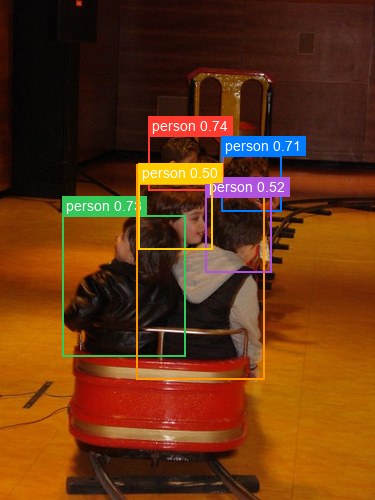
Basic Usage: Object Detection
from PIL import Image
from kerasformers.models.rf_detr import RFDETRDetect, RFDETRImageProcessor

model = RFDETRDetect.from_weights("rfdetr-nano")
processor = RFDETRImageProcessor.from_weights("rfdetr-nano")   # resolves 384

image = Image.open("assets/data/coco_fairground_ride.jpg").convert("RGB")
inputs = processor(image)

output = model(inputs["pixel_values"], training=False)
# output["logits"]:     (1, 300, 91)
# output["pred_boxes"]: (1, 300, 4)

results = processor.post_process_object_detection(
    output, threshold=0.5, target_sizes=[(image.height, image.width)]
)[0]

# Queries come back in the model's own order, so sort by score for readability.
detections = sorted(
    zip(results["scores"], results["label_names"], results["boxes"]),
    key=lambda d: -float(d[0]),
)
for score, name, box in detections:
    print(f"{name:14s} {float(score):.3f}  {[round(float(v)) for v in box]}")
person         0.745  [148, 135, 223, 190]
person         0.726  [62, 215, 185, 356]
person         0.705  [221, 155, 281, 211]
person         0.685  [136, 183, 264, 379]
person         0.522  [205, 196, 271, 272]
person         0.504  [138, 182, 212, 249]
Using from_weights on both the model and the processor is what keeps their
resolutions in agreement. A bare RFDETRImageProcessor() emits 560 while
RFDETRDetect.from_weights("rfdetr-nano") builds at 384, and the mismatch raises.
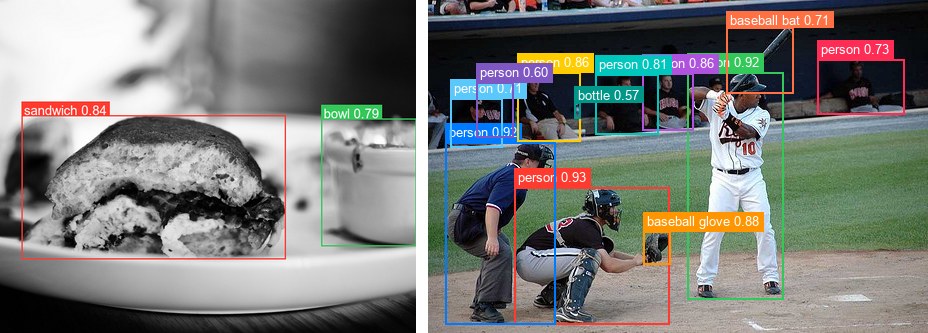
Batch Processing Multiple Images
Pass a list of images and one target_sizes entry per image:
from PIL import Image
from kerasformers.models.rf_detr import RFDETRDetect, RFDETRImageProcessor

model = RFDETRDetect.from_weights("rfdetr-nano")
processor = RFDETRImageProcessor.from_weights("rfdetr-nano")

paths = ["assets/data/coco_sandwich.jpg", "assets/data/coco_baseball.jpg"]
images = [Image.open(p).convert("RGB") for p in paths]

inputs = processor(paths)                                  # (2, 384, 384, 3)
output = model(inputs["pixel_values"], training=False)

results = processor.post_process_object_detection(
    output, threshold=0.5,
    target_sizes=[(im.height, im.width) for im in images],
)

for path, result in zip(paths, results):
    print(f"\n{path}")
    detections = sorted(
        zip(result["scores"], result["label_names"], result["boxes"]),
        key=lambda d: -float(d[0]),
    )
    for score, name, box in detections:
        print(f"  {name:12s} {float(score):.3f}  {[round(float(v)) for v in box]}")
assets/data/coco_sandwich.jpg
  sandwich     0.841  [33, 177, 439, 398]
  bowl         0.787  [494, 182, 640, 378]

assets/data/coco_baseball.jpg
  person       0.933  [86, 187, 241, 324]
  person       0.925  [259, 72, 355, 299]
  person       0.924  [17, 142, 127, 324]
  baseball glove 0.880  [215, 231, 242, 264]
  person       0.864  [214, 73, 265, 130]
  person       0.858  [89, 72, 152, 141]
  person       0.806  [167, 74, 230, 134]
  person       0.733  [389, 59, 476, 114]
  person       0.712  [22, 98, 74, 147]
  baseball bat 0.709  [298, 27, 365, 93]
  person       0.602  [48, 82, 85, 137]
  bottle       0.574  [146, 102, 152, 118]
Every image is resized to the same square, so stacking is always safe.
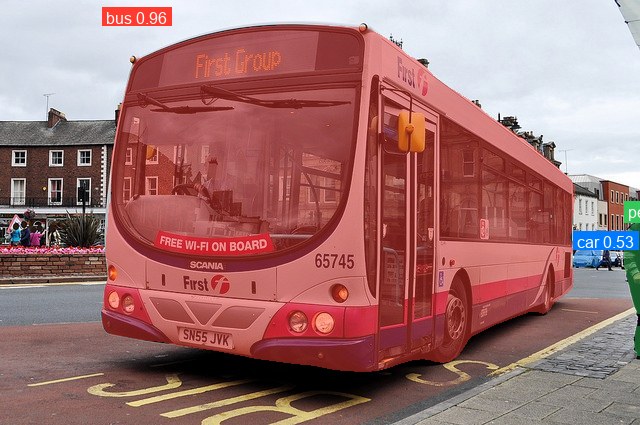
Instance Segmentation
RFDETRInstanceSegment predicts a mask per query alongside the class and box. The
post-processor upsamples masks to the original image size and thresholds them.
import numpy as np
from PIL import Image
from kerasformers.models.rf_detr import RFDETRImageProcessor, RFDETRInstanceSegment

model = RFDETRInstanceSegment.from_weights("rfdetr-seg-small")
processor = RFDETRImageProcessor.from_weights("rfdetr-seg-small")   # resolves 384

image = Image.open("assets/data/coco_bus.jpg").convert("RGB")
output = model(processor(image)["pixel_values"], training=False)
# output["logits"]:     (1, 100, 91)
# output["pred_boxes"]: (1, 100, 4)
# output["pred_masks"]: (1, 100, 96, 96)     resolution // mask_downsample_ratio

result = processor.post_process_instance_segmentation(
    output, threshold=0.5, target_sizes=[(image.height, image.width)]
)[0]
# result keys: boxes, label_names, labels, masks, scores

scores = np.asarray(result["scores"])
masks = np.asarray(result["masks"])
for i in np.argsort(-scores):
    print(f"{result['label_names'][i]:14s} {float(scores[i]):.3f}  "
          f"area {int(masks[i].sum())}")
print("masks:", masks.shape)
Masks come back already upsampled to the image size, one per surviving instance, as
booleans. pred_masks in the raw output is at resolution // 4 (96×96 for a 384
variant), so the post-processor does the upsample and threshold for you.
Note the spread in area: the bus covers 130280 pixels while the distant car covers
454. When compositing several instances, paint the largest first so small objects are
not buried, the same ordering DETR's panoptic section
needs.
Input Resolution
RF-DETR is Functional, so the input shape is fixed at construction. Both the model and
the processor must agree, which from_weights handles. To run at another resolution,
set it on both:
model = RFDETRDetect.from_weights("rfdetr-nano", resolution=512, image_size=512)
processor = RFDETRImageProcessor(size={"height": 512, "width": 512})
Pretrained weights load fine at a non-native size, because the learned DINOv2 position grid is interpolated to the actual patch grid at build time. But RF-DETR has two hard constraints that its siblings do not:
| rule | why |
|---|---|
(side / patch_size)² >= num_queries |
two-stage selection needs at least num_queries patch tokens |
(side / patch_size) % num_windows == 0 |
windowed attention partitions the patch grid |
For rfdetr-nano (patch 16, windows 2, 300 queries) that means multiples of 32 at or
above 288:
256  16x16=256 patches   FAIL  (256 < 300 queries)
288  18x18=324 patches   OK    laptop 0.96, keyboard 0.95, mouse 0.89, tv 0.78
304  19x19=361 patches   FAIL  (19 is odd, window partition breaks)
320  20x20=400 patches   OK    laptop 0.97, keyboard 0.94, mouse 0.89, tv 0.76
384  24x24=576 patches   OK    laptop 0.96, keyboard 0.96, mouse 0.88, tv 0.74  <- native
512  32x32=1024 patches  OK    laptop 0.96, keyboard 0.96, mouse 0.89, tv 0.71
224 fails both ways: it gives only 196 tokens for 300 queries. The error names both
numbers (300 ... cannot be broadcasted to 196). This is architectural rather than a
kerasformers limitation, the reference implementation raises selected index k out of
range on the same input.
Custom Class Names
A model fine-tuned on your own dataset predicts your class indices, not COCO's:
MY_CLASSES = ["cat", "dog", "bird"]

results = processor.post_process_object_detection(
    output, threshold=0.5, target_sizes=[(image.height, image.width)],
    label_names=MY_CLASSES,
)
Without it the post-processor falls back to COCO's 91 names. The integer labels are
unaffected.
Data Format
Both the models and the processors support channels_last and channels_first.
Neither is hard-coded to a layout, so the whole pipeline runs either way.
| How it picks the format | |
|---|---|
| Processors | A data_format kwarg, per instance. None (the default) resolves to keras.config.image_data_format(). |
| Models | Read keras.config.image_data_format() when they are constructed. There is no data_format argument. |
Overriding the processor only
RFDETRImageProcessor(data_format="channels_last")("photo.jpg")
# {"pixel_values": (1, 560, 560, 3)}

RFDETRImageProcessor(data_format="channels_first")("photo.jpg")
# {"pixel_values": (1, 3, 560, 560)}
Switching the whole pipeline
import keras

keras.config.set_image_data_format("channels_first")

model = RFDETRDetect.from_weights("rfdetr-nano")
processor = RFDETRImageProcessor.from_weights("rfdetr-nano")
Detections are the same under either layout. Only the tensor shape changes. Set it once at the top of a script, since already-built models keep the layout they were constructed with.
The detection post-processor emits xyxy pixel boxes and class indices, so it takes no
data_format kwarg. Masks from post_process_instance_segmentation are returned as
(N, H, W) regardless of layout.
Loading Fine-tuned and Community Weights
Any Hugging Face repo whose model_type is "rf_detr" loads directly with the hf:
prefix, including the Roboflow checkpoints and arbitrary fine-tunes.
from kerasformers.models.rf_detr import RFDETRDetect, RFDETRInstanceSegment

# Upstream release
model = RFDETRDetect.from_weights("hf:Roboflow/rf-detr-nano")
seg = RFDETRInstanceSegment.from_weights("hf:Roboflow/rf-detr-seg-small")

# Somebody's fine-tune
model = RFDETRDetect.from_weights("hf:<user>/rfdetr-finetuned-on-my-data")

# Architecture only, randomly initialized
model = RFDETRDetect.from_weights("rfdetr-nano", load_weights=False)
No shape arguments are needed. The architecture is read from the repo's config.json
and mapped onto the constructor. All three model classes accept hf:, as does
RFDETRImageProcessor:
Loading hf:Roboflow/rf-detr-nano and the rfdetr-nano release variant produces
identical outputs, since they are the same checkpoint by two routes.