SAM
from_weights(...).
SAM (Segment Anything Model) segments whatever you point at. It has no class vocabulary at all: you give it a prompt, a click or a box, and it returns a mask. That makes it complementary to every other segmenter in this library, which decide what a region is; SAM only decides where it is.
The architecture splits into a heavy image encoder and a light prompt decoder. The ViT encoder runs once per image and is most of the cost; the prompt encoder plus mask decoder are small enough to run interactively, so a user can click repeatedly and get new masks without re-encoding.
Paper: Segment Anything
API
SAMPromptableSegment
SAMPromptableSegment(vision_hidden_size=768, vision_num_hidden_layers=12,
                     vision_num_attention_heads=12, vision_mlp_dim=3072,
                     vision_global_attn_indexes=(2, 5, 8, 11),
                     enable_boxes=False, enable_masks=False, ...,
                     name="SAMPromptableSegment")
Image encoder, prompt encoder and mask decoder. This is the class for prompted segmentation.
Architecture arguments are filled in by from_weights from the variant config. The two
that change the model's input signature are worth knowing:
- enable_boxes (
bool, optional, defaults toFalse): addsinput_boxesandhas_boxes_inputto the graph. Box prompts do nothing unless you set this, see Box Prompts. - enable_masks (
bool, optional, defaults toFalse): addsinput_masksandhas_mask_input, for feeding a previous mask back in as a prompt.
Call model(inputs) with the processor's tensor outputs. Returns a dict:
- pred_masks (
(B, point_batch, 3, 256, 256)): three mask candidates per prompt, at the decoder's low resolution. - iou_scores (
(B, point_batch, 3)): the model's own quality estimate for each candidate.
Three candidates is SAM's "multimask" behaviour: a click is ambiguous, so it offers several plausible scales (a part, a subpart, and the whole object). Picking among them is your decision, and not always the top IoU.
SAMModel
The image encoder alone, producing image embeddings. Useful when you want to encode once and prompt many times without paying for the ViT again.
Preprocessing
SAMImageProcessorWithPrompts
Resizes the long edge to target_length, pads to a square, normalizes, and rescales
any prompt coordinates by the same factor.
Call processor(image, input_points=None, input_labels=None, input_boxes=None).
Returns a dict:
- pixel_values (
(1, 1024, 1024, 3)): the padded square. - input_points (
(1, point_batch, num_points, 2)): prompt coordinates, rescaled. - input_labels (
(1, point_batch, num_points)):1foreground,0background,-1padding. - input_boxes (
(1, num_boxes, 4)) and has_boxes_input: present only when you pass boxes. - original_size / reshaped_size: plain tuples, for
post_process_masks.
The last two are metadata, not model inputs. Keras refuses a nested call argument that mixes tensors and non-tensors, so pass the tensors only.
META = ("original_size", "reshaped_size")
feed = {k: v for k, v in inputs.items() if k not in META}
output = model(feed)
Coordinates are in the original image's pixel space; the processor handles the rescale to 1024, so you never convert by hand.
post_process_masks
Removes the padding, upsamples the 256×256 decoder output back to the original
resolution, and returns (B, point_batch, 3, H, W) float logits. Threshold at zero for
a binary mask.
SAMImageProcessor
The same preprocessing without the prompt arguments, for use with SAMModel.
Model Variants
| Variant id | Vision tower | Params | HF original |
|---|---|---|---|
sam_vit_base |
ViT-B | ~94 M | facebook/sam-vit-base |
sam_vit_large |
ViT-L | ~312 M | facebook/sam-vit-large |
sam_vit_huge |
ViT-H | ~641 M | facebook/sam-vit-huge |
Only the image encoder grows; the prompt decoder is the same size in all three, so interactive re-prompting costs the same regardless of variant.
Basic Usage: Point Prompts
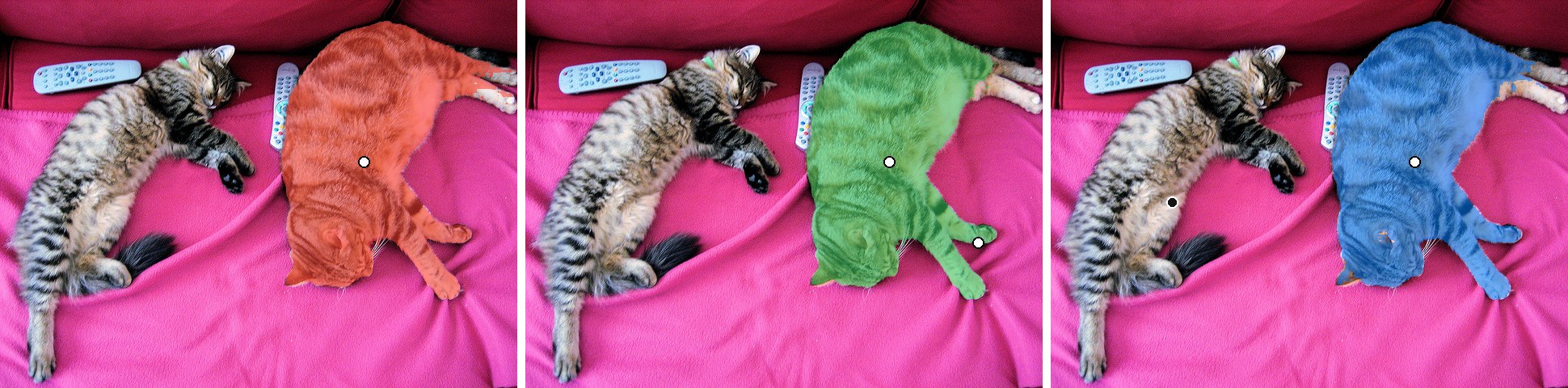
White dots are positive points, the black dot is negative.
import keras
import numpy as np
import torch
from PIL import Image
from kerasformers.models.sam import (
    SAMImageProcessorWithPrompts, SAMPromptableSegment,
)

model = SAMPromptableSegment.from_weights("sam_vit_base")
processor = SAMImageProcessorWithPrompts()

image = Image.open("assets/data/coco_cats.jpg").convert("RGB")

# One click on the right-hand cat. Coordinates are in original pixel space.
inputs = processor(
    image,
    input_points=np.array([[[[450, 200]]]], dtype="float32"),
    input_labels=np.array([[[1]]], dtype="int32"),
)

META = ("original_size", "reshaped_size")
with torch.no_grad():
    output = model({k: v for k, v in inputs.items() if k not in META})
# output["pred_masks"]: (1, 1, 3, 256, 256)
# output["iou_scores"]: (1, 1, 3)

masks = processor.post_process_masks(
    output["pred_masks"],
    original_size=inputs["original_size"],
    reshaped_size=inputs["reshaped_size"],
)
masks = np.asarray(keras.ops.convert_to_numpy(masks))
iou = np.asarray(keras.ops.convert_to_numpy(output["iou_scores"])).ravel()

best = int(np.argmax(iou))
mask = masks[0, 0, best] > 0
print(f"iou {[round(float(v), 3) for v in iou]}  best={best}  {int(mask.sum())} px")
The three candidates are different interpretations of the same click. Here candidate 1 is the cat, candidate 0 is a much larger region (the whole sofa scene), and candidate 2 a smaller part.
Multiple Points for Refinement
Add more positive points to extend the mask:
inputs = processor(
    image,
    input_points=np.array([[[[450, 200], [560, 300]]]], dtype="float32"),
    input_labels=np.array([[[1, 1]]], dtype="int32"),
)
Add a negative point (label 0) to carve a region out:
inputs = processor(
    image,
    input_points=np.array([[[[450, 200], [150, 250]]]], dtype="float32"),
    input_labels=np.array([[[1, 0]]], dtype="int32"),   # 1 = keep, 0 = exclude
)
The mask shrinks from 55518 to 53475 pixels: the negative point on the left-hand cat trims the overlap where the two animals touch.
Choosing among the three masks
argmax(iou) is the obvious rule and it is wrong when you use negative points. On
the example above the three candidates are:
cand0  iou 0.956  101767 px   contains the negative point
cand1  iou 0.920   53475 px   excludes it
cand2  iou 0.873   32048 px   excludes it
The highest-scoring candidate is the whole-scene mask, which covers the very region you asked to exclude. IoU measures the model's confidence in a mask's quality, not its agreement with your prompt. Filter first, then rank:
neg = [(x, y) for (x, y), lab in zip(points, labels) if lab == 0]
valid = [i for i in range(masks.shape[2])
         if not any((masks[0, 0, i] > 0)[y, x] for x, y in neg)]
best = max(valid, key=lambda i: iou[i]) if valid else int(np.argmax(iou))
Box Prompts
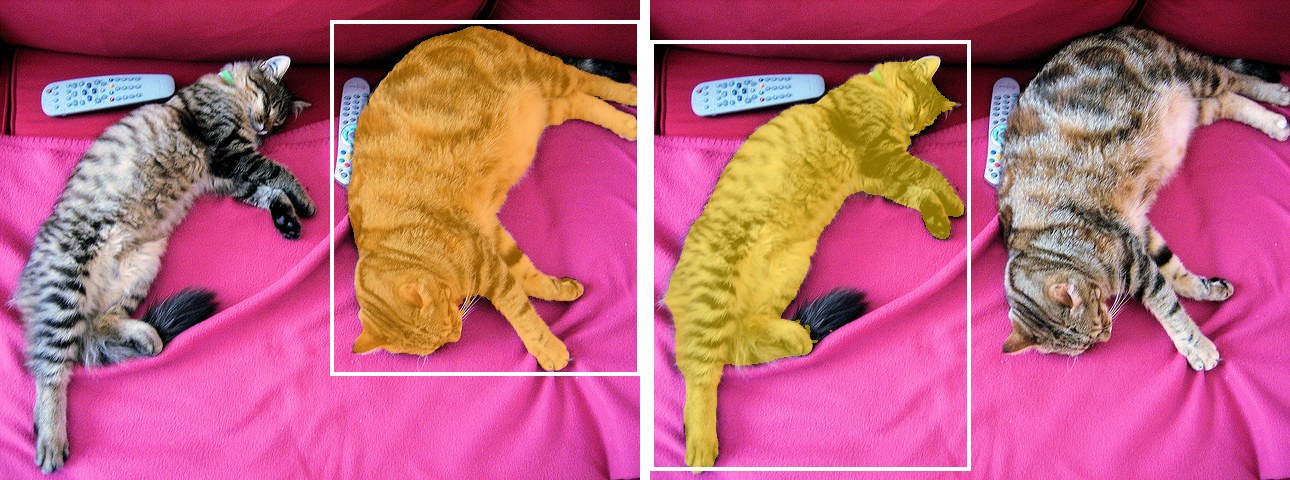
A box is a stronger constraint than a click and usually scores higher. You must build
the model with enable_boxes=True: the box input is not in the default graph, and
passing boxes without it raises a confusing shape error about input_points.
import numpy as np
import torch
from PIL import Image
from kerasformers.models.sam import (
    SAMImageProcessorWithPrompts, SAMPromptableSegment,
)

# enable_boxes adds input_boxes and has_boxes_input to the graph
model = SAMPromptableSegment.from_weights("sam_vit_base", enable_boxes=True)
processor = SAMImageProcessorWithPrompts()

image = Image.open("assets/data/coco_cats.jpg").convert("RGB")

# (x0, y0, x1, y1) around the right-hand cat
inputs = processor(image, input_boxes=np.array([[[330, 20, 640, 375]]], "float32"))

META = ("original_size", "reshaped_size")
with torch.no_grad():
    output = model({k: v for k, v in inputs.items() if k not in META})
box [330, 20, 640, 375]   iou [0.984, 0.973, 0.841]  best=0  57159 px
box [0, 40, 320, 470]     iou [0.926, 0.979, 0.630]  best=1  47985 px
Top IoU of 0.984 against 0.968 for the single click on the same cat: the box removes the scale ambiguity that makes a click return three answers.
The processor supplies has_boxes_input and pads the point inputs with SAM's -1
"not a point" label automatically, so its output feeds the model unchanged. You can
combine both by passing points and boxes together.
Automatic Mask Generation
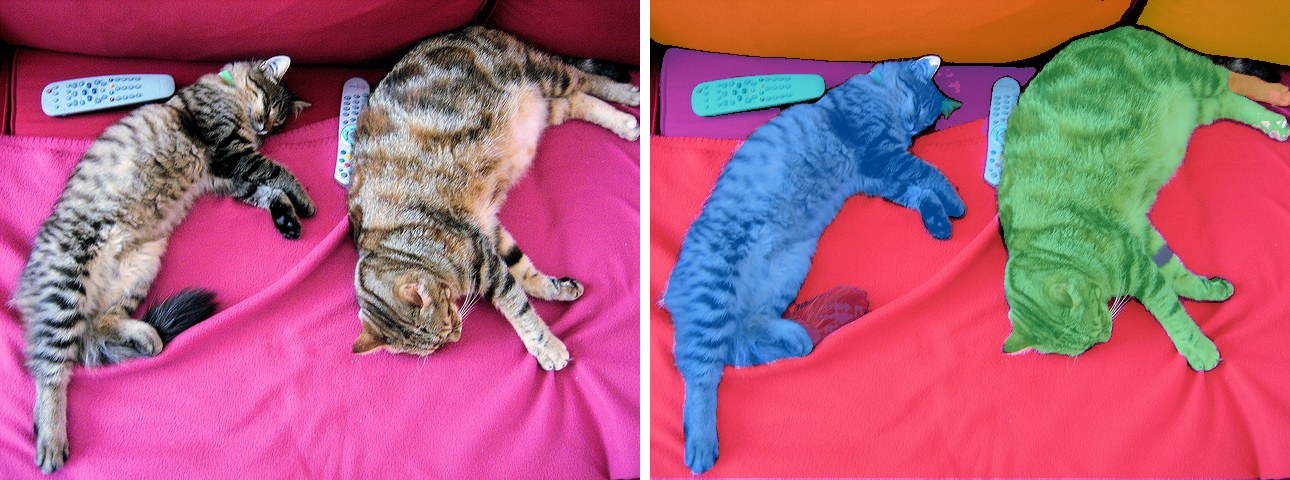
With no prompt at all, SAMGenerateMasks sweeps a grid of points over the image and
keeps whatever survives quality and stability filtering. This is "segment everything".
import torch
from kerasformers.models.sam import SAMGenerateMasks, SAMPromptableSegment

model = SAMPromptableSegment.from_weights("sam_vit_base")

with torch.no_grad():
    result = SAMGenerateMasks(
        model, "assets/data/coco_cats.jpg",
        points_per_side=12,             # 12 x 12 = 144 candidate clicks
        points_per_batch=8,
        stability_score_thresh=0.85,    # the default 0.95 drops the cats
    )

print(sorted(result))
print(len(result["masks"]), tuple(result["masks"][0].shape))
Twelve regions from 144 candidate clicks, already at full resolution: both cats, the
blanket, the sofa back and both remotes. Note masks is a list of bool (H, W)
arrays, not a stacked array, alongside iou_scores (N,) and XYXY boxes (N, 4) in
original-image pixels. rle_masks gives the same masks run-length encoded, which is far
cheaper to store or ship.
Why the defaults may miss the obvious objects
Run the same call with stock settings and the cats vanish, leaving only small crisp objects:
stability_score_thresh=0.95 (default)  ->  7 masks, largest [25242, 7516, 4100]
stability_score_thresh=0.85            -> 12 masks, largest [135696, 56145, 48796]
pred_iou_thresh=0.7 (quality relaxed)  ->  7 masks, largest [25242, 7516, 4100]
Relaxing the quality bar changes nothing, because the cats are not low quality: they
score IoU 0.974 and 0.989, and a single click on one scores 0.968. They fail the
stability test, which measures how much a mask changes when the binarization
threshold is nudged. A soft, furry boundary against a blanket moves more than the hard
edge of a remote control, so stability_score_thresh=0.95 discards precisely the
objects you probably wanted.
If automatic generation returns a handful of small fragments, lower
stability_score_thresh before touching anything else.
Wrap this in
torch.no_grad()and lowerpoints_per_batch. The mask decoder runs aConv2DTransposeper candidate, and the default batch of 64 with autograd live will exhaust an 8 GB card.points_per_batch=8is comfortable; raise it if you have room.
Key parameters:
- points_per_side (
int, defaults to32): grid density. 32 means 1024 candidate clicks, thorough and slow. - points_per_batch (
int, defaults to64): how many candidates go through the decoder at once. This is the memory knob. - pred_iou_thresh (
float, defaults to0.88): drop candidates the model is unsure about. - stability_score_thresh (
float, defaults to0.95): drop masks that change a lot when the threshold is nudged. - crop_n_layers (
int, defaults to0): re-run on image crops to catch small objects, at multiplied cost.
Encode Once, Prompt Many Times
The ViT encoder dominates the cost, and an interactive tool re-prompts the same image
over and over. SAMPromptableSegment splits itself into two sub-models for exactly this,
so the backbone runs once and each new click pays only for the decoder:
import keras
import numpy as np
import torch
from PIL import Image
from kerasformers.models.sam import SAMImageProcessorWithPrompts, SAMPromptableSegment

model = SAMPromptableSegment.from_weights("sam_vit_base")
processor = SAMImageProcessorWithPrompts()
image = Image.open("assets/data/coco_cats.jpg").convert("RGB")

# Run the ViT once.
with torch.no_grad():
    embedding = model.vision_encoder_model(processor(image)["pixel_values"])

# Then pay only for the decoder on each new click.
for x, y in [(450, 200), (150, 250)]:
    inputs = processor(image,
                       input_points=np.array([[[[x, y]]]], "float32"),
                       input_labels=np.array([[[1]]], "int32"))
    with torch.no_grad():
        output = model.prompt_decoder_model({
            "image_embeddings": embedding,
            "input_points": inputs["input_points"],
            "input_labels": inputs["input_labels"],
        })
    masks = processor.post_process_masks(
        output["pred_masks"],
        original_size=inputs["original_size"],
        reshaped_size=inputs["reshaped_size"],
    )
    masks = np.asarray(keras.ops.convert_to_numpy(masks))
    iou = np.asarray(keras.ops.convert_to_numpy(output["iou_scores"])).ravel()
    best = int(np.argmax(iou))
    print(f"({x}, {y}) -> {int((masks[0, 0, best] > 0).sum())} px")
The first click reproduces the whole-model number above exactly, which is the point: splitting the graph changes nothing but where the time goes.
The prompt encoder and mask decoder are identical across all three variants, so the
per-click cost does not change between sam_vit_base and sam_vit_huge; only the
one-off encode does.
SAMModelis the encoder-only class, but it has no entry on the release tag, soSAMModel.from_weights("sam_vit_base")raises. Usehf:facebook/sam-vit-baseif you want it standalone, or thevision_encoder_modelsub-model above.
Data Format
Both the model and the processor support channels_last and channels_first.
| How it picks the format | |
|---|---|
| Processors | A data_format kwarg, per instance. None (the default) resolves to keras.config.image_data_format(). |
| Models | Read keras.config.image_data_format() when they are constructed. There is no data_format argument. |
post_process_masks returns (B, point_batch, 3, H, W) in either case: masks have no
channel axis to reorder.
Loading Fine-tuned and Community Weights
Any Hugging Face repo whose model_type is "sam" loads with the hf: prefix.
from kerasformers.models.sam import SAMPromptableSegment

model = SAMPromptableSegment.from_weights("hf:facebook/sam-vit-base")
model = SAMPromptableSegment.from_weights("hf:<user>/sam-finetuned-on-my-data")

# Architecture only, randomly initialized
model = SAMPromptableSegment.from_weights("sam_vit_base", load_weights=False)

# Box prompts work through the hf: route too
model = SAMPromptableSegment.from_weights("hf:facebook/sam-vit-base", enable_boxes=True)
See also SAM2, which extends this to video and a faster Hiera backbone, and SAM3, which adds text prompts.