SAM2
from_weights(...).
SAM2 keeps SAM's promptable formulation and replaces the plain ViT with a Hiera backbone: a hierarchical encoder that produces multi-scale features, feeding an FPN neck before the mask decoder. The result is both faster and sharper at object boundaries than the original.
The paper's headline is video, where a memory bank carries object identity across frames. This port covers the image path only: the classes here segment a single image from point or box prompts, with no memory or frame propagation.
Paper: SAM 2: Segment Anything in Images and Videos
API
SAM2PromptableSegment
SAM2PromptableSegment(hidden_dim=96, blocks_per_stage=(1, 2, 7, 2),
                      embed_dim_per_stage=(96, 192, 384, 768),
                      num_attention_heads_per_stage=(1, 2, 4, 8),
                      window_size_per_stage=..., num_multimask_outputs=3,
                      include_box_input=False, include_mask_input=False,
                      multimask_output=True, image_size=1024,
                      name="SAM2PromptableSegment")
Hiera image encoder, FPN neck, prompt encoder and mask decoder. This is the class for prompted segmentation.
Architecture arguments are filled in by from_weights from the variant config. The
per-stage tuples are where the size difference between variants lives.
| Argument | What it does |
|---|---|
include_box_input |
Adds an input_boxes input to the graph. Off by default: the point-only graph is what automatic mask generation requires. |
include_mask_input |
Adds input_masks plus a has_input_masks gate, for refining a mask from a previous pass. |
multimask_output |
True returns three candidates; False returns one. |
Because the prompt inputs are baked into the functional graph, choose the flags at construction, not per call.
Call model(inputs) with the processor's tensor outputs. Returns a dict:
- pred_masks (
(B, point_batch, 3, 256, 256)): three mask candidates per prompt. - iou_scores (
(B, point_batch, 3)): predicted quality per candidate. - object_score_logits (
(B, point_batch, 1)): whether an object is present at all. SAM has no equivalent; it is the signal SAM2 uses in video to notice an object has left the frame.
SAM2Model
The Hiera encoder and neck alone, producing multi-scale image embeddings. Use it to encode once and prompt repeatedly.
Preprocessing
SAM2ImageProcessorWithPrompts
SAM2ImageProcessorWithPrompts(target_length=1024, image_mean=None,
                              image_std=None, data_format=None)
Stretches the image to a square target_length, normalizes, and rescales prompt
coordinates the same way.
SAM2 stretches, SAM pads. SAM resizes the long edge and pads the short one, so a single scale factor covers both axes. SAM2 stretches each axis independently, so
xandyare scaled by different factors. This is also whypost_process_masksneeds noreshaped_size: there is no padding to undo.
Call processor(image, input_points=None, input_labels=None, input_boxes=None).
Returns a dict:
- pixel_values (
(1, 1024, 1024, 3)). - input_points (
(1, point_batch, num_points, 2)): coordinates, rescaled from the original image's pixel space. - input_labels (
(1, point_batch, num_points)):1foreground,0background,-1padding. - input_boxes (
(1, num_boxes, 4)), only wheninput_boxeswas passed:(x1, y1, x2, y2), rescaled. - original_size / reshaped_size: plain tuples, for
post_process_masks.
The last two are metadata, not model inputs. Keras refuses a nested call argument that mixes tensors and non-tensors, so pass the tensors only.
META = ("original_size", "reshaped_size")
output = model({k: v for k, v in inputs.items() if k not in META})
post_process_masks
Upsamples the decoder output back to the original resolution and returns
(B, point_batch, 3, H, W) float logits; threshold at zero.
SAM2ImageProcessor
The same preprocessing without prompt arguments, for use with SAM2Model.
Model Variants
| Variant id | Backbone | Params | HF original |
|---|---|---|---|
sam2_hiera_tiny |
Hiera-T | ~39 M | facebook/sam2.1-hiera-tiny |
sam2_hiera_small |
Hiera-S | ~46 M | facebook/sam2.1-hiera-small |
sam2_hiera_base_plus |
Hiera-B+ | ~81 M | facebook/sam2.1-hiera-base-plus |
sam2_hiera_large |
Hiera-L | ~224 M | facebook/sam2.1-hiera-large |
Even sam2_hiera_tiny at 39 M is less than half sam_vit_base, while producing
tighter boundaries.
Basic Usage: Point Prompts
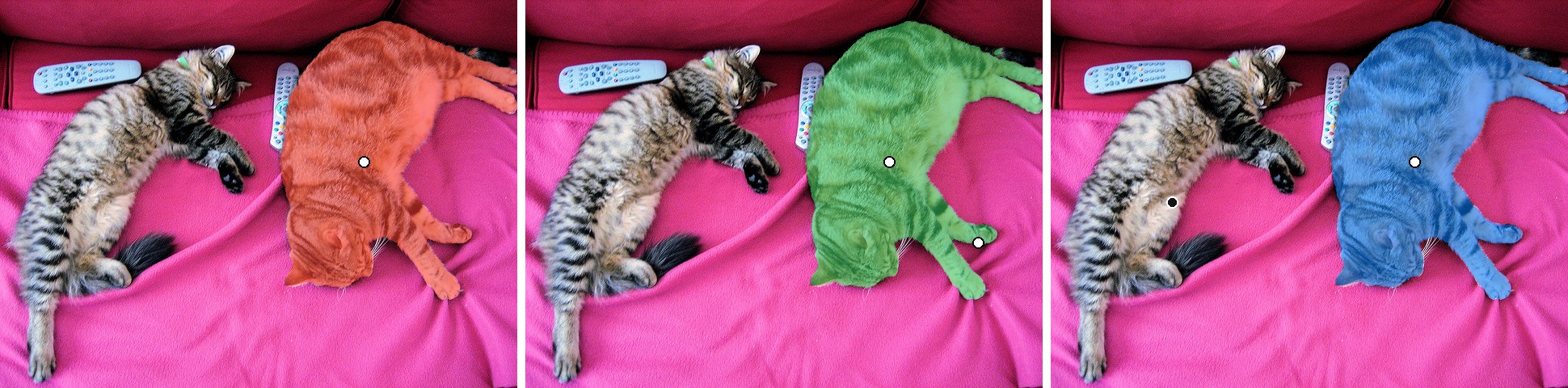
White dots are positive points, the black dot is negative.
import keras
import numpy as np
import torch
from PIL import Image
from kerasformers.models.sam2 import (
    SAM2ImageProcessorWithPrompts, SAM2PromptableSegment,
)

model = SAM2PromptableSegment.from_weights("sam2_hiera_tiny")
processor = SAM2ImageProcessorWithPrompts()

image = Image.open("assets/data/coco_cats.jpg").convert("RGB")

# One click on the right-hand cat, in original pixel space.
inputs = processor(
    image,
    input_points=np.array([[[[450, 200]]]], dtype="float32"),
    input_labels=np.array([[[1]]], dtype="int32"),
)

META = ("original_size", "reshaped_size")
with torch.no_grad():
    output = model({k: v for k, v in inputs.items() if k not in META})
# output["pred_masks"]:          (1, 1, 3, 256, 256)
# output["iou_scores"]:          (1, 1, 3)
# output["object_score_logits"]: (1, 1, 1)

masks = processor.post_process_masks(
    output["pred_masks"], original_size=inputs["original_size"]
)
masks = np.asarray(keras.ops.convert_to_numpy(masks))
iou = np.asarray(keras.ops.convert_to_numpy(output["iou_scores"])).ravel()

best = int(np.argmax(iou))
mask = masks[0, 0, best] > 0
print(f"iou {[round(float(v), 3) for v in iou]}  best={best}  {int(mask.sum())} px")
Note the candidate ordering differs from SAM's. SAM returns its most confident mask at
index 1 on this image; SAM2 puts it at index 2, and spreads the scores much wider
(0.610 to 0.980 against SAM's 0.784 to 0.968). Never hard-code a candidate index:
always rank by iou_scores.
Multiple Points for Refinement
inputs = processor(
    image,
    input_points=np.array([[[[450, 200], [560, 300]]]], dtype="float32"),
    input_labels=np.array([[[1, 1]]], dtype="int32"),
)
A negative point (label 0) carves a region out:
inputs = processor(
    image,
    input_points=np.array([[[[450, 200], [150, 250]]]], dtype="float32"),
    input_labels=np.array([[[1, 0]]], dtype="int32"),   # 1 = keep, 0 = exclude
)
All three prompts land within about 400 pixels of each other (57302, 57391, 56960), which is the point: SAM2's mask on this cat is already tight enough that extra prompts barely move it. The same three prompts on SAM shift the mask by nearly 2000 pixels.
As with SAM, argmax(iou) can pick a candidate that contains your negative point.
Filter first, then rank:
neg = [(x, y) for (x, y), lab in zip(points, labels) if lab == 0]
valid = [i for i in range(masks.shape[2])
         if not any((masks[0, 0, i] > 0)[y, x] for x, y in neg)]
best = max(valid, key=lambda i: iou[i]) if valid else int(np.argmax(iou))
Box Prompts
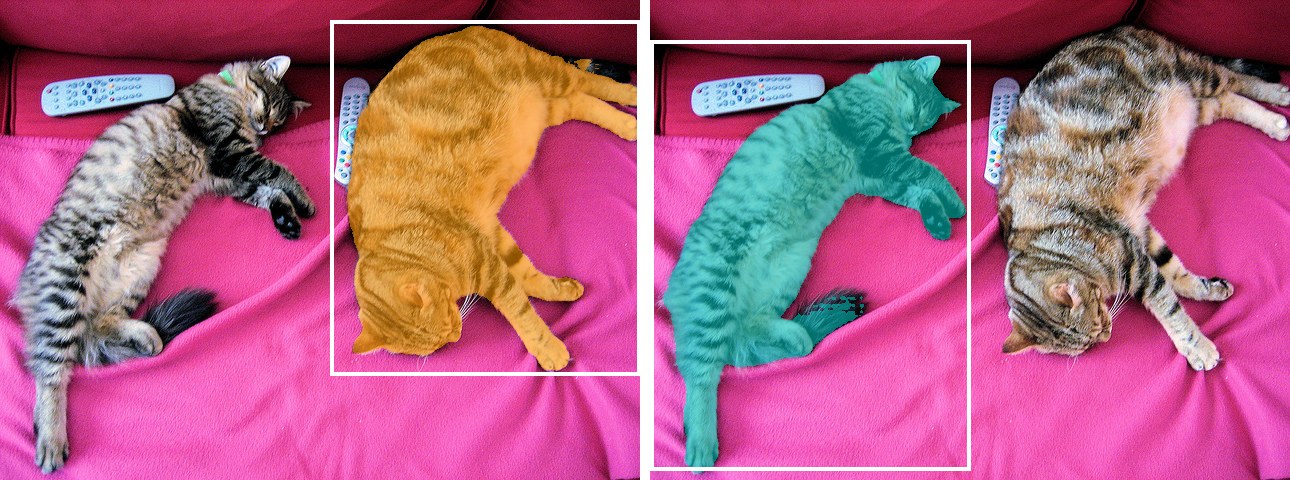
A box is the easiest prompt to produce automatically, since any detector already emits
them. Box support is off by default, so build the model with include_box_input=True:
import keras
import numpy as np
import torch
from PIL import Image
from kerasformers.models.sam2 import (
    SAM2ImageProcessorWithPrompts, SAM2PromptableSegment,
)

model = SAM2PromptableSegment.from_weights(
    "sam2_hiera_tiny", include_box_input=True
)
processor = SAM2ImageProcessorWithPrompts()
image = Image.open("assets/data/coco_cats.jpg").convert("RGB")

# (x1, y1, x2, y2) in original pixel space, shaped (batch, num_boxes, 4).
inputs = processor(image, input_boxes=np.array([[[330, 20, 640, 375]]], "float32"))

META = ("original_size", "reshaped_size")
with torch.no_grad():
    output = model({k: v for k, v in inputs.items() if k not in META})

masks = processor.post_process_masks(
    output["pred_masks"], original_size=inputs["original_size"]
)
masks = np.asarray(keras.ops.convert_to_numpy(masks))
iou = np.asarray(keras.ops.convert_to_numpy(output["iou_scores"])).ravel()

best = int(np.argmax(iou))
print(f"iou {[round(float(v), 3) for v in iou]}  best={best}  {int((masks[0, 0, best] > 0).sum())} px")
The second box, [0, 40, 320, 470], gives iou [0.916, 0.941, 0.973] and 50398 px.
In both panels the mask escapes the box where the animal does, following the tail and
the outstretched paw past the drawn edge: the box is a hint about which object, not a
crop.
The box-enabled graph still declares the point inputs. Passing
input_boxesalone is fine, the processor pads the points with SAM2's "not a point" label (-1) for you. If you pass both,num_boxesmust equalpoint_batch, because the box embedding is concatenated onto the point embedding along that axis.
include_mask_input=True adds input_masks and a has_input_masks gate on the same
pattern, for feeding a previous mask back in as a starting point.
Automatic Mask Generation
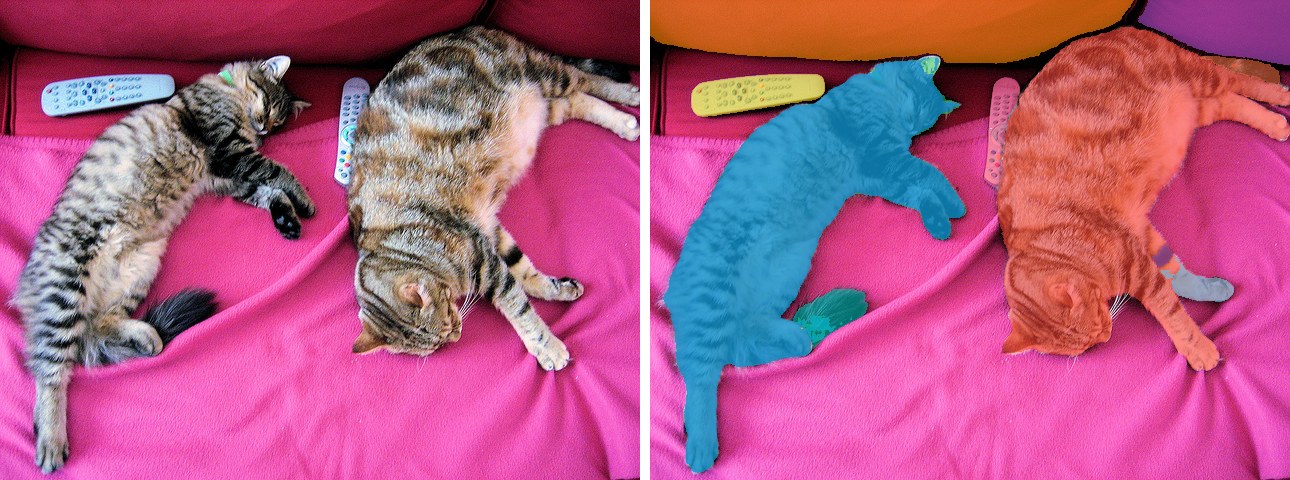
With no prompt, SAM2GenerateMasks sweeps a grid of points and keeps whatever survives
quality and stability filtering.
import torch
from kerasformers.models.sam2 import SAM2GenerateMasks, SAM2PromptableSegment

model = SAM2PromptableSegment.from_weights("sam2_hiera_tiny")

with torch.no_grad():
    result = SAM2GenerateMasks(
        model, "assets/data/coco_cats.jpg",
        points_per_side=12,             # 12 x 12 = 144 candidate clicks
        points_per_batch=8,
        stability_score_thresh=0.85,    # the default 0.95 drops soft-edged objects
    )

print(sorted(result))
print(len(result["masks"]), tuple(result["masks"][0].shape))
masks is a list of bool (H, W) arrays, one per surviving object, alongside
iou_scores (N,), XYXY boxes (N, 4) in original-image pixels, and rle_masks in
COCO run-length form.
Two parameters need attention, for the same reasons as SAM:
stability_score_threshdefaults to0.95, which discards objects with soft boundaries such as fur, keeping only crisp-edged ones. Lower it first if the output looks sparse.points_per_batchdefaults to64, which runs 64Conv2DTransposecalls at once and will exhaust an 8 GB card. Wrap the call intorch.no_grad()and use8to start.
SAM2GenerateMasks needs the point-only graph and raises if you hand it a model
built with include_box_input=True or include_mask_input=True, since it drives the
decoder with grid points and supplies neither.
Encode Once, Prompt Many Times
The Hiera encoder dominates the cost, and an interactive tool re-prompts the same image
over and over. SAM2PromptableSegment splits itself into two sub-models for exactly
this, so the backbone runs once and each new click pays only for the decoder:
import keras
import numpy as np
import torch
from PIL import Image
from kerasformers.models.sam2 import SAM2ImageProcessorWithPrompts, SAM2PromptableSegment

model = SAM2PromptableSegment.from_weights("sam2_hiera_tiny")
processor = SAM2ImageProcessorWithPrompts()
image = Image.open("assets/data/coco_cats.jpg").convert("RGB")

# Run the Hiera backbone once.
with torch.no_grad():
    features = model.vision_encoder_model(processor(image)["pixel_values"])

# Then pay only for the decoder on each new click.
for x, y in [(450, 200), (150, 250)]:
    inputs = processor(image,
                       input_points=np.array([[[[x, y]]]], "float32"),
                       input_labels=np.array([[[1]]], "int32"))
    with torch.no_grad():
        output = model.prompt_decoder_model({
            **features,
            "input_points": inputs["input_points"],
            "input_labels": inputs["input_labels"],
        })
    masks = processor.post_process_masks(
        output["pred_masks"], original_size=inputs["original_size"]
    )
    masks = np.asarray(keras.ops.convert_to_numpy(masks))
    iou = np.asarray(keras.ops.convert_to_numpy(output["iou_scores"])).ravel()
    best = int(np.argmax(iou))
    print(f"({x}, {y}) -> {int((masks[0, 0, best] > 0).sum())} px")
The first click reproduces the whole-model number above exactly, which is the point: splitting the graph changes nothing but where the time goes.
vision_encoder_model returns three tensors, not one. SAM2 feeds high_res_feat_s0 and
high_res_feat_s1 past the low-resolution image_embeddings straight into the decoder,
and those skip connections are where the sharper boundaries come from. Splatting the
dict with **features keeps all three.
SAM2Modelis the encoder-only class, but it has no entry on the release tag, soSAM2Model.from_weights("sam2_hiera_tiny")raises. Usehf:facebook/sam2.1-hiera-tinyif you want it standalone, or thevision_encoder_modelsub-model above.
Data Format
Both the model and the processor support channels_last and channels_first.
| How it picks the format | |
|---|---|
| Processors | A data_format kwarg, per instance. None (the default) resolves to keras.config.image_data_format(). |
| Models | Read keras.config.image_data_format() when they are constructed. There is no data_format argument. |
post_process_masks returns (B, point_batch, 3, H, W) in either case.
Loading Fine-tuned and Community Weights
Any Hugging Face repo whose model_type is "sam2" loads with the hf: prefix.
from kerasformers.models.sam2 import SAM2PromptableSegment

model = SAM2PromptableSegment.from_weights("hf:facebook/sam2.1-hiera-tiny")
model = SAM2PromptableSegment.from_weights("hf:<user>/sam2-finetuned-on-my-data")

# Architecture only, randomly initialized
model = SAM2PromptableSegment.from_weights("sam2_hiera_tiny", load_weights=False)
See also SAM, the original, and SAM3, which prompts with text.