Grounding DINO
from_weights(...).
Grounding DINO detects objects named by a free-text prompt rather than a fixed label set. A Swin image backbone and a BERT text encoder are fused by a cross-modality encoder, query proposals are selected by image-text similarity, and boxes are refined DINO-style across six decoder layers. Every output box is scored against the prompt's tokens, so the "classes" are whatever you asked for.
Unlike OWL-ViT and OWLv2, which score each patch independently against CLIP-style embeddings, Grounding DINO fuses the two modalities throughout the encoder. That generally makes it stronger on phrases and on objects that need context to disambiguate, at a higher compute cost.
Paper: Grounding DINO: Marrying DINO with Grounded Pre-Training for Open-Set Object Detection
API
GroundingDinoForObjectDetection
GroundingDinoForObjectDetection(..., d_model=256, decoder_layers=6,
                                num_queries=900, max_text_len=256,
                                name="GroundingDinoForObjectDetection")
The detector: backbone, cross-modality encoder, decoder, and the contrastive class and box heads. This is the class for open-set detection.
Architecture arguments are filled in by from_weights from the variant config. The
ones worth knowing:
- decoder_layers (
int, optional, defaults to6): decoder depth. All six share one bbox head. - num_queries (
int, optional, defaults to900): decoder queries, the ceiling on detections per image. - max_text_len (
int, optional, defaults to256): prompt token budget the contrastive head pads to. - d_model (
int, optional, defaults to256): transformer width.
Call model(inputs) with the processor's output dict. Returns a dict:
- logits (
(B, num_queries, max_text_len)): per-query similarity against each prompt token position. - pred_boxes (
(B, num_queries, 4)): normalized(cx, cy, w, h)in[0, 1]. - last_hidden_state (
(B, num_queries, d_model)): final decoder features.
Unlike the closed-set detectors, this is a subclassed model, so it accepts varying input shapes from call to call. No rebuilding to change resolution.
Wrap inference in
torch.no_grad()on the torch backend. Without it, autograd retains every encoder intermediate and the deformable-attention gathers push allocation past 14 GB, which will exhaust an 8 GB card even on a single image.
GroundingDinoModel
The backbone and cross-modality encoder/decoder without detection heads. Use it for fused image-text features.
GroundingDinoTextModel / GroundingDinoTokenizer
The BERT text tower and its WordPiece tokenizer, available separately when you only need the text side.
Preprocessing
GroundingDinoProcessor
GroundingDinoProcessor(hf_id=None, shortest_edge=800, longest_edge=1333,
                       tokenizer=None, image_processor=None, variant=None)
Tokenizer and image processor behind one callable.
Parameters
- shortest_edge (
int, optional, defaults to800): resize target for the short side. - longest_edge (
int, optional, defaults to1333): cap for the long side, preserving aspect ratio. - variant (
str, optional): release variant, used to pick the matchingtokenizer.json. - tokenizer / image_processor (optional): pre-built components.
Call processor(images=..., text=...). text accepts a list of label strings, or a
list of such lists for a batch. Returns a dict with input_ids,
attention_mask, token_type_ids, pixel_values, and pixel_mask.
Labels are lowercased and joined into a single ". "-separated prompt ending in ".",
the convention the model was trained on.
post_process_object_detection
Sigmoids the token scores, keeps queries above threshold, and converts boxes to pixel
(x0, y0, x1, y1) scaled to target_sizes. Omitting target_sizes leaves boxes
normalized.
Returns a list with one dict per image holding scores, labels, and
boxes, plus text_labels when input_ids is supplied.
labels is the prompt-token position each query matched, which is what the open-set
head actually predicts. This matches the reference implementation's schema. Passing
input_ids additionally decodes those positions back to strings.
Prompt Phrasing
Two habits make a large difference, and both are easy to get wrong:
Drop the articles. A query matches a single token, not a span, so in "a paddle"
the article can outscore the noun and the detection comes back labelled "a". Removing
articles fixes the label and raises the score substantially:
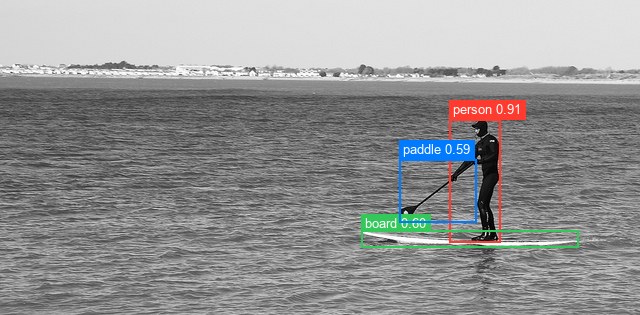
["a person", "a paddle", "a paddle board"]  ->  a 0.738, person 0.732, paddle 0.405
["person", "paddle", "board"]               ->  person 0.911, board 0.603, paddle 0.588
Prefer single words. Because a query matches one token, a multi-word phrase like
"paddle board" is reported by whichever of its tokens scored highest. Use "board"
rather than "paddle board" when a single word will do.
Model Variants
| Variant id | Image backbone | HF original |
|---|---|---|
grounding_dino_tiny |
Swin-Tiny | IDEA-Research/grounding-dino-tiny |
grounding_dino_base |
Swin-Base | IDEA-Research/grounding-dino-base |
Both use the same BERT text encoder and a 6-layer decoder with 900 queries.
Basic Usage: Open-Set Detection
import torch
from PIL import Image
from kerasformers.models.grounding_dino import (
    GroundingDinoForObjectDetection, GroundingDinoProcessor,
)

model = GroundingDinoForObjectDetection.from_weights("grounding_dino_tiny")
processor = GroundingDinoProcessor.from_weights("grounding_dino_tiny")

image = Image.open("assets/data/coco_paddleboard.jpg").convert("RGB")

# No articles: in "a paddle" the "a" can outscore the noun.
inputs = processor(images=image, text=["person", "paddle", "board"])

with torch.no_grad():          # see the memory note above
    output = model(inputs)
# output["logits"]:     (1, 900, 256)
# output["pred_boxes"]: (1, 900, 4)

results = processor.post_process_object_detection(
    output, threshold=0.3,
    target_sizes=[(image.height, image.width)],
    input_ids=inputs["input_ids"],
)[0]

detections = sorted(
    zip(results["scores"], results["text_labels"], results["boxes"]),
    key=lambda d: -float(d[0]),
)
for score, name, box in detections:
    print(f"{name:8s} {float(score):.3f}  {[round(float(v)) for v in box]}")
person   0.911  [449, 119, 500, 242]
board    0.603  [361, 230, 578, 247]
paddle   0.588  [399, 159, 476, 222]
Note that "paddle" and "board" are not COCO categories. This is the point of an open-set detector: a closed-set model can offer at best "surfboard" here, and nothing at all for the paddle.
Batch Processing Multiple Images
Pass a list of images and a list of label lists. The prompts do not have to match across images:
import torch
from PIL import Image
from kerasformers.models.grounding_dino import (
    GroundingDinoForObjectDetection, GroundingDinoProcessor,
)

model = GroundingDinoForObjectDetection.from_weights("grounding_dino_tiny")
# Batching a portrait with a landscape pads to the union of both. At the default
# 800/1333 that is ~29k tokens per image, enough to exhaust an 8 GB card.
processor = GroundingDinoProcessor.from_weights(
    "grounding_dino_tiny", shortest_edge=600, longest_edge=1000,
)

paths = ["assets/data/coco_bathroom.jpg", "assets/data/coco_motorcycle.jpg"]
images = [Image.open(p).convert("RGB") for p in paths]
texts = [["man", "toilet", "sink"], ["motorcycle", "helmet", "person"]]

inputs = processor(images=images, text=texts)

with torch.no_grad():
    output = model(inputs)

results = processor.post_process_object_detection(
    output, threshold=0.3,
    target_sizes=[(im.height, im.width) for im in images],
    input_ids=inputs["input_ids"],
)

for path, result in zip(paths, results):
    print(f"\n{path}")
    detections = sorted(
        zip(result["scores"], result["text_labels"], result["boxes"]),
        key=lambda d: -float(d[0]),
    )
    for score, name, box in detections:
        print(f"  {name:11s} {float(score):.3f}  {[round(float(v)) for v in box]}")
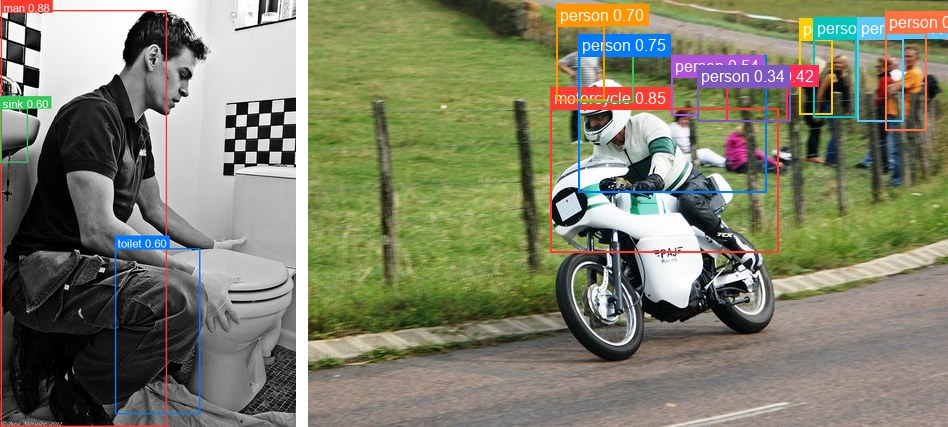
assets/data/coco_bathroom.jpg
  man         0.883  [1, 15, 249, 639]
  sink        0.602  [0, 162, 41, 243]
  toilet      0.598  [172, 372, 299, 620]

assets/data/coco_motorcycle.jpg
  motorcycle  0.852  [242, 108, 470, 252]
  helmet      0.846  [271, 55, 325, 102]
  person      0.752  [270, 55, 458, 192]
  person      0.703  [248, 25, 296, 100]
  person      0.536  [363, 76, 390, 115]
  person      0.461  [491, 39, 524, 114]
  person      0.443  [505, 38, 548, 117]
  person      0.420  [418, 86, 479, 121]
  person      0.410  [549, 38, 595, 121]
  person      0.369  [577, 32, 618, 130]
  person      0.335  [389, 86, 482, 121]
helmet is not a COCO category, and neither is the distinction it draws from the
rider wearing it. The long tail of low-scoring person boxes on the second image is
the crowd of spectators behind the rider.
Images are resized preserving aspect ratio and then padded to the batch's largest size,
with pixel_mask marking the real pixels. That is why batching mixed aspect ratios
works here without any manual stacking.
Input Resolution
Grounding DINO is subclassed, not Functional, so one built model handles any input size. Change the resolution on the processor alone:
processor = GroundingDinoProcessor.from_weights(
    "grounding_dino_tiny", shortest_edge=480, longest_edge=800,
)
The default 800/1333 follows the reference implementation. Lowering it is the main lever if memory is tight, since the deformable-attention cost grows with the token count: 800 on the short side gives roughly 20k tokens for a landscape image.
Data Format
Both the model and the processor support channels_last and channels_first.
| How it picks the format | |
|---|---|
| Processors | A data_format kwarg, per instance. None (the default) resolves to keras.config.image_data_format(). |
| Models | Read keras.config.image_data_format() when they are constructed. There is no data_format argument. |
Set the global format before constructing the model and both sides agree:
import keras

keras.config.set_image_data_format("channels_first")

model = GroundingDinoForObjectDetection.from_weights("grounding_dino_tiny")
processor = GroundingDinoProcessor.from_weights("grounding_dino_tiny")
Detections are identical under either layout; only the tensor shape changes. The
post-processor emits xyxy pixel boxes and token positions, so it takes no
data_format kwarg.
Loading Fine-tuned and Community Weights
Any Hugging Face repo whose model_type is "grounding-dino" loads directly with the
hf: prefix.
from kerasformers.models.grounding_dino import GroundingDinoForObjectDetection

# The original IDEA-Research checkpoints
model = GroundingDinoForObjectDetection.from_weights("hf:IDEA-Research/grounding-dino-tiny")

# Somebody's fine-tune
model = GroundingDinoForObjectDetection.from_weights("hf:<user>/grounding-dino-finetune")
No shape arguments are needed. The architecture is read from the repo's config.json.
Both model classes accept hf:, as do GroundingDinoProcessor,
GroundingDinoImageProcessor, and GroundingDinoTokenizer:
Loading hf:IDEA-Research/grounding-dino-tiny and the grounding_dino_tiny release
variant produces identical outputs, since they are the same checkpoint by two routes.