MaskFormer
from_weights(...).
MaskFormer's insight is in its title: per-pixel classification is not the only way to segment. Instead of labelling every pixel independently, it predicts a fixed set of binary masks, each paired with one class. A DETR-style transformer decoder turns 100 learned queries into 100 (mask, class) pairs, and how you combine them decides the task.
Fuse the masks by class and you get semantic segmentation. Keep them separate and resolve overlaps and you get panoptic. One trained model, both outputs, which is what "universal segmentation" means here.
Paper: Per-Pixel Classification is Not All You Need for Semantic Segmentation
API
MaskFormerUniversalSegment
MaskFormerUniversalSegment(backbone_embed_dim=96, backbone_depths=(2, 2, 6, 2),
                           backbone_num_heads=(3, 6, 12, 24),
                           backbone_window_size=7, fpn_feature_size=256,
                           mask_feature_size=256, decoder_d_model=256, ...,
                           name="MaskFormerUniversalSegment")
Swin backbone, pixel decoder, and transformer decoder producing per-query masks and classes. This is the class for segmentation.
Architecture arguments are filled in by from_weights from the variant config. The
ones worth knowing:
- backbone_embed_dim (
int, optional, defaults to96): Swin width.128for the base variants. - backbone_depths (
tuple, optional, defaults to(2, 2, 6, 2)): Swin stage depths. - backbone_window_size (
int, optional, defaults to7): Swin attention window.12for base. - mask_feature_size (
int, optional, defaults to256): width of the per-pixel embedding the masks are dotted against.
Call model(pixel_values, training=False). Returns a dict:
- class_queries_logits (
(B, 100, num_classes + 1)): one class distribution per query, with a trailing "no object" column. - masks_queries_logits (
(B, 100, H/4, W/4)): one binary mask logit map per query.
Neither is usable directly: the post-processors fuse them into a label map.
MaskFormerModel
The backbone and pixel decoder without the query heads.
Preprocessing
MaskFormerImageProcessor
MaskFormerImageProcessor(target_size=None, image_mean=None, image_std=None,
                         data_format=None, variant=None)
Resizes the longest edge to target_size preserving aspect ratio, pads to a square
canvas, rescales, and normalizes with ImageNet statistics.
Prefer
MaskFormerImageProcessor.from_weights(variant). The COCO checkpoints build at 384 and the ADE ones at 512, so a fixed default mismatches the model for one of the two and the forward pass raises on shape.
Parameters
- variant (
str, optional): release variant whose resolution to adopt. - target_size (
int, optional): square canvas edge, overridingvariant. Falls back to512. - image_mean / image_std (
tuple, optional): defaults to the ImageNet statistics. - data_format (
str, optional):"channels_last"or"channels_first".
post_process_panoptic_segmentation
processor.post_process_panoptic_segmentation(outputs, target_size,
                                             threshold=0.8, mask_threshold=0.5,
                                             overlap_mask_area_threshold=0.8,
                                             stuff_classes=None,
                                             label_names=None)
Resolves the 100 queries into one non-overlapping map. Returns a dict:
- segmentation (
(H, W)int32): the segment id per pixel,-1where nothing survived. - segments_info: one entry per segment with
id,label_id,label_name, andscore.
label_names defaults to the label set matching the head width, so COCO panoptic's 133
classes resolve automatically.
post_process_semantic_segmentation
Fuses queries by class instead. Note this one takes target_sizes (a list) and
returns a list of (H, W) arrays, unlike the panoptic method's singular target_size.
Model Variants
| Variant id | Backbone | Training set | Resolution |
|---|---|---|---|
maskformer-swin-tiny-coco |
Swin-Tiny | COCO panoptic | 384 |
maskformer-swin-small-coco |
Swin-Small | COCO panoptic | 384 |
maskformer-swin-base-coco |
Swin-Base | COCO panoptic | 384 |
maskformer-swin-tiny-ade |
Swin-Tiny | ADE20K | 512 |
maskformer-swin-base-ade |
Swin-Base | ADE20K | 512 |
The COCO variants use the 133-class panoptic vocabulary, which splits into things
(countable objects) and stuff (amorphous regions like sea or grass).
Basic Usage: Panoptic Segmentation
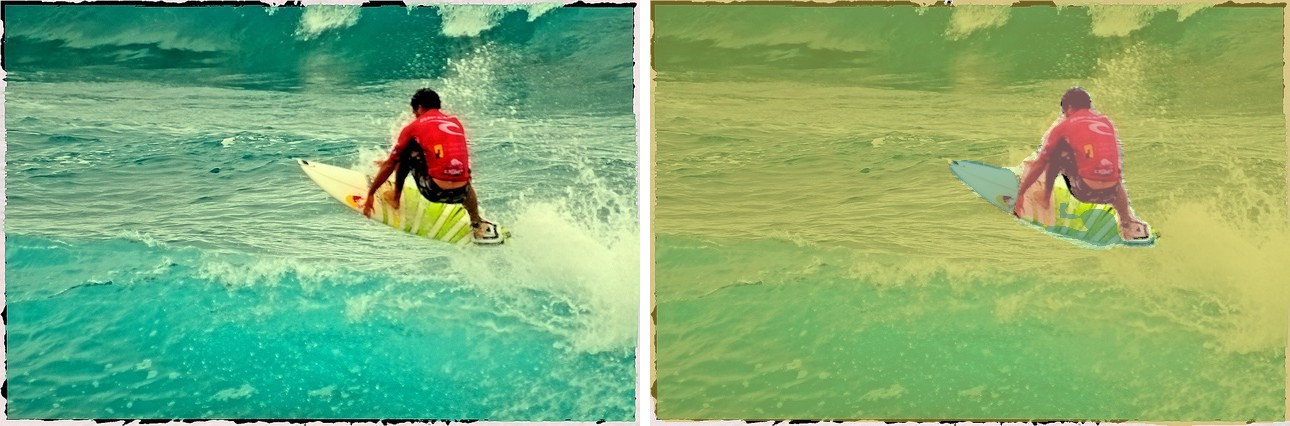
Each figure is the original image beside the predicted segmentation overlaid on it.
import keras
import numpy as np
from PIL import Image
from kerasformers.models.maskformer import (
    MaskFormerImageProcessor, MaskFormerUniversalSegment,
)

model = MaskFormerUniversalSegment.from_weights("maskformer-swin-tiny-coco")
processor = MaskFormerImageProcessor.from_weights("maskformer-swin-tiny-coco")  # 384

image = Image.open("assets/data/coco_surfer_wave.jpg").convert("RGB")
output = model(processor(image)["pixel_values"], training=False)
# output["class_queries_logits"]: (1, 100, 134)
# output["masks_queries_logits"]: (1, 100, 96, 96)

result = processor.post_process_panoptic_segmentation(
    output, target_size=(image.height, image.width)
)
seg = np.asarray(keras.ops.convert_to_numpy(result["segmentation"]))

for s in result["segments_info"]:
    area = int((seg == s["id"]).sum())
    print(f"{s['label_name']:22s} {area} px  score {s['score']:.3f}")
The stuff: and things: prefixes come from COCO panoptic's vocabulary. sea is
stuff, a region with no instance identity; person and surfboard are things, and two
surfers would be two separate segments rather than one merged region. That distinction
is exactly what semantic segmentation cannot express.
Batch Processing Multiple Images
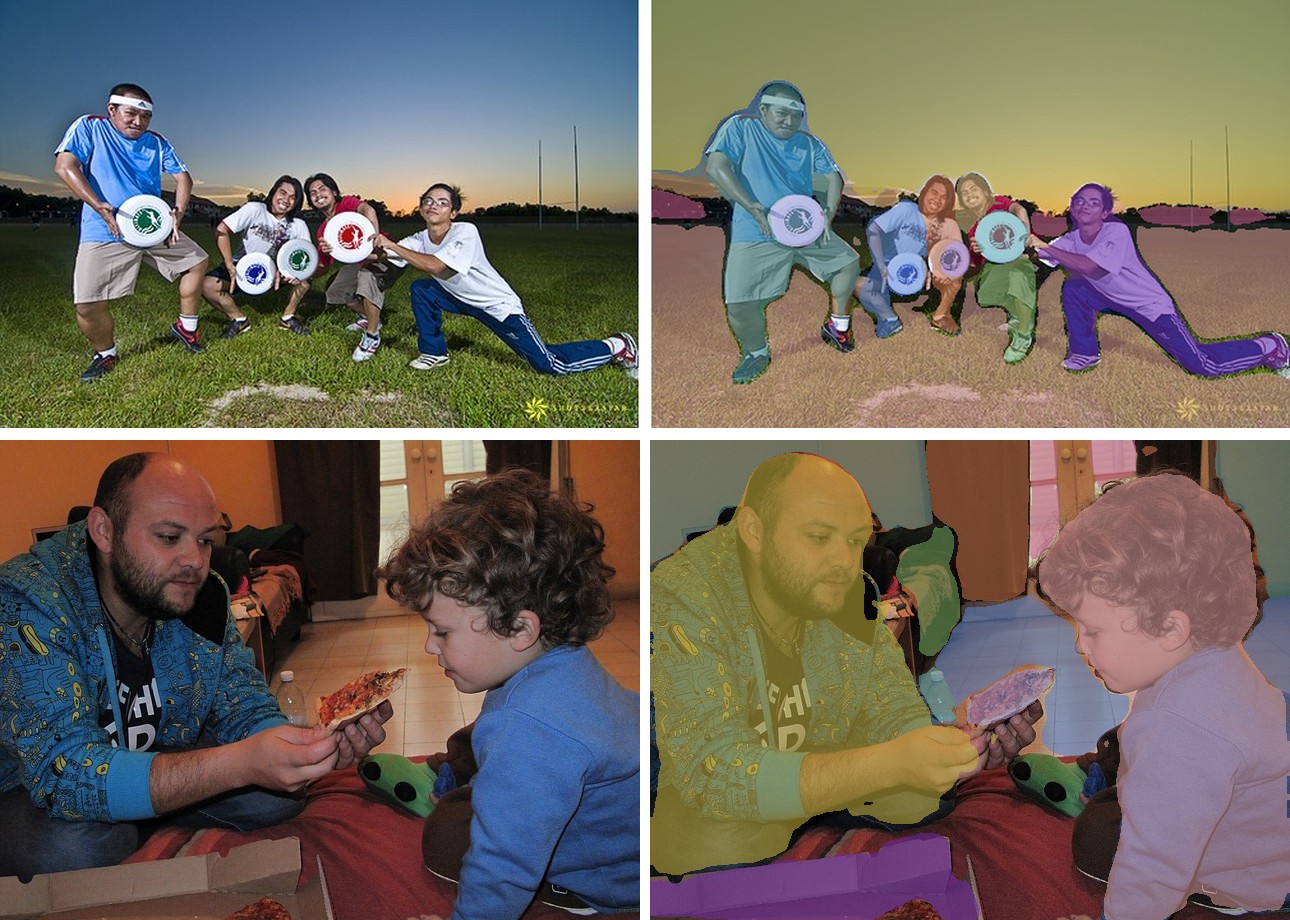
Post-process one image at a time, since each has its own target size:
import keras
import numpy as np
from PIL import Image
from kerasformers.models.maskformer import (
    MaskFormerImageProcessor, MaskFormerUniversalSegment,
)

model = MaskFormerUniversalSegment.from_weights("maskformer-swin-tiny-coco")
processor = MaskFormerImageProcessor.from_weights("maskformer-swin-tiny-coco")

paths = ["assets/data/coco_frisbee.jpg", "assets/data/coco_pizza_kid.jpg"]

for path in paths:
    image = Image.open(path).convert("RGB")
    output = model(processor(image)["pixel_values"], training=False)
    result = processor.post_process_panoptic_segmentation(
        output, target_size=(image.height, image.width)
    )
    seg = np.asarray(keras.ops.convert_to_numpy(result["segmentation"]))
    print(f"\n{path}")
    for s in result["segments_info"][:6]:
        print(f"  {s['label_name']:26s} {int((seg == s['id']).sum())} px")
assets/data/coco_frisbee.jpg
  stuff: fence-merged               68765 px
  stuff: grass-merged               48836 px
  things: person                    13086 px
  things: person                    9910 px
  things: person                    2822 px
  things: person                    2274 px

assets/data/coco_pizza_kid.jpg
  things: person                    88764 px
  things: person                    74544 px
  stuff: wall-other-merged          24413 px
  stuff: cardboard                  18209 px
  stuff: floor-other-merged         17554 px
  stuff: door-stuff                 13612 px
The frisbee image yields 14 segments in total, including five separate person
entries and four separate frisbee entries. Every one is its own segment with its own
id, which is the whole point of panoptic over semantic.
Data Format
Both the model and the processor support channels_last and channels_first.
| How it picks the format | |
|---|---|
| Processors | A data_format kwarg, per instance. None (the default) resolves to keras.config.image_data_format(). |
| Models | Read keras.config.image_data_format() when they are constructed. There is no data_format argument. |
The post-processors emit (H, W) label maps and segment metadata, so they take no
data_format kwarg.
Custom Class Names
A model fine-tuned on your own dataset predicts your class indices:
result = processor.post_process_panoptic_segmentation(
    output, target_size=(image.height, image.width),
    label_names=["background", "road", "building"],
)
Without it the post-processor picks COCO panoptic, ADE20K, or Cityscapes names from the
head width, and falls back to class_57 placeholders when the width matches none of
them.
Loading Fine-tuned and Community Weights
Any Hugging Face repo whose model_type is "maskformer" loads with the hf: prefix.
from kerasformers.models.maskformer import MaskFormerUniversalSegment

model = MaskFormerUniversalSegment.from_weights("hf:facebook/maskformer-swin-tiny-coco")
model = MaskFormerUniversalSegment.from_weights("hf:<user>/maskformer-finetuned")

# Architecture only, randomly initialized
model = MaskFormerUniversalSegment.from_weights(
    "maskformer-swin-tiny-coco", load_weights=False,
)
See also Mask2Former, the direct successor with masked attention, and OneFormer, which adds task conditioning to the same idea.