Mask2Former
from_weights(...).
Mask2Former keeps MaskFormer's formulation, a fixed set of (mask, class) query predictions, and fixes the part that made it slow to train: attention.
In MaskFormer each query attends over the entire image, most of which is irrelevant to the region it will eventually own. Mask2Former uses masked attention, restricting each query's cross-attention to the area inside its own predicted mask from the previous layer. Queries specialize sooner, training converges faster, and accuracy improves across all three segmentation tasks. It also feeds the decoder multi-scale features in a round-robin so small objects are not lost.
Paper: Masked-attention Mask Transformer for Universal Image Segmentation
API
Mask2FormerUniversalSegment
Swin backbone, multi-scale deformable pixel decoder, and the masked-attention transformer decoder. This is the class for segmentation.
Architecture arguments are filled in by from_weights from the variant config.
Call model(pixel_values, training=False). Returns a dict:
- class_queries_logits (
(B, 100, num_classes + 1)): one class distribution per query, with a trailing "no object" column. - masks_queries_logits (
(B, 100, H/4, W/4)): one binary mask logit map per query.
The output format is identical to MaskFormer's, which is why both share the same post-processors.
Mask2FormerModel
Mask2FormerModel(backbone_embed_dim=96, backbone_depths=(2, 2, 6, 2),
                 backbone_num_heads=(3, 6, 12, 24), backbone_window_size=12,
                 hidden_dim=256, mask_feature_size=256, encoder_num_layers=6,
                 ..., name="Mask2FormerModel")
The backbone and pixel decoder without the query heads.
Preprocessing
Mask2FormerImageProcessor
Resizes the longest edge to target_size preserving aspect ratio, pads to a square
canvas, rescales, and normalizes with ImageNet statistics.
Parameters
- target_size (
int, optional, defaults to384): square canvas edge, matching the model'simage_size. - image_mean / image_std (
tuple, optional): defaults to the ImageNet statistics. - data_format (
str, optional):"channels_last"or"channels_first".
post_process_panoptic_segmentation
processor.post_process_panoptic_segmentation(outputs, target_size,
                                             threshold=0.8, mask_threshold=0.5,
                                             overlap_mask_area_threshold=0.8,
                                             stuff_classes=None,
                                             label_names=None)
Resolves the queries into one non-overlapping map. Returns a dict with
segmentation (H, W) int32 (-1 where nothing survived) and segments_info
entries carrying id, label_id, label_name, and score.
post_process_semantic_segmentation
Fuses queries by class. Takes target_sizes (a list) and returns a list of
(H, W) arrays, unlike the panoptic method's singular target_size.
Both delegate to MaskFormer's implementations, since the output format is the same.
label_names defaults to the label set matching the head width.
Model Variants
| Variant id | Backbone | Task | Training set |
|---|---|---|---|
mask2former-swin-tiny-coco-instance |
Swin-Tiny | instance | COCO |
mask2former-swin-small-coco-instance |
Swin-Small | instance | COCO |
mask2former-swin-base-coco-instance |
Swin-Base | instance | COCO |
mask2former-swin-large-coco-instance |
Swin-Large | instance | COCO |
mask2former-swin-tiny-coco-panoptic |
Swin-Tiny | panoptic | COCO |
mask2former-swin-tiny-ade-semantic |
Swin-Tiny | semantic | ADE20K |
The task suffix is what the checkpoint was trained for. The architecture is the same in every case, so a panoptic checkpoint can still be post-processed semantically, but a checkpoint trained for instance segmentation has no stuff classes to offer.
Basic Usage: Panoptic Segmentation
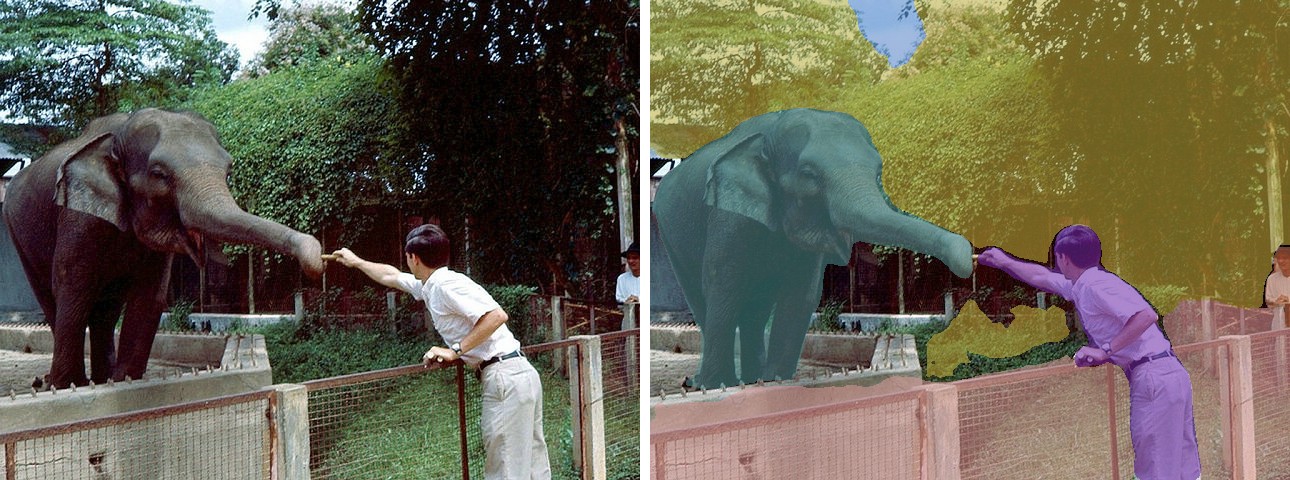
Each figure is the original image beside the predicted segmentation overlaid on it.
import keras
import numpy as np
from PIL import Image
from kerasformers.models.mask2former import (
    Mask2FormerImageProcessor, Mask2FormerUniversalSegment,
)

model = Mask2FormerUniversalSegment.from_weights("mask2former-swin-tiny-coco-panoptic")
processor = Mask2FormerImageProcessor()

image = Image.open("assets/data/coco_elephant_trainer.jpg").convert("RGB")
output = model(processor(image)["pixel_values"], training=False)
# output["class_queries_logits"]: (1, 100, 134)
# output["masks_queries_logits"]: (1, 100, 96, 96)

result = processor.post_process_panoptic_segmentation(
    output, target_size=(image.height, image.width)
)
seg = np.asarray(keras.ops.convert_to_numpy(result["segmentation"]))

for s in result["segments_info"]:
    print(f"{s['label_name']:28s} {int((seg == s['id']).sum())} px  score {s['score']:.3f}")
stuff: window-blind             138787 px
stuff: window-other             65415 px
things: elephant                47346 px
things: person                  18440 px
stuff: fence-merged             3434 px
things: person                  1311 px
Two separate person segments, one large and one small, each with its own id. A
semantic model would merge them into a single person region.
Batch Processing Multiple Images
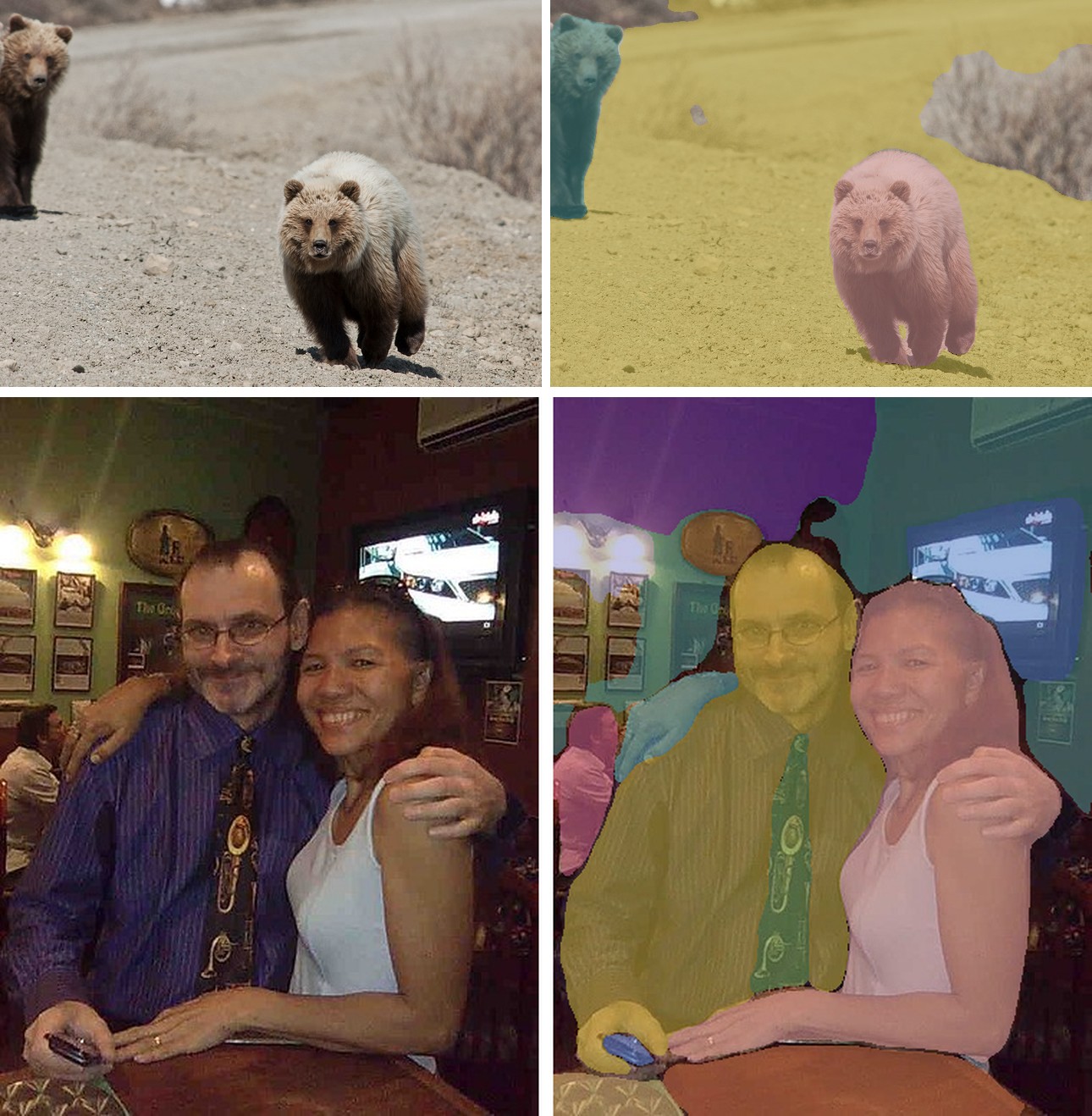
Post-process one image at a time, since each has its own target size:
import keras
import numpy as np
from PIL import Image
from kerasformers.models.mask2former import (
    Mask2FormerImageProcessor, Mask2FormerUniversalSegment,
)

model = Mask2FormerUniversalSegment.from_weights("mask2former-swin-tiny-coco-panoptic")
processor = Mask2FormerImageProcessor()

paths = ["assets/data/coco_bear_cub.jpg", "assets/data/coco_couple.jpg"]

for path in paths:
    image = Image.open(path).convert("RGB")
    output = model(processor(image)["pixel_values"], training=False)
    result = processor.post_process_panoptic_segmentation(
        output, target_size=(image.height, image.width)
    )
    seg = np.asarray(keras.ops.convert_to_numpy(result["segmentation"]))
    print(f"\n{path}")
    for s in result["segments_info"][:6]:
        print(f"  {s['label_name']:28s} {int((seg == s['id']).sum())} px")
assets/data/coco_bear_cub.jpg
  stuff: dirt-merged               213329 px
  things: bear                     35128 px
  things: bear                     14020 px

assets/data/coco_couple.jpg
  things: person                   42659 px
  things: person                   40521 px
  stuff: wall-other-merged         24970 px
  stuff: tree-merged               18400 px
  things: tv                       10321 px
  things: dining table             10061 px
The first image finds two bears, one in the foreground and a smaller one behind,
as separate segments. The second yields 13 segments in total, including a tie, a
handbag, a clock and a cell phone alongside the two people.
Data Format
Both the model and the processor support channels_last and channels_first.
| How it picks the format | |
|---|---|
| Processors | A data_format kwarg, per instance. None (the default) resolves to keras.config.image_data_format(). |
| Models | Read keras.config.image_data_format() when they are constructed. There is no data_format argument. |
The post-processors emit (H, W) label maps and segment metadata, so they take no
data_format kwarg.
Loading Fine-tuned and Community Weights
Any Hugging Face repo whose model_type is "mask2former" loads with the hf: prefix.
from kerasformers.models.mask2former import Mask2FormerUniversalSegment

model = Mask2FormerUniversalSegment.from_weights(
    "hf:facebook/mask2former-swin-tiny-coco-panoptic"
)
model = Mask2FormerUniversalSegment.from_weights("hf:<user>/mask2former-finetuned")

# Architecture only, randomly initialized
model = Mask2FormerUniversalSegment.from_weights(
    "mask2former-swin-tiny-coco-panoptic", load_weights=False,
)
See also MaskFormer, the predecessor whose post-processors this model shares, and OneFormer, which conditions one checkpoint on the task.