SAM3
huggingface-cli login or export HF_TOKEN=....
The first from_weights call downloads the checkpoint, converts it, and caches
the result at ~/.cache/kerasformers/sam3_saco/ (about 3.1 GB); later calls load
straight from that cache.
SAM3 breaks with SAM and SAM2: instead of a click or a box saying this thing here, you give it a noun phrase and it finds every instance. "car" returns eleven cars; "person" returns ninety-five people including the crowd in the stands. The prompt is a concept, not a location, so a single call segments an open vocabulary the model was never given a fixed label set for.
Architecturally it is a different model too: a ViT-L backbone and FPN feed a DETR-style encoder/decoder with 200 object queries, a CLIP text encoder supplies the open-vocabulary side, and a mask decoder turns each surviving query into a mask. Boxes are still available, through a geometry encoder, and can be mixed with text.
Paper: SAM 3: Segment Anything with Concepts
API
Three task wrappers share one SAM3Model. They differ only in what they return.
SAM3Detect(model=None, variant="sam3_saco", load_weights=True)
SAM3InstanceSegment(model=None, variant="sam3_saco", load_weights=True)
SAM3SemanticSegment(model=None, variant="sam3_saco", load_weights=True)
Constructing one with no arguments loads sam3_saco. Pass model= to share a loaded
backbone rather than paying for a second copy:
from kerasformers.models.sam3 import (
    SAM3Detect, SAM3InstanceSegment, SAM3SemanticSegment,
)

segmenter = SAM3InstanceSegment()
detector = SAM3Detect(model=segmenter.model)          # same weights, no reload
semantic = SAM3SemanticSegment(model=segmenter.model)
predict
task.predict(images=None, text=None, input_boxes=None, input_boxes_labels=None,
             threshold=0.3, vision_embeds=None, text_embeds=None)
SAM3InstanceSegment.predict also takes mask_threshold=0.5. All three return a list
with one entry per image:
| Class | Each entry |
|---|---|
SAM3Detect |
{"scores": (N,), "boxes": (N, 4)}, boxes (x1, y1, x2, y2) in original pixels |
SAM3InstanceSegment |
the same plus "masks" (N, H, W) int32, at original resolution |
SAM3SemanticSegment |
a single (H, W) int32 mask, not a dict |
images accepts a path, a PIL image, a numpy array, or a list of any of those.
SAM3Model
The functional model underneath. Its detect / segment_instances / segment_semantic
methods are what the wrappers delegate to, and encode_image / encode_text are the
caching entry points. Raw outputs:
- pred_logits
(B, 200)and presence_logits: multiply the sigmoids to get scores. - pred_boxes
(B, 200, 4)normalizedcxcywh. - pred_masks
(B, 200, 288, 288)per-query mask logits. - semantic_seg
(B, 288, 288, 1)logits.
Free functions post_process_object_detection, post_process_instance_segmentation and
post_process_semantic_segmentation turn those into the dicts above if you drive the
model directly.
Model Variants
| Variant id | Backbone | Params | Source |
|---|---|---|---|
sam3_saco |
ViT-L/14 | ~839 M | facebook/sam3 (gated) |
One variant. Input resolution is fixed at 1008x1008: the ViT uses windowed attention
with 2-D RoPE sized to a 72x72 patch grid, and predict always preprocesses to that size.
Text Prompts
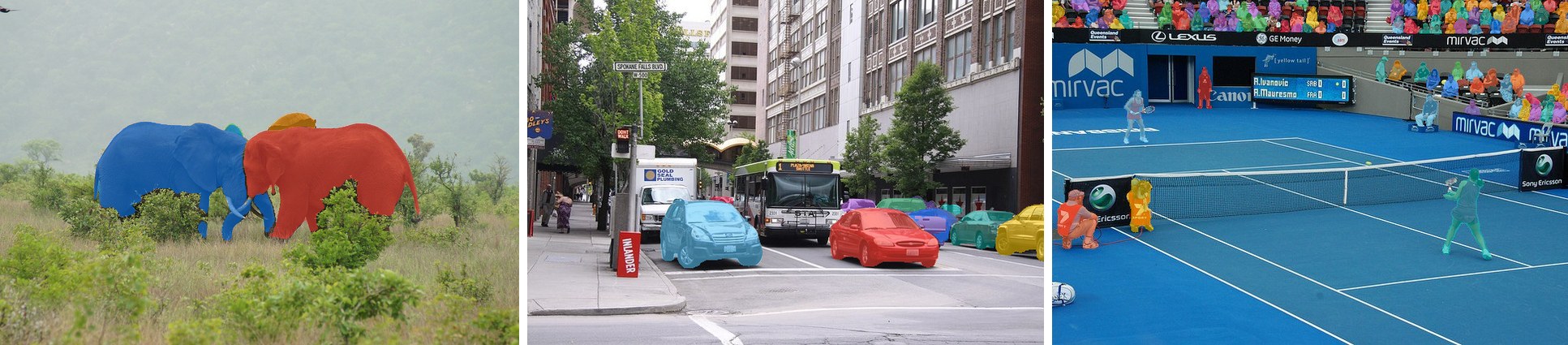
import torch
from kerasformers.models.sam3 import SAM3InstanceSegment

segmenter = SAM3InstanceSegment()

with torch.no_grad():
    result = segmenter.predict(
        images="assets/data/coco_elephants.jpg", text="elephant"
    )[0]

print(len(result["scores"]), [round(float(s), 3) for s in result["scores"]])
print(result["masks"].shape)
The same call with text="car" on a street scene returns 11 instances, and
text="person" on a tennis match returns 95, including the spectators. Nothing about
the prompt is drawn from a fixed label set.
Wrap inference in
torch.no_grad()on the torch backend. A ViT-L at 1008x1008 is 5184 tokens per image, and autograd will hold every intermediate.
Threshold
threshold filters on sigmoid(pred_logits) * sigmoid(presence_logits). On the street
scene with text="car":
threshold |
instances |
|---|---|
0.1 |
26 |
0.3 (default) |
11 |
0.5 |
6 |
0.7 |
5 |
Open-vocabulary scores are not calibrated across prompts. Sweep it per prompt rather than trusting the default.
Box Prompts
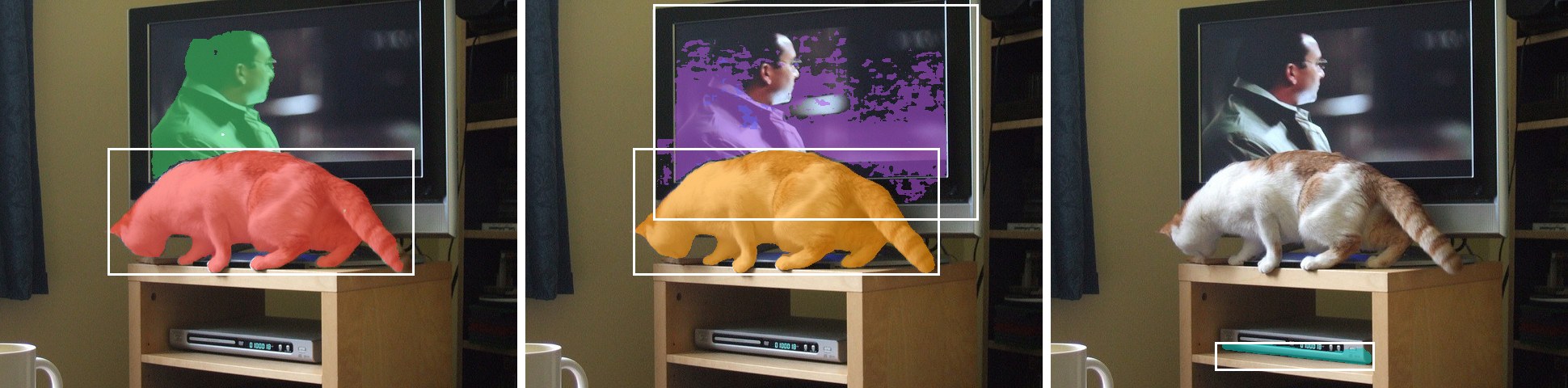
A box says this region, and needs no text at all. Coordinates are (x1, y1, x2, y2)
in original pixels.
CAT = [133, 183, 512, 340]
TV = [158, 5, 560, 272]

with torch.no_grad():
    result = segmenter.predict(
        images="assets/data/coco_cat_tv.jpg", input_boxes=[[CAT]]
    )[0]
print(len(result["scores"]), [round(float(s), 3) for s in result["scores"]])
input_boxesis nested per image. The outer list is the batch. Two boxes on one image is[[CAT, TV]]; writing[CAT, TV]is read as one box for each of two images, and since only one image was passed, the second box is silently dropped. The call succeeds and returns the single-box answer, so nothing warns you.
With both boxes, [[CAT, TV]] returns 3 instances scoring [0.695, 0.965, 0.859].
Boxes reach objects that are awkward to name. A box on the DVD player,
[[203, 423, 400, 458]], returns one mask at 0.934, against 0.884 for the text
prompt "dvd player".
Mixing Text and Boxes
Pass both, and label each box. Labels index a learned Embedding(2, dim), so 0 and
1 are conditioning signals, not a hard include/exclude:
with torch.no_grad():
    result = segmenter.predict(
        images="assets/data/coco_cat_tv.jpg",
        text="cat",
        input_boxes=[[CAT]],
        input_boxes_labels=[[0]],      # 0 = negative, 1 = positive
    )[0]
| Call | instances | top score |
|---|---|---|
text="cat" |
1 | 0.978 |
text="cat" + negative box on the cat |
1 | 0.481 |
The cat survives, but its score halves. A negative box suppresses, it does not delete. If you need it gone, threshold on the suppressed score.
Leaving text=None while passing boxes substitutes the prompt "visual" for you, which
is the box-only mode above. Every image in a batch needs either text or boxes, or
predict raises.
Semantic Segmentation
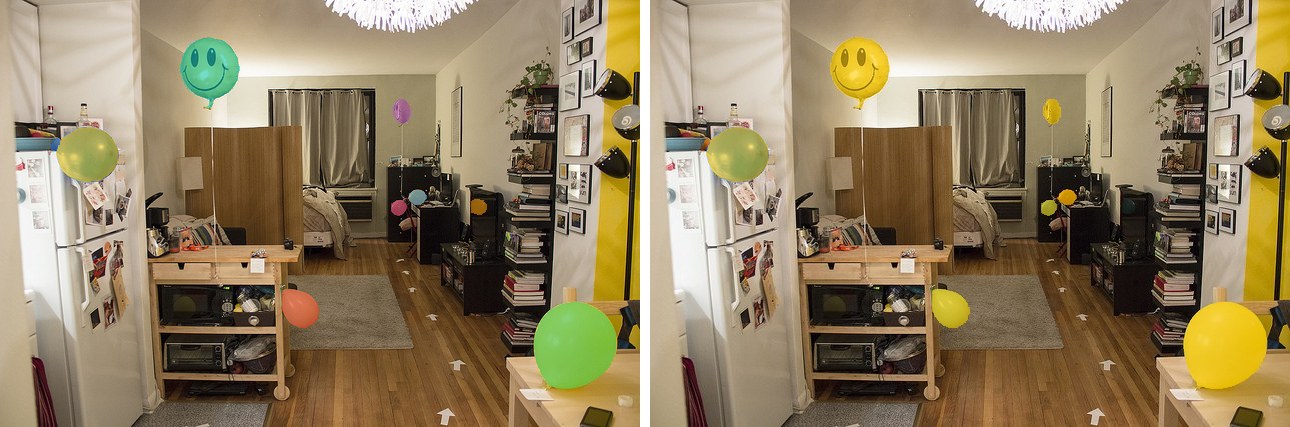
Same prompt, same image, different question. Instance mode asks which balloons; semantic mode asks where is balloon, and returns one merged binary mask.
from kerasformers.models.sam3 import SAM3SemanticSegment

semantic = SAM3SemanticSegment(model=segmenter.model)

with torch.no_grad():
    mask = semantic.predict(images="assets/data/coco_apartment.jpg", text="balloon")[0]

print(mask.shape, mask.dtype, int(mask.sum()), sorted(set(mask.ravel().tolist())))
The instance call on the same image returns 9 separate masks. Note the return is a bare
array per image, not a dict, and threshold here defaults to 0.5 and binarizes the
semantic map rather than filtering queries.
Detection Only
Skip the mask decoder when boxes are all you need:
from kerasformers.models.sam3 import SAM3Detect

detector = SAM3Detect(model=segmenter.model)

with torch.no_grad():
    result = detector.predict(images="assets/data/coco_city_bus.jpg", text="car")[0]

print(sorted(result), len(result["scores"]))
print([[round(float(v), 1) for v in b] for b in result["boxes"][:2]])
Encode Once, Prompt Many Times
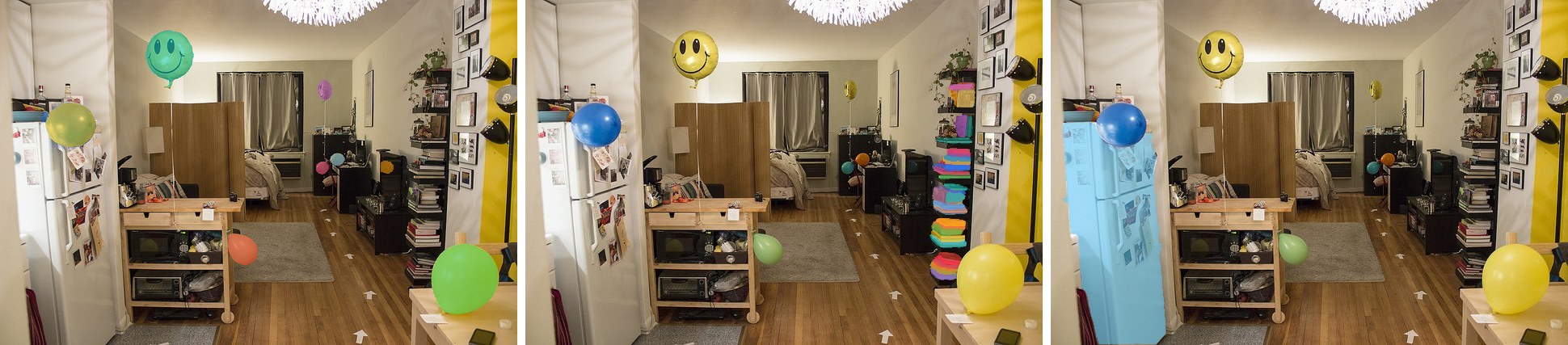
The ViT-L dominates the cost and does not depend on the prompt, so cache it with
encode_image and pay only the decoder per prompt:
import torch
from kerasformers.models.sam3 import SAM3InstanceSegment

segmenter = SAM3InstanceSegment()

with torch.no_grad():
    features = segmenter.model.encode_image("assets/data/coco_apartment.jpg")
print(sorted(features))

for prompt in ("balloon", "book", "refrigerator"):
    with torch.no_grad():
        r = segmenter.predict(text=prompt, vision_embeds=features)[0]
    print(f"{prompt:14s} {len(r['scores']):3d}  {r['scores'].max():.3f}")
['fpn_0', 'fpn_1', 'fpn_2', 'fpn_3', 'original_size', 'text_projected']
balloon          9  0.969
book            52  0.692
refrigerator     1  0.977
The balloon row reproduces the uncached call exactly, which is the point: caching moves
where the time goes, not the answer.
encode_text is the mirror image, for one prompt against many images:
text = segmenter.model.encode_text("balloon")
r = segmenter.predict(images="other.jpg", text_embeds=text)[0]
vision_embedsis single-image and text-only. It carries oneoriginal_size, so the batch axis is fixed at 1, and the cached path holds nopixel_valuesfor the geometry encoder to read, so it cannot be combined withinput_boxes.
Batching
Pass a list of images. One shared prompt applies to all; a list of prompts pairs positionally.
images = ["a.jpg", "b.jpg"]

with torch.no_grad():
    rs = segmenter.predict(images=images, text="animal")              # shared
    rs = segmenter.predict(images=images, text=["elephant", "bus"])   # per image
    rs = segmenter.predict(images=images, text=["elephant", None],
                           input_boxes=[[], [[200, 150, 400, 330]]])  # mixed
In the mixed form, None text with boxes falls back to "visual", and [] means that
image has no boxes. Batched rows are identical to running the images one at a time,
verified against the same image duplicated.
Batching is memory-bound, not compute-bound. Two images at 1008x1008 through a ViT-L needs roughly 3 GB more than an 8 GB card has free, so batch size 2 already OOMs there. Looping one image at a time costs the same compute and is the practical choice on consumer hardware. Box prompts are looped internally regardless: the geometry encoder runs once per image.
Data Format
channels_last and channels_first are both supported. The model reads
keras.config.image_data_format() when it is constructed, so set it first:
import keras
keras.config.set_image_data_format("channels_first")

from kerasformers.models.sam3 import SAM3InstanceSegment
segmenter = SAM3InstanceSegment()
Returned masks and boxes are in original-image pixel space either way.
Visualization
sam3_utils ships the overlay helpers used for the figures above:
from kerasformers.models.sam3.sam3_utils import (
    draw_detections, draw_instance_masks, draw_semantic_mask,
)

draw_instance_masks(image, result, title="balloons").save("out.jpg")
Tokenizer
SAM3CLIPTokenizer is the OpenAI CLIP BPE tokenizer with max_seq_len=32. It resolves
tokenizer.json from the gated repo on the fly, so it needs the same authentication as
the weights. encode returns an (input_ids, attention_mask) tuple, not a dict.
from kerasformers.models.sam3 import SAM3CLIPTokenizer

tokenizer = SAM3CLIPTokenizer()
input_ids, attention_mask = tokenizer.encode("a photo of a cat")
See also SAM and SAM2, which prompt by location rather than concept.