DINOv3
huggingface-cli login or export HF_TOKEN=....
The first from_weights call downloads the checkpoint, converts it, and caches
the result under ~/.cache/kerasformers/; later calls load from that cache.
DINOv3 pushes DINOv2's self-supervised features further, on 1.7 B images, and adds two architectural pieces aimed squarely at dense features: register tokens, extra learned tokens that soak up the global-information artifacts that otherwise show up as high-norm outlier patches, and rotary position embeddings, which encode position by rotating queries and keys rather than adding a learned table. It also ships a ConvNeXt line for a convolutional alternative.
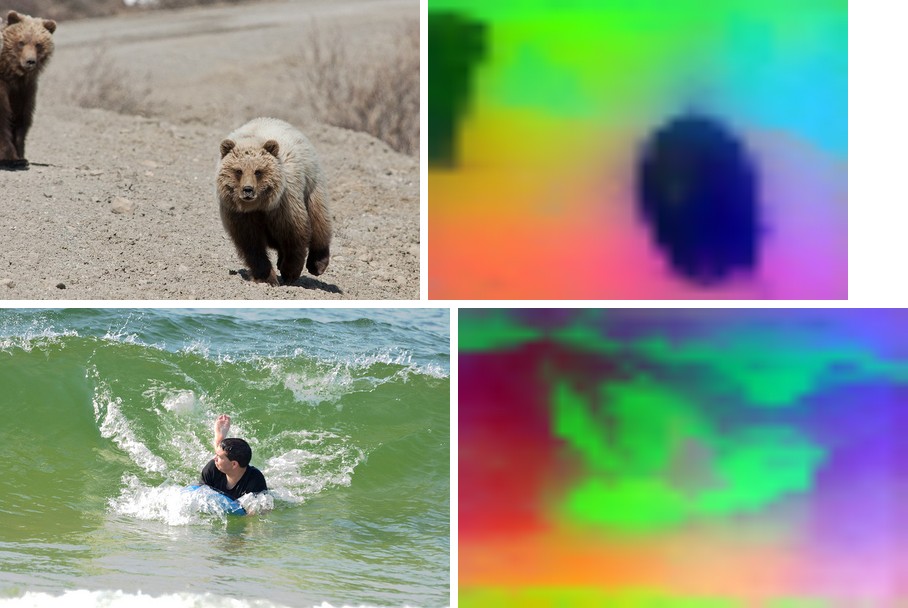
Like the earlier DINOs these are backbones, not task models. The figures below PCA the patch features to three RGB components; the register tokens make the resulting maps noticeably cleaner than DINOv2's.
Paper: DINOv3: Self-Supervised Visual Representation Learning at Scale
API
DinoV3ViTModel
DinoV3ViTModel(as_backbone=False, patch_size=16, embed_dim=768, depth=12,
               num_heads=12, mlp_ratio=4.0, use_swiglu=False,
               num_register_tokens=4, layer_scale_init=1.0, rope_theta=100.0,
               query_bias=True, key_bias=False, value_bias=True,
               hidden_act="gelu", mlp_bias=True, layer_norm_eps=1e-5,
               include_normalization=True, normalization_mode="imagenet",
               image_size=224, input_tensor=None, name="DinoV3ViTModel")
The DINOv3 Vision Transformer with RoPE and register tokens. This is the main backbone class.
Parameters
- as_backbone (
bool, optional, defaults toFalse): return a list of intermediate feature maps instead of the final token sequence. - patch_size (
int, optional, defaults to16): pixels per patch. - embed_dim / depth / num_heads (
int, optional): transformer width, blocks, and heads. Filled in byfrom_weightsfrom the variant config. - use_swiglu (
bool, optional, defaults toFalse): SwiGLU MLP instead of GELU, used by the larger variants. - num_register_tokens (
int, optional, defaults to4): learned register tokens inserted after[CLS]. The token layout is[CLS, registers..., patches...]. - rope_theta (
float, optional, defaults to100.0): rotary position embedding base. Position is applied on the fly, so there is no learned position table to interpolate. - layer_scale_init, query_bias / key_bias / value_bias, hidden_act, mlp_bias, layer_norm_eps: block-level knobs, all set from the variant config.
- include_normalization (
bool, optional, defaults toTrue): normalize inside the model, so you feed raw[0, 255]pixels. - image_size (
intortuple, optional, defaults to224): input resolution the model is built for. - input_tensor (
dict, optional): pre-existing input tensors to build on. - name (
str, optional, defaults to"DinoV3ViTModel"): model name.
Call model(pixel_values, training=False) with raw [0, 255] pixels. Returns the
token sequence (B, 1 + num_register_tokens + num_patches, embed_dim). With
as_backbone=True, a list of intermediate tensors.
DinoV3ConvNeXtModel
DinoV3ConvNeXtModel(as_backbone=False, depths=None, projection_dim=None,
                    include_normalization=True, normalization_mode="imagenet",
                    image_size=224, input_tensor=None, name="DinoV3ConvNeXtModel")
The DINOv3 ConvNeXt backbone, a convolutional alternative. Returns the final spatial
feature map ((B, 7, 7, 768) for the tiny variant under channels_last), or with
as_backbone=True the per-stage maps.
Preprocessing
There is no separate image processor. Both models carry include_normalization=True, so
feed raw [0, 255] pixels resized to the model's image_size; normalization happens
inside. Pass include_normalization=False if you have already normalized.
Model Variants
| Variant id | Backbone | Patch | Params |
|---|---|---|---|
dinov3_vits16 |
ViT-S | 16 | ~21 M |
dinov3_vitb16 |
ViT-B | 16 | ~86 M |
dinov3_vitl16 |
ViT-L | 16 | ~300 M |
dinov3_convnext_tiny |
ConvNeXt-T | n/a | ~29 M |
dinov3_convnext_small |
ConvNeXt-S | n/a | ~50 M |
dinov3_convnext_base |
ConvNeXt-B | n/a | ~89 M |
dinov3_convnext_large |
ConvNeXt-L | n/a | ~198 M |
Basic Usage: Feature Extraction
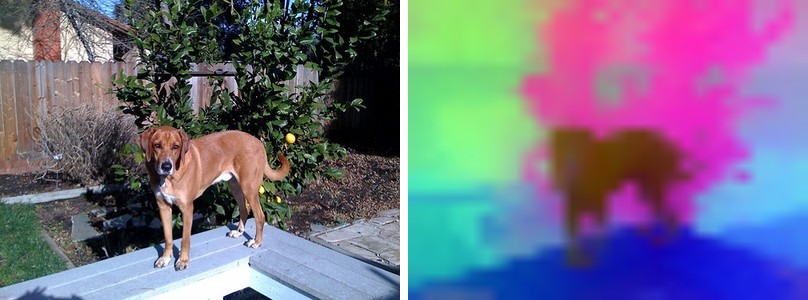
Run the backbone, drop the [CLS] and the register tokens, then PCA the patch
features to three components. The dog, the foliage, and the deck each take a distinct
colour.
import keras
import numpy as np
import torch
from PIL import Image
from kerasformers.models.dino_v3 import DinoV3ViTModel

size, patch, registers = 448, 16, 4
model = DinoV3ViTModel.from_weights("dinov3_vits16", image_size=size)

image = Image.open("assets/data/coco_dog_yard.jpg").convert("RGB")
x = np.asarray(image.resize((size, size)))[None].astype("float32")   # raw [0, 255]

with torch.no_grad():
    tokens = model(x, training=False)
tokens = np.asarray(keras.ops.convert_to_numpy(tokens))[0]
print(tokens.shape)   # (1 + registers + num_patches, embed_dim)

# PCA the patch tokens (drop the CLS token and the register tokens) to RGB.
grid = size // patch
prefix = 1 + registers
patches = tokens[prefix:prefix + grid * grid].reshape(grid * grid, -1).astype("float64")
patches -= patches.mean(0, keepdims=True)
proj = patches @ np.linalg.svd(patches, full_matrices=False)[2][:3].T
proj = proj.reshape(grid, grid, 3)
lo, hi = proj.min((0, 1)), proj.max((0, 1))
proj = (proj - lo) / (hi - lo + 1e-8)

vis = Image.fromarray((proj * 255).astype("uint8")).resize(image.size, Image.BILINEAR)
vis.save("assets/dinov3_pca.jpg")
789 = 1 + 4 + 28 * 28: the [CLS] token, four register tokens, and a 28x28 patch grid
at 448/16. Forgetting to drop the register tokens shifts every patch by four and
scrambles the map, so always slice from 1 + num_register_tokens.
Use
torch.no_grad()on the torch backend. These are pure forward passes; autograd would retain every intermediate for nothing.
Batch Processing Multiple Images
Stack images that share a size into one batch:
import keras
import numpy as np
import torch
from PIL import Image
from kerasformers.models.dino_v3 import DinoV3ViTModel

size = 448
model = DinoV3ViTModel.from_weights("dinov3_vits16", image_size=size)

paths = ["assets/data/coco_bear_cub.jpg", "assets/data/coco_surfer.jpg"]
batch = np.stack(
    [np.asarray(Image.open(p).convert("RGB").resize((size, size)), "float32")
     for p in paths]
)   # (2, 448, 448, 3)

with torch.no_grad():
    tokens = model(batch, training=False)
print(np.asarray(keras.ops.convert_to_numpy(tokens)).shape)   # (2, 789, 384)
The bear cub lifts off the gravel and the surfer out of the breaking wave, each as a single coherent region.
Intermediate Features
as_backbone=True returns intermediate feature maps for feeding a DPT-style neck or a
segmentation head:
model = DinoV3ViTModel.from_weights("dinov3_vits16", as_backbone=True, image_size=size)
features = model(x, training=False)   # x from above, at 448
print(len(features), features[-1].shape)   # (1, 789, 384) per map
DinoV3ConvNeXtModel(as_backbone=True) gives the convolutional stage maps instead.
Data Format
The ViT works in token space, so it is layout-agnostic. DinoV3ConvNeXtModel reads
keras.config.image_data_format() when it is constructed and returns
channels_last or channels_first spatial maps accordingly.
Input Resolution
Any size that is a multiple of the patch size, 16, works. DINOv3 uses rotary position
embeddings computed on the fly, so unlike DINO and DINOv2 there is no learned position
table to interpolate: a new resolution just works, on the release or hf: path alike.
The figures here use image_size=448.
Loading Fine-tuned and Community Weights
Any Hugging Face repo whose model_type is "dinov3_vit" or "dinov3_convnext" loads
with the hf: prefix (the base checkpoints are gated; see the banner above).
from kerasformers.models.dino_v3 import DinoV3ViTModel

model = DinoV3ViTModel.from_weights("hf:facebook/dinov3-vits16-pretrain-lvd1689m")
model = DinoV3ViTModel.from_weights("hf:<user>/dinov3-finetuned")

# Architecture only, randomly initialized
model = DinoV3ViTModel.from_weights("dinov3_vits16", load_weights=False)
See also DINO and DINOv2, the earlier self-supervised backbones this builds on.