RT-DETR
from_weights(...).
RT-DETR was the first DETR-style detector to beat YOLO on the real-time speed/accuracy tradeoff. It pairs a ResNet-vd backbone with a hybrid encoder that decouples intra-scale attention from cross-scale fusion, then feeds IoU-aware selected queries into a deformable decoder.
The practical appeal is that it is NMS-free. YOLO's latency depends on how many boxes survive to non-maximum suppression, which varies per image and per threshold. RT-DETR emits a fixed 300 queries and does no suppression, so inference cost is constant and there is no NMS threshold to tune.
Paper: DETRs Beat YOLOs on Real-time Object Detection
API
RTDETRDetect
RTDETRDetect(backbone_hidden_sizes=(256, 512, 1024, 2048),
             backbone_block_repeats=(3, 4, 6, 3), backbone_embedding_size=64,
             backbone_layer_type="bottleneck", encoder_in_channels=(512, 1024, 2048),
             encoder_hidden_dim=256, encoder_num_layers=1, encoder_ffn_dim=1024,
             encoder_num_heads=8, encode_proj_layers=(2,),
             encoder_activation_function="gelu", activation_function="silu",
             hidden_expansion=1.0, hidden_dim=256, decoder_num_layers=6,
             decoder_ffn_dim=1024, decoder_num_heads=8, decoder_n_points=4,
             decoder_activation_function="relu", num_feature_levels=3,
             feat_strides=(8, 16, 32), num_queries=300, num_classes=80,
             image_size=640, input_tensor=None, name="RTDETRDetect")
The detector: ResNet-vd backbone, hybrid encoder, and deformable decoder with class and box heads. This is the class for object detection.
Most parameters are architecture dimensions that from_weights fills in from the
variant config. The ones worth knowing:
- num_classes (
int, optional, defaults to80): COCO's 80 categories. No background class. - num_queries (
int, optional, defaults to300): decoder queries, the ceiling on detections per image. - image_size (
int, optional, defaults to640): input resolution the model is built for. Must be a multiple of 32, see Input Resolution. - backbone_block_repeats (
tuple, optional, defaults to(3, 4, 6, 3)): ResNet stage depths.(2, 2, 2, 2)for r18,(3, 4, 23, 3)for r101. - backbone_layer_type (
str, optional, defaults to"bottleneck"):"basic"for r18 and r34,"bottleneck"for r50 and r101. - encoder_hidden_dim (
int, optional, defaults to256): hybrid-encoder width.384for r101. - decoder_num_layers (
int, optional, defaults to6): decoder depth. - decoder_n_points (
int, optional, defaults to4): deformable sampling points per level. - feat_strides (
tuple, optional, defaults to(8, 16, 32)): strides of the three feature levels. - input_tensor (
dict, optional): pre-existing input tensors to build on. - name (
str, optional, defaults to"RTDETRDetect"): model name.
Call model(pixel_values, training=False). Returns a dict:
- logits (
(B, num_queries, num_classes)): per-query class logits, sigmoid-activated downstream. - pred_boxes (
(B, num_queries, 4)): normalized(cx, cy, w, h)in[0, 1].
RTDetrModel
The backbone and hybrid encoder without detection heads. Parameters match
RTDETRDetect, minus num_classes, with name defaulting to
"RTDetrModel".
Preprocessing
RTDETRImageProcessor
RTDETRImageProcessor(size=None, resample="bilinear", do_rescale=True,
                     rescale_factor=1/255, do_normalize=False, image_mean=None,
                     image_std=None, return_tensor=True, data_format=None)
Resizes to a fixed square and rescales to [0, 1].
Parameters
- size (
dict, optional, defaults to{"height": 640, "width": 640}): target size. - resample (
str, optional, defaults to"bilinear"): resize interpolation. - do_rescale (
bool, optional, defaults toTrue): scale pixels to[0, 1]. - rescale_factor (
float, optional, defaults to1/255): the rescaling factor. - do_normalize (
bool, optional, defaults toFalse): see the note below. - image_mean / image_std (
tuple, optional): normalization statistics, unused whiledo_normalizeisFalse. - return_tensor (
bool, optional, defaults toTrue): return backend tensors rather than numpy. - data_format (
str, optional):"channels_last"or"channels_first". Defaults tokeras.config.image_data_format().
do_normalizedefaults toFalsehere, and that is correct. RT-DETR was trained on rescaled[0, 1]input with no ImageNet normalization, matchingPekingU/rtdetr_*upstream. DETR and RF-DETR default toTrue. Turning it on here measurably degrades quality: oncoco_desk.jpgevery score drops andtvfalls from 0.928 to 0.789, with a duplicatemouseappearing above threshold.
Call processor(image) with a path, a PIL image, an array, or a list of any
mix of those. Returns a dict:
- pixel_values (
(B, H, W, 3)): preprocessed images, in the configured data format.
post_process_object_detection
processor.post_process_object_detection(outputs, threshold=0.5,
                                        num_top_queries=300, target_sizes=None,
                                        label_names=None)
Applies sigmoid, takes the top scoring query/class pairs, converts boxes to pixel
(x0, y0, x1, y1), and filters by threshold. Omitting target_sizes leaves boxes
normalized.
Returns a list with one dict per image, holding scores, labels,
label_names, and boxes.
Model Variants
| Variant id | Backbone | Params | HF original |
|---|---|---|---|
rtdetr-r18vd |
ResNet-18-vd | 20 M | PekingU/rtdetr_r18vd |
rtdetr-r18vd-coco-o365 |
ResNet-18-vd | 20 M | PekingU/rtdetr_r18vd_coco_o365 |
rtdetr-r34vd |
ResNet-34-vd | 31 M | PekingU/rtdetr_r34vd |
rtdetr-r50vd |
ResNet-50-vd | 43 M | PekingU/rtdetr_r50vd |
rtdetr-r50vd-coco-o365 |
ResNet-50-vd | 43 M | PekingU/rtdetr_r50vd_coco_o365 |
rtdetr-r101vd |
ResNet-101-vd | 77 M | PekingU/rtdetr_r101vd |
rtdetr-r101vd-coco-o365 |
ResNet-101-vd | 77 M | PekingU/rtdetr_r101vd_coco_o365 |
The coco-o365 variants are pretrained on Objects365 before COCO fine-tuning, which
generally helps on classes that are rare in COCO. All are 640×640.
Basic Usage: Object Detection
from PIL import Image
from kerasformers.models.rt_detr import RTDETRDetect, RTDETRImageProcessor

model = RTDETRDetect.from_weights("rtdetr-r18vd")
processor = RTDETRImageProcessor()

image = Image.open("assets/data/coco_children_pool.jpg").convert("RGB")
inputs = processor(image)

output = model(inputs["pixel_values"], training=False)
# output["logits"]:     (1, 300, 80)
# output["pred_boxes"]: (1, 300, 4)

results = processor.post_process_object_detection(
    output, threshold=0.5, target_sizes=[(image.height, image.width)]
)[0]

# Queries come back in the model's own order, so sort by score for readability.
detections = sorted(
    zip(results["scores"], results["label_names"], results["boxes"]),
    key=lambda d: -float(d[0]),
)
for score, name, box in detections:
    print(f"{name:14s} {float(score):.3f}  {[round(float(v)) for v in box]}")
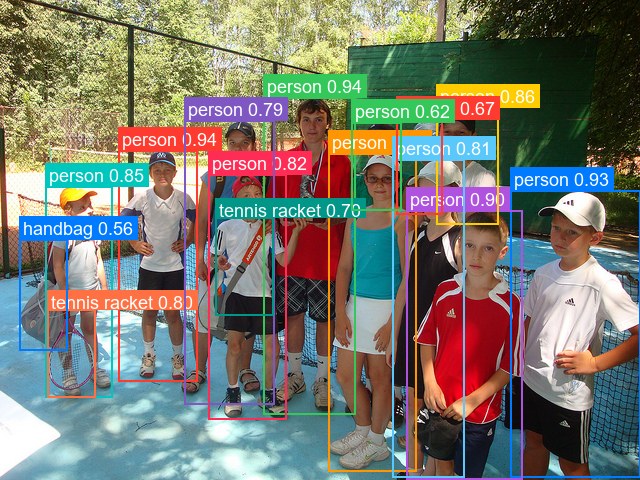
person         0.944  [118, 150, 197, 381]
person         0.935  [263, 97, 355, 414]
person         0.934  [510, 190, 640, 477]
person         0.924  [328, 153, 416, 471]
person         0.899  [406, 210, 522, 479]
person         0.862  [436, 107, 498, 224]
person         0.850  [45, 186, 112, 397]
person         0.823  [208, 174, 286, 419]
person         0.806  [392, 159, 464, 477]
tennis racket  0.800  [47, 309, 95, 397]
person         0.788  [184, 120, 274, 404]
tennis racket  0.702  [215, 217, 273, 315]
person         0.669  [396, 119, 442, 214]
person         0.616  [351, 122, 401, 210]
handbag        0.556  [19, 239, 67, 350]
Fifteen detections in a crowded scene, including two tennis rackets and a handbag among thirteen people. The 300-query budget is generous enough that crowding is rarely the limit in practice.
Batch Processing Multiple Images
Pass a list of images and one target_sizes entry per image:
from PIL import Image
from kerasformers.models.rt_detr import RTDETRDetect, RTDETRImageProcessor

model = RTDETRDetect.from_weights("rtdetr-r18vd")
processor = RTDETRImageProcessor()

paths = ["assets/data/coco_conference.jpg", "assets/data/coco_stop_sign.jpg"]
images = [Image.open(p).convert("RGB") for p in paths]

inputs = processor(paths)                                  # (2, 640, 640, 3)
output = model(inputs["pixel_values"], training=False)

results = processor.post_process_object_detection(
    output, threshold=0.5,
    target_sizes=[(im.height, im.width) for im in images],
)

for path, result in zip(paths, results):
    print(f"\n{path}")
    detections = sorted(
        zip(result["scores"], result["label_names"], result["boxes"]),
        key=lambda d: -float(d[0]),
    )
    for score, name, box in detections:
        print(f"  {name:12s} {float(score):.3f}  {[round(float(v)) for v in box]}")
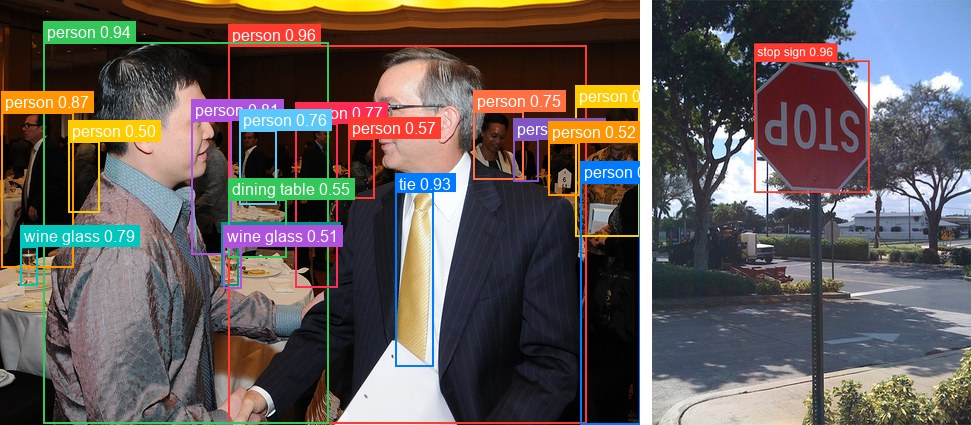
assets/data/coco_conference.jpg
  person       0.962  [228, 45, 586, 423]
  person       0.944  [43, 42, 328, 423]
  tie          0.925  [395, 191, 433, 366]
  person       0.869  [1, 112, 73, 267]
  person       0.814  [191, 120, 231, 254]
  person       0.801  [575, 106, 639, 236]
  wine glass   0.789  [20, 246, 37, 285]
  person       0.766  [295, 123, 337, 287]
  person       0.763  [239, 130, 276, 204]
  person       0.751  [473, 111, 523, 179]
  person       0.654  [513, 139, 538, 181]
  wine glass   0.605  [221, 243, 238, 285]
  person       0.575  [348, 138, 374, 198]
  dining table 0.554  [228, 199, 286, 257]
  person       0.550  [580, 182, 640, 424]
  person       0.524  [548, 142, 579, 195]
  wine glass   0.507  [223, 246, 241, 288]
  person       0.505  [68, 141, 99, 212]

assets/data/coco_stop_sign.jpg
  stop sign    0.961  [120, 71, 255, 226]
One image yields a single detection and the other eighteen, which is fine: results are per-image lists, not a fixed-width tensor. Every image is resized to the same square, so stacking is always safe.
Input Resolution
RT-DETR is Functional, so the input shape is fixed when the model is constructed. To run at another resolution, build at that size and match the processor:
model = RTDETRDetect.from_weights("rtdetr-r18vd", image_size=512)
processor = RTDETRImageProcessor(size={"height": 512, "width": 512})
The side must be a multiple of 32. The three feature levels use strides 8, 16, and 32, and the encoder fuses an upsampled stride-32 map with the stride-16 map. At 600 the two come out 37 and 38 wide and the addition fails:
Pretrained weights load at any valid size, because RT-DETR's position encodings are
computed sine functions (rt_detr_sine_pos_embed) rather than a learned grid. There is
nothing tied to the training resolution and nothing to interpolate:
320:  mouse 0.877, tv 0.769, keyboard 0.718           <- laptop missed entirely
480:  laptop 0.962, keyboard 0.961, tv 0.932, mouse 0.906
512:  keyboard 0.961, laptop 0.950, tv 0.930, mouse 0.914
640:  keyboard 0.962, laptop 0.961, tv 0.928, mouse 0.912   <- native
800:  laptop 0.961, keyboard 0.952, tv 0.919, mouse 0.901
480 to 800 holds up well. At 320 the model starts missing objects outright.
Custom Class Names
A model fine-tuned on your own dataset predicts your class indices, not COCO's. Pass
the names so label_names reads correctly:
MY_CLASSES = ["cat", "dog", "bird"]

results = processor.post_process_object_detection(
    output, threshold=0.5, target_sizes=[(image.height, image.width)],
    label_names=MY_CLASSES,
)
Without it the post-processor falls back to COCO's 80 names, silently mislabeling a
custom model. The integer labels are unaffected.
Data Format
Both the models and the processors support channels_last and channels_first.
Neither is hard-coded to a layout, so the whole pipeline runs either way.
They pick the format differently, which is the one thing to keep straight:
| How it picks the format | |
|---|---|
| Processors | A data_format kwarg, per instance. None (the default) resolves to keras.config.image_data_format(). |
| Models | Read keras.config.image_data_format() when they are constructed. There is no data_format argument. |
Overriding the processor only
RTDETRImageProcessor(data_format="channels_last")("photo.jpg")
# {"pixel_values": (1, 640, 640, 3)}

RTDETRImageProcessor(data_format="channels_first")("photo.jpg")
# {"pixel_values": (1, 3, 640, 640)}
Switching the whole pipeline
Set the global format before constructing the model, and both sides agree:
import keras

keras.config.set_image_data_format("channels_first")

model = RTDETRDetect.from_weights("rtdetr-r18vd")
processor = RTDETRImageProcessor()
Detections are the same under either layout. Only the tensor shape changes. Set it once at the top of a script, since already-built models keep the layout they were constructed with.
The post-processor is not format-sensitive: it emits xyxy pixel boxes and class
indices, which have no channel axis, so it takes no data_format kwarg.
Loading Fine-tuned and Community Weights
Any Hugging Face repo whose model_type is "rt_detr" loads directly with the hf:
prefix, including the upstream checkpoints and arbitrary fine-tunes.
from kerasformers.models.rt_detr import RTDETRDetect

# Upstream release
model = RTDETRDetect.from_weights("hf:PekingU/rtdetr_r18vd")

# Somebody's fine-tune
model = RTDETRDetect.from_weights("hf:<user>/rtdetr-finetuned-on-my-data")

# Architecture only, randomly initialized
model = RTDETRDetect.from_weights("rtdetr-r18vd", load_weights=False)
No shape arguments are needed. The architecture is read from the repo's config.json
and mapped onto the constructor. Both model classes accept hf:, as does
RTDETRImageProcessor:
Loading hf:PekingU/rtdetr_r18vd and the rtdetr-r18vd release variant produces
identical outputs, since they are the same checkpoint by two routes.
See also RT-DETRv2, which keeps this architecture and improves the deformable sampling.