SegFormer
from_weights(...).
SegFormer pairs a hierarchical transformer encoder (MiT) with a decoder that is nothing but a few MLPs. The encoder produces features at four scales like a CNN, and the decoder simply upsamples each scale, concatenates, and projects. No dilated convolutions, no attention in the decoder.
Two design choices make it efficient. The encoder uses sequence-reduction attention, shrinking keys and values before the attention product, and it has no positional encoding at all: position comes from a 3x3 depthwise convolution inside each MLP. That is why SegFormer transfers to resolutions it never trained on without the interpolation that ViT-style models need.
Paper: SegFormer: Simple and Efficient Design for Semantic Segmentation with Transformers
API
SegFormerSemanticSegment
SegFormerSemanticSegment(embed_dim=None, depths=None, decode_head_dim=256,
                         dropout_rate=0.1, num_classes=19, image_size=512,
                         input_tensor=None, name="SegFormerSemanticSegment")
The MiT encoder plus the all-MLP decode head. This is the class for semantic segmentation.
Parameters
- embed_dim (
tuple, optional): per-stage widths. Filled in byfrom_weightsfrom the variant config. - depths (
tuple, optional): blocks per stage, the main size lever from B0 to B5. - decode_head_dim (
int, optional, defaults to256): width of the MLP decoder. - dropout_rate (
float, optional, defaults to0.1): decoder dropout, active only during training. - num_classes (
int, optional, defaults to19): Cityscapes' 19. The ADE20K variants use150. - image_size (
int, optional, defaults to512): input resolution the model is built for. - input_tensor (
dict, optional): pre-existing input tensors to build on. - name (
str, optional, defaults to"SegFormerSemanticSegment"): model name.
Call model(pixel_values, training=False). Returns a tensor of shape
(B, H, W, num_classes): per-pixel class logits.
SegFormerModel
SegFormerModel(embed_dim=None, depths=None, image_size=512,
               input_tensor=None, name="SegFormerModel")
The MiT encoder alone, for its multi-scale features.
Preprocessing
SegFormerImageProcessor
SegFormerImageProcessor(do_resize=True, size=None, resample="bilinear",
                        do_rescale=True, rescale_factor=1/255,
                        do_normalize=True, image_mean=None, image_std=None,
                        return_tensor=True, data_format=None, variant=None)
Resizes to a fixed square, rescales to [0, 1], and normalizes with ImageNet
statistics.
Prefer
SegFormerImageProcessor.from_weights(variant). The variants train at 512, 640, 768 or 1024, so the bare constructor's 512 mismatches the model for most of them and the forward pass raises on shape.
Parameters
- variant (
str, optional): release variant whose resolution to adopt. Ignored whensizeis given. - do_resize (
bool, optional, defaults toTrue): resize before normalizing. - size (
dict, optional): target size, overridingvariant. Falls back to 512. - resample (
str, optional, defaults to"bilinear"): resize interpolation. - do_rescale / rescale_factor: scale pixels to
[0, 1]. - do_normalize (
bool, optional, defaults toTrue): apply ImageNet normalization. - image_mean / image_std (
tuple, optional): defaults to the ImageNet statistics. - return_tensor (
bool, optional, defaults toTrue): return backend tensors rather than numpy. - data_format (
str, optional):"channels_last"or"channels_first". Defaults tokeras.config.image_data_format().
post_process_semantic_segmentation
processor.post_process_semantic_segmentation(outputs, target_size=None,
                                             label_names=None, data_format=None)
Takes the per-pixel argmax and resizes the label map to target_size. Returns a
dict with segmentation (H, W), unique_classes, and class_names.
Names default to the label set matching the head width: ADE20K's 150 or Cityscapes' 19.
Model Variants
Thirteen variants across two label sets. B0 is the smallest and B5 the largest:
| Variant id | Backbone | Classes | Resolution |
|---|---|---|---|
segformer_b0_ade_512 |
MiT-B0 | 150 | 512 |
segformer_b1_ade_512 |
MiT-B1 | 150 | 512 |
segformer_b2_ade_512 |
MiT-B2 | 150 | 512 |
segformer_b3_ade_512 |
MiT-B3 | 150 | 512 |
segformer_b4_ade_512 |
MiT-B4 | 150 | 512 |
segformer_b5_ade_640 |
MiT-B5 | 150 | 640 |
segformer_b0_cityscapes_768 |
MiT-B0 | 19 | 768 |
segformer_b0_cityscapes_1024 |
MiT-B0 | 19 | 1024 |
segformer_b1_cityscapes_1024 |
MiT-B1 | 19 | 1024 |
segformer_b2_cityscapes_1024 |
MiT-B2 | 19 | 1024 |
segformer_b3_cityscapes_1024 |
MiT-B3 | 19 | 1024 |
segformer_b4_cityscapes_1024 |
MiT-B4 | 19 | 1024 |
segformer_b5_cityscapes_1024 |
MiT-B5 | 19 | 1024 |
The ADE20K variants cover 150 indoor and outdoor classes; the Cityscapes ones cover 19 street-scene classes at higher resolution.
Basic Usage: Semantic Segmentation
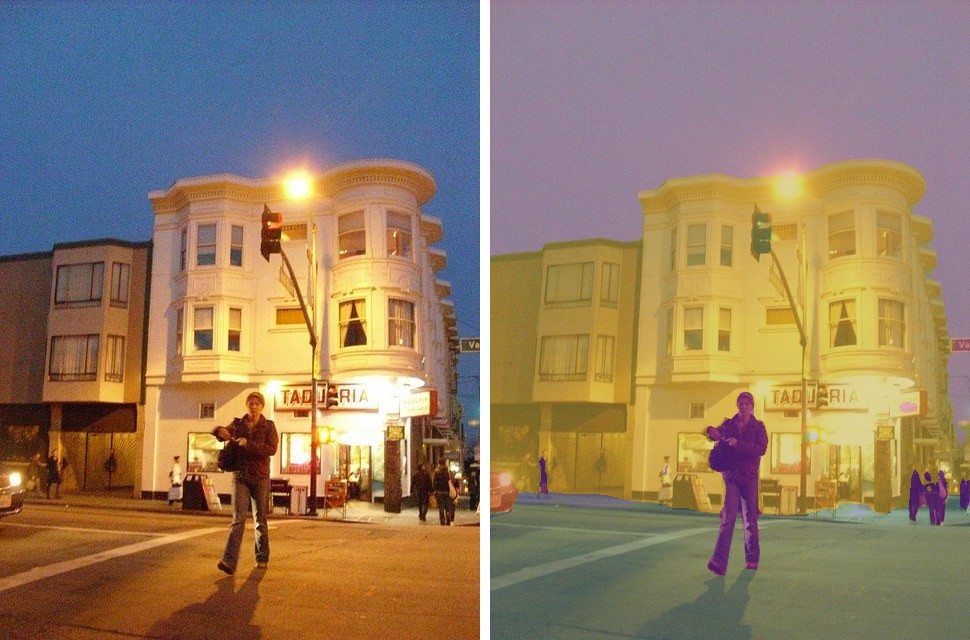
Each figure is the original image beside the predicted segmentation overlaid on it.
import keras
import numpy as np
from PIL import Image
from kerasformers.models.segformer import (
    SegFormerImageProcessor, SegFormerSemanticSegment,
)

model = SegFormerSemanticSegment.from_weights("segformer_b5_ade_640")
processor = SegFormerImageProcessor.from_weights("segformer_b5_ade_640")  # 640

image = Image.open("assets/data/coco_street_dusk.jpg").convert("RGB")
output = model(processor(image)["pixel_values"], training=False)
# output: (1, 640, 640, 150)

result = processor.post_process_semantic_segmentation(
    output, target_size=(image.height, image.width)
)
seg = np.asarray(keras.ops.convert_to_numpy(result["segmentation"]))

areas = [(int((seg == int(c)).sum()), n)
         for c, n in zip(result["unique_classes"], result["class_names"])]
for area, name in sorted(areas, reverse=True):
    print(f"{name:14s} {area} px")
building           133158 px
sky                101140 px
road               61001 px
person             8240 px
sidewalk           1481 px
car                966 px
traffic light      791 px
signboard          341 px
streetlight        80 px
trade name         2 px
Ten classes, and the fine structure is what a large model buys: an 84-pixel
streetlight, a 794-pixel traffic light, and trade name (the shop signage) at 8
pixels. The person is cut out cleanly against the road behind.
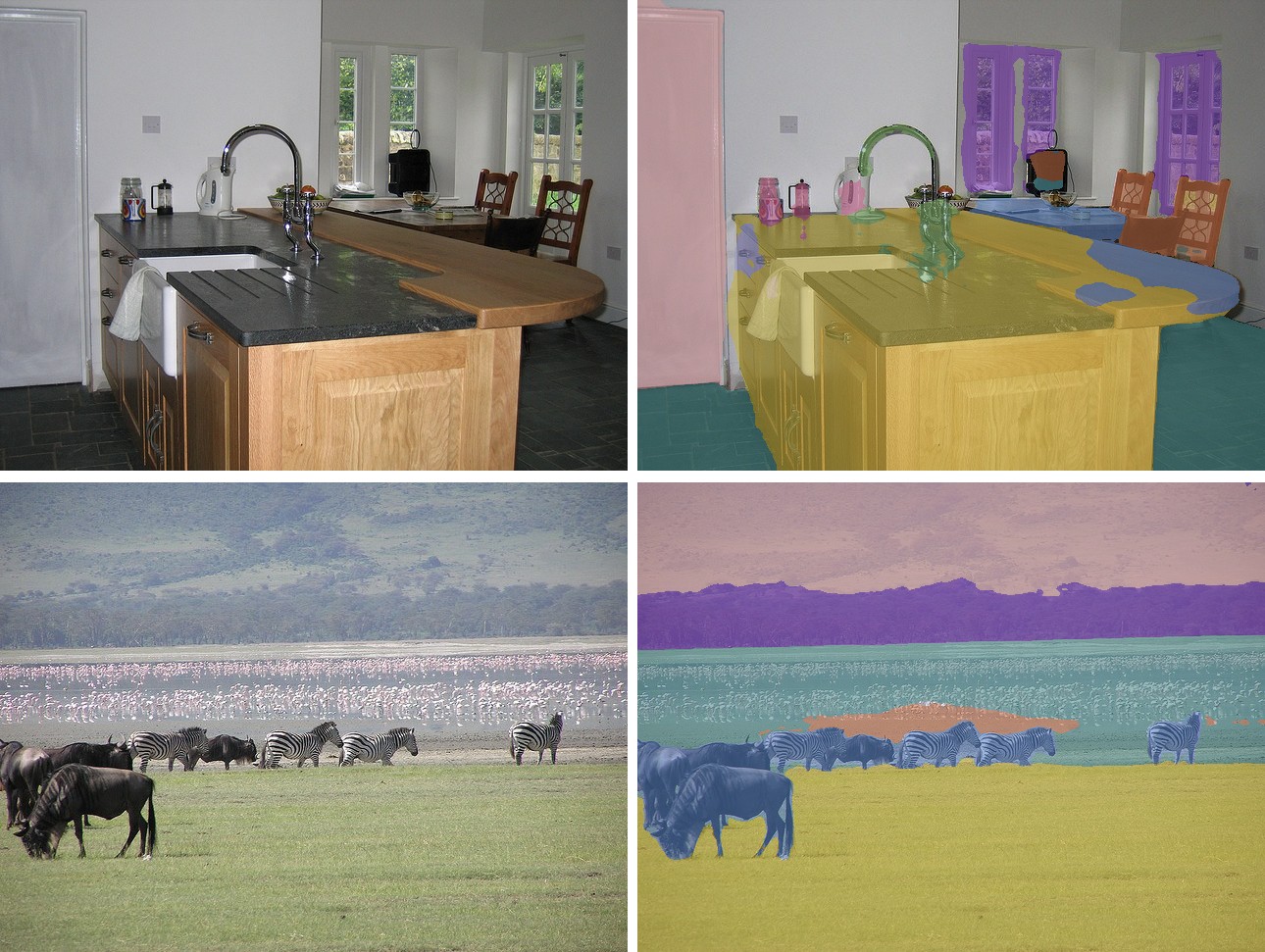
These three scenes follow the qualitative figures in the paper: an outdoor street, an indoor room, and animals in a field.
Batch Processing Multiple Images
import keras
import numpy as np
from PIL import Image
from kerasformers.models.segformer import (
    SegFormerImageProcessor, SegFormerSemanticSegment,
)

model = SegFormerSemanticSegment.from_weights("segformer_b5_ade_640")
processor = SegFormerImageProcessor.from_weights("segformer_b5_ade_640")  # 640

paths = ["assets/data/coco_open_kitchen.jpg", "assets/data/coco_herd_field.jpg"]
images = [Image.open(p).convert("RGB") for p in paths]

outputs = model(processor(paths)["pixel_values"], training=False)  # (2, 640, 640, 150)

for path, image, logits in zip(paths, images, outputs):
    result = processor.post_process_semantic_segmentation(
        logits[None], target_size=(image.height, image.width)
    )
    seg = np.asarray(keras.ops.convert_to_numpy(result["segmentation"]))
    areas = [(int((seg == int(c)).sum()), n)
             for c, n in zip(result["unique_classes"], result["class_names"])]
    print(f"\n{path}")
    for area, name in sorted(areas, reverse=True)[:6]:
        print(f"  {name:12s} {area} px")
assets/data/coco_open_kitchen.jpg
  cabinet      101128 px
  wall         97424 px
  door         33833 px
  floor        27494 px
  windowpane   20683 px
  table         9980 px

assets/data/coco_herd_field.jpg
  grass        110387 px
  mountain     68734 px
  field        59707 px
  tree         35713 px
  animal       26212 px
  water        5713 px
The kitchen resolves 15 classes in total, down to a 2-pixel countertop, and the field
separates grass from field and picks the herd out as animal. Both listings are
truncated to the six largest. Every image is resized to the same square, so stacking is
always safe.
Data Format
Both the model and the processor support channels_last and channels_first.
| How it picks the format | |
|---|---|
| Processors | A data_format kwarg, per instance. None (the default) resolves to keras.config.image_data_format(). |
| Models | Read keras.config.image_data_format() when they are constructed. There is no data_format argument. |
import keras

keras.config.set_image_data_format("channels_first")

model = SegFormerSemanticSegment.from_weights("segformer_b5_ade_640")
processor = SegFormerImageProcessor.from_weights("segformer_b5_ade_640")  # 640
post_process_semantic_segmentation also takes data_format, since it needs to know
which axis holds the classes. It always returns (H, W).
Custom Class Names
result = processor.post_process_semantic_segmentation(
    output, target_size=(image.height, image.width),
    label_names=["background", "road", "building"],
)
Without it the post-processor picks ADE20K or Cityscapes names from the head width.
Loading Fine-tuned and Community Weights
Any Hugging Face repo whose model_type is "segformer" loads with the hf: prefix.
from kerasformers.models.segformer import SegFormerSemanticSegment

model = SegFormerSemanticSegment.from_weights(
    "hf:nvidia/segformer-b0-finetuned-ade-512-512"
)
model = SegFormerSemanticSegment.from_weights("hf:<user>/segformer-finetuned-on-my-data")

# Architecture only, randomly initialized
model = SegFormerSemanticSegment.from_weights("segformer_b0_ade_512", load_weights=False)
The architecture is read from the repo's config.json, including the class count, so a
fine-tune with a different vocabulary needs no extra arguments. Both model classes
accept hf:, as does SegFormerImageProcessor.
See also DeepLabV3 for the convolutional approach to the same task.