EoMT
from_weights(...).
EoMT (Encoder-only Mask Transformer) takes the opposite direction from the MaskFormer line. Where Mask2Former adds a pixel decoder, a transformer decoder and multi-scale deformable attention on top of its backbone, EoMT deletes all of it.
The claim in the title is the design: a plain ViT already computes everything segmentation needs. Concatenate learned query tokens onto the patch tokens, run them through the same ViT blocks, and read masks and classes off the query tokens at the end. No decoder, no pixel decoder, no deformable attention. The result is far simpler and, at large scale, competitive.
Paper: Your ViT is Secretly an Image Segmentation Model
API
EoMTUniversalSegment
EoMTUniversalSegment(hidden_dim=1024, num_hidden_layers=24, num_heads=16,
                     depths=4, num_queries=200, num_classes=133,
                     layerscale_value=1e-05, patch_size=16,
                     num_register_tokens=4, num_upscale_blocks=2,
                     mlp_ratio=4, ..., name="EoMTUniversalSegment")
A ViT with query tokens appended, plus the mask and class heads. This is the class for segmentation.
Architecture arguments are filled in by from_weights from the variant config. The
ones worth knowing:
- num_queries (
int, optional, defaults to200): query tokens appended to the patch sequence, the ceiling on segments per image. - num_classes (
int, optional, defaults to133): COCO panoptic's vocabulary.150for the ADE20K variant. - depths (
int, optional, defaults to4): how many of the final blocks the queries participate in. - num_hidden_layers / hidden_dim / num_heads: the ViT itself, small through large.
- num_register_tokens (
int, optional, defaults to4): DINOv2-style register tokens. - patch_size (
int, optional, defaults to16): ViT patch size.
Call model(pixel_values, training=False). Returns a dict:
- class_logits (
(B, num_queries, num_classes + 1)): one class distribution per query. - mask_logits (
(B, num_queries, H/4, W/4)): one binary mask logit map per query.
Note the key names differ from the MaskFormer family's class_queries_logits /
masks_queries_logits, so EoMT carries its own post-processors rather than sharing
theirs.
EoMTModel
The ViT trunk without the segmentation heads.
Preprocessing
EoMTImageProcessor
Resizes the longest edge to target_size preserving aspect ratio, pads to a square
canvas, rescales, and normalizes.
Parameters
- target_size (
int, optional, defaults to640): square canvas edge.512for the ADE20K variant. - image_mean / image_std (
tuple, optional): normalization statistics. - data_format (
str, optional):"channels_last"or"channels_first".
EoMT ships all three post-processors, the most complete surface of any segmenter here:
processor.post_process_semantic_segmentation(outputs, target_size, label_names=None)
processor.post_process_instance_segmentation(outputs, target_size, threshold=0.5, label_names=None)
processor.post_process_panoptic_segmentation(outputs, target_size, threshold=0.8,
                                             mask_threshold=0.5,
                                             overlap_mask_area_threshold=0.8,
                                             stuff_classes=None, label_names=None)
All three take singular target_size. Semantic returns a dict with segmentation
and class_names; instance and panoptic return segmentation plus
segments_info. Names default to COCO panoptic's 133 classes.
Model Variants
| Variant id | ViT | Task | Training set | Resolution |
|---|---|---|---|---|
eomt_small_coco_panoptic_640 |
Small | panoptic | COCO | 640 |
eomt_base_coco_panoptic_640 |
Base | panoptic | COCO | 640 |
eomt_large_coco_panoptic_640 |
Large | panoptic | COCO | 640 |
eomt_large_coco_instance_640 |
Large | instance | COCO | 640 |
eomt_large_ade20k_semantic_512 |
Large | semantic | ADE20K | 512 |
Basic Usage: Panoptic Segmentation
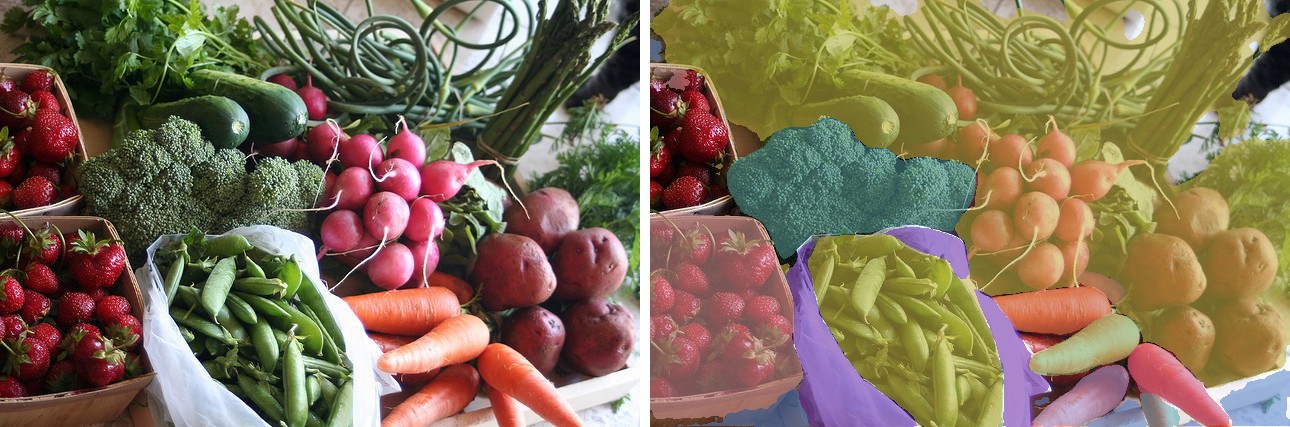
Each figure is the original image beside the predicted segmentation overlaid on it.
import keras
import numpy as np
from PIL import Image
from kerasformers.models.eomt import EoMTImageProcessor, EoMTUniversalSegment

model = EoMTUniversalSegment.from_weights("eomt_small_coco_panoptic_640")
processor = EoMTImageProcessor()

image = Image.open("assets/data/coco_produce.jpg").convert("RGB")
output = model(processor(image)["pixel_values"], training=False)
# output["class_logits"]: (1, 200, 134)
# output["mask_logits"]:  (1, 200, 160, 160)

result = processor.post_process_panoptic_segmentation(
    output, target_size=(image.height, image.width)
)
seg = np.asarray(keras.ops.convert_to_numpy(result["segmentation"]))

for s in result["segments_info"]:
    print(f"{s['label_name']:30s} {int((seg == s['id']).sum())} px")
stuff: food-other-merged        160728 px
things: bowl                    27419 px
things: broccoli                20754 px
stuff: paper-merged             14280 px
stuff: sky-other-merged         6076 px
things: carrot                  4052 px
things: carrot                  4029 px
things: carrot                  3878 px
things: carrot                  3275 px
things: carrot                  952 px
things: carrot                  826 px
Six separate carrots, each its own segment. That is the payoff of instance-aware
segmentation: a semantic model would return one merged carrot region and you could
not count them.
Batch Processing Multiple Images
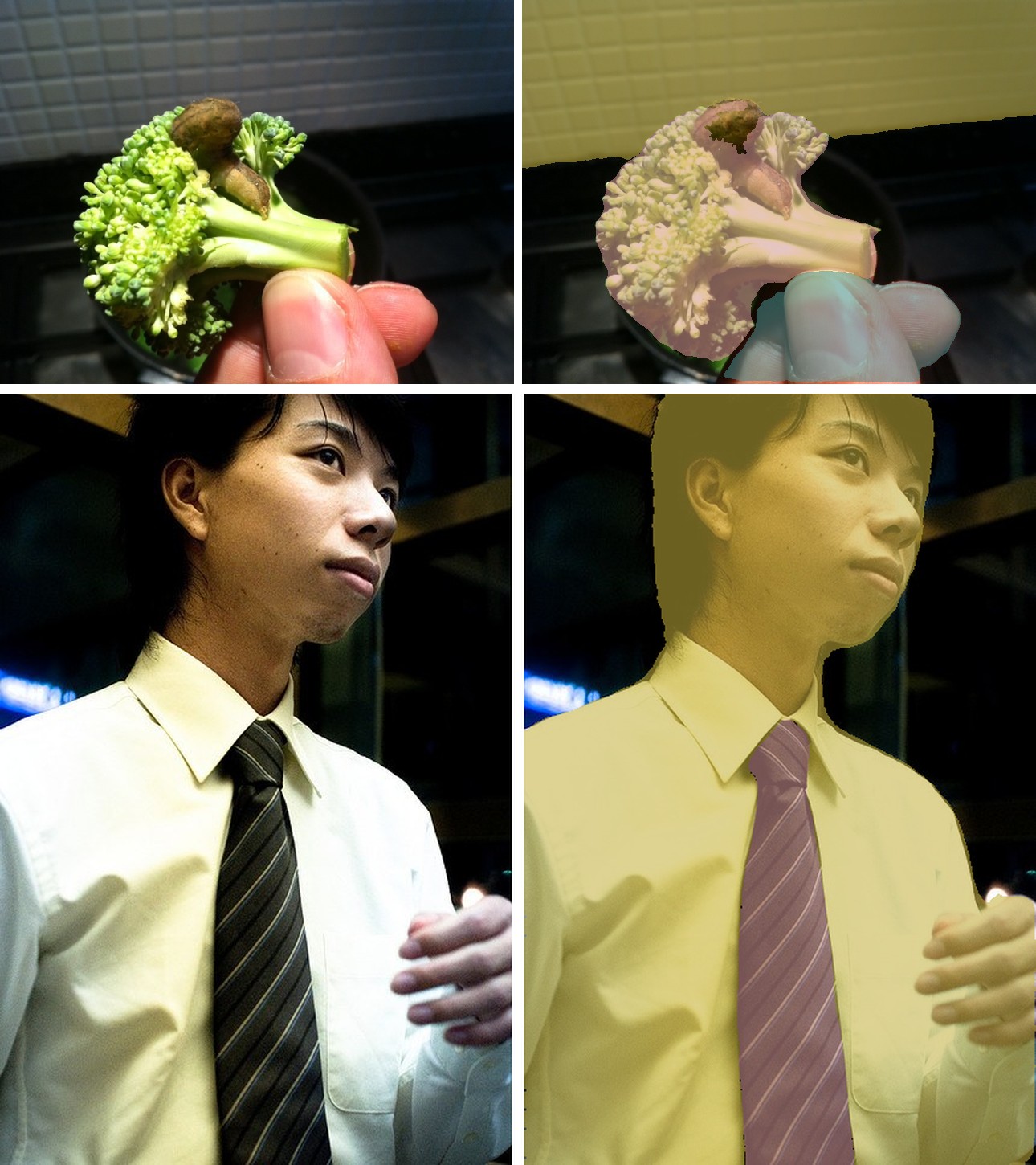
Post-process one image at a time, since each has its own target size:
import keras
import numpy as np
from PIL import Image
from kerasformers.models.eomt import EoMTImageProcessor, EoMTUniversalSegment

model = EoMTUniversalSegment.from_weights("eomt_small_coco_panoptic_640")
processor = EoMTImageProcessor()

paths = ["assets/data/coco_broccoli.jpg", "assets/data/coco_man_tie.jpg"]

for path in paths:
    image = Image.open(path).convert("RGB")
    output = model(processor(image)["pixel_values"], training=False)
    result = processor.post_process_panoptic_segmentation(
        output, target_size=(image.height, image.width)
    )
    seg = np.asarray(keras.ops.convert_to_numpy(result["segmentation"]))
    print(f"\n{path}")
    for s in result["segments_info"]:
        print(f"  {s['label_name']:26s} {int((seg == s['id']).sum())} px")
assets/data/coco_broccoli.jpg
  stuff: wall-other              103770 px
  things: broccoli               67479 px
  things: person                 30868 px

assets/data/coco_man_tie.jpg
  things: person                 174225 px
  things: tie                    25473 px
The tie is separated from the person wearing it, rather than absorbed into one
region.
Other Tasks
The same output works for instance and semantic segmentation:
# Instance: things only, one segment per object
result = processor.post_process_instance_segmentation(
    output, target_size=(image.height, image.width), threshold=0.5,
)

# Semantic: one region per class, instances merged
result = processor.post_process_semantic_segmentation(
    output, target_size=(image.height, image.width),
)
A panoptic checkpoint post-processed as instance drops the stuff classes; post-processed as semantic it merges the six carrots into one region.
Data Format
Both the model and the processor support channels_last and channels_first.
| How it picks the format | |
|---|---|
| Processors | A data_format kwarg, per instance. None (the default) resolves to keras.config.image_data_format(). |
| Models | Read keras.config.image_data_format() when they are constructed. There is no data_format argument. |
The post-processors emit (H, W) label maps and segment metadata, so they take no
data_format kwarg.
Loading Fine-tuned and Community Weights
Any Hugging Face repo whose model_type is "eomt" loads with the hf: prefix.
from kerasformers.models.eomt import EoMTUniversalSegment

model = EoMTUniversalSegment.from_weights("hf:tue-mps/coco_panoptic_eomt_large_640")
model = EoMTUniversalSegment.from_weights("hf:<user>/eomt-finetuned")

# Architecture only, randomly initialized
model = EoMTUniversalSegment.from_weights(
    "eomt_small_coco_panoptic_640", load_weights=False,
)
See also Mask2Former for the decoder-heavy approach EoMT argues against.